How to Design the Bottom and Drainage Holes of a Silicone Hanging Drain Bag
The sample drains in four seconds on the bench, and the customer's bag leaves a puddle in the bottom corner after every use. Same holes, same compound, same nominal geometry. The difference is that the bench sample was empty, and the customer's bag was hanging from a rail with a kilo of wet scraps pulling the base out of the shape the drawing specified.
Water does not read the drawing. It leaves through whichever hole is lowest at that moment, and on a hanging bag the lowest point moves once the product is loaded. The bottom and the hole pattern have to be designed in the loaded shape, not the moulded one, or the drainage path you drew is not the one the water takes.
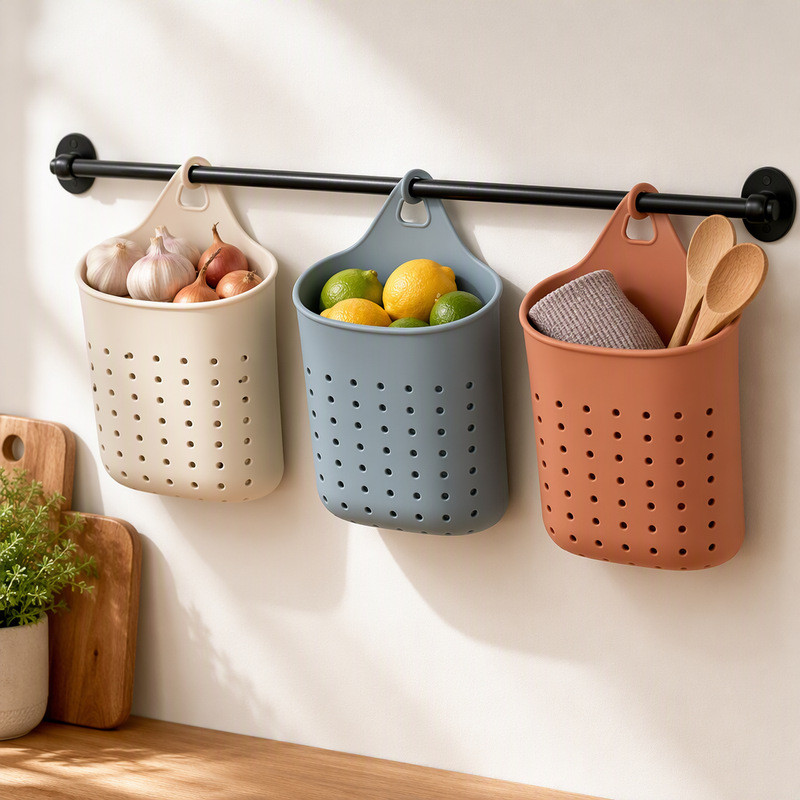
A hanging drain bag does two jobs at once: it holds solids and it lets liquid go. Those jobs compete in the same surface area. Every hole is material removed from the base, and the base is also the part carrying the contents.
Most drainage complaints are described as a hole problem and turn out to be a shape problem. Adding holes to a base that holds water in the wrong place tends to make the product weaker without making it drier.
Why Does Water Collect at the Bottom of a Silicone Hanging Drain Bag?
The bottom surface may not guide water toward the drainage holes
A hole removes water only from the area that drains to it. If the base is flat, water spreads across the whole floor and finds the nearest hole eventually, but the film left behind sits everywhere, and anything suspended in it settles wherever the flow slows down.
Fall is what turns a floor into a drain. A base drawn with three degrees of fall across 120 mm has about 6 mm of drop from back to front, which is enough to keep a film moving. The trouble is that 6 mm is well inside the range of deflection a loaded silicone base will produce. If the base sags 8 mm under load, the fall is gone, and in the worst case it reverses: the front edge drops below the back, water pools against the back seam, and the holes at the front are now above the water line.
This is the single most common reason a bag drains on the bench and holds water on the rail. The design was validated in the wrong state.
Drainage holes may be placed outside the main water collection area
A hole in the middle of a flat base looks like the logical place for it. On a hanging bag, the middle of the base is often the highest point once the product is loaded, because the walls pull the perimeter down and the base bows upward under the tension. Water then collects in a ring near the front and side seams, where there may be no holes at all.
The pattern to watch for is a tidy grid. A grid is easy to draw and easy to tool, and it assumes a symmetry the loaded product does not have. Holes should be placed where water will actually arrive: along the front third of the base, around the lowest point of the curve, and in the ring where the base meets the front wall.
The bag may deform when filled
Silicone does not just deflect and come back. Under a sustained load it creeps, which means the base continues to move for days and weeks after the load is applied, and some of that movement stays after the bag is emptied. A bag that drains acceptably in the first week can drain noticeably worse in the third month.
That is not a defect in the compound. It is a material property that has to be allowed for, in the same way that a timber floor is designed with an allowance for long-term deflection. Our note on why a moulded silicone cup loses its shape after repeated use sets out how elastic recovery, creep and permanent set differ, and why a short load test hides the last two.
How Should the Bottom Structure Be Designed?
Choose a bottom shape that matches the intended drainage direction
Three base shapes cover most of this category, and they behave differently once loaded.
- A flat base with a generous corner radius is the easiest to tool and the easiest to clean, but it depends entirely on the product staying flat. On a hanging bag it usually does not, so the fall has to be designed in and then protected by structure.
- A continuous curved base, flowing from the front wall through the lowest point and up into the back wall, keeps a drainage direction even when it deflects, because the curve has no flat region to invert. It is harder to tool and harder to clean at the wall junction.
- A base with a shallow collection channel along the front edge gives water one place to gather and one line of holes to leave through. It drains predictably and it concentrates residue in a place the user can see and rinse, which is a usability advantage as much as a hydraulic one.
Whichever is chosen, the base should be drawn with the loaded deflection applied. That is a modelling step, not a guess: apply the expected load in the CAD model, look at the resulting base shape, and check that the lowest point still has a hole under it. If it does not, the design is not finished.
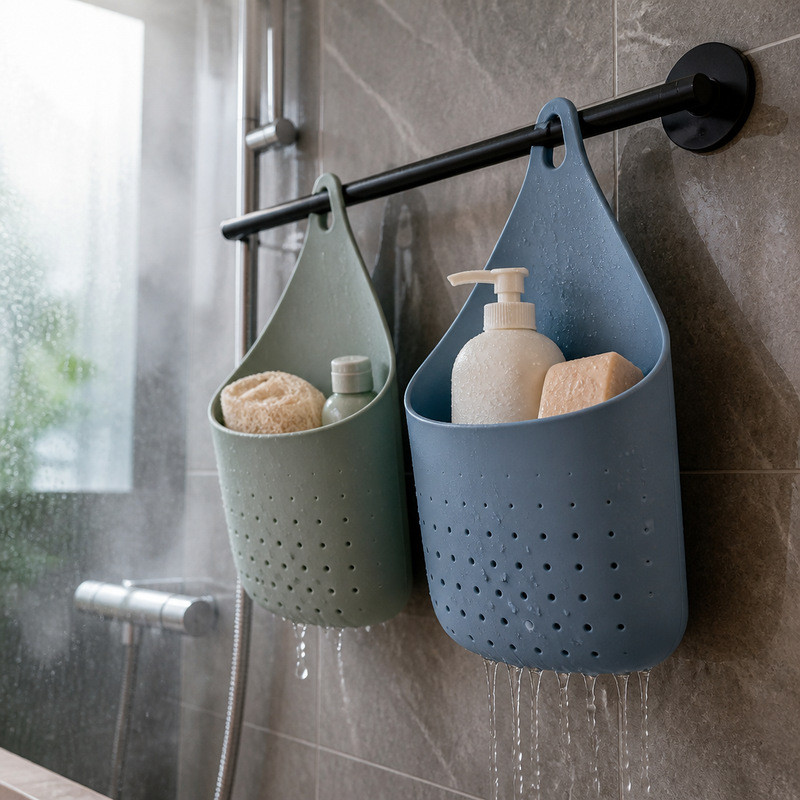
Watching water leave is more informative than counting holes. A base that releases water in a steady curtain is draining from a wetted surface. A base that drips from two or three points is draining from pools, and the rest of the base is holding a film that will dry in place.
The same test on a bench and on a rail gives different answers, which is why the installation position belongs in the test, not in the caption.
Avoid deep recesses that trap water and food residue
Every recess in a base is a small reservoir. A 3 mm deep depression across a 100 mm wide base holds roughly 30 ml before it overflows to the nearest hole, and 30 ml of warm vegetable water left in a warm kitchen is a smell within a day.
The recesses that cause trouble are rarely intentional. They appear where a rib crosses the base, where a logo or a brand mark is embossed on the underside, where a locating step was added for mould alignment, or where the base meets the wall at a small radius. All of them create a local low point that is not connected to a hole.
The fix is not to remove the feature but to connect it. A shallow channel from the recess to the nearest hole, 1 mm deep and 3 mm wide, is enough to stop it holding water and costs almost nothing in tooling. Where a feature cannot be connected, it should not be on the underside at all.
Consider bottom thickness and support
A base that is too thin bows under load; a base that is too thick is heavy, slow to cool and expensive. The useful question is not "how thick" but "how is the thickness distributed".
Thickness should follow the load path. The band running from the strap down the back wall and across the base to the front edge carries most of the hanging load, and it should be the thickest part of the base. The two side regions carry less and can be thinner, which also makes the bag easier to squeeze and to invert for cleaning.
Any specific figure depends on the bag's dimensions, the expected load and the compound, and it should come out of a tooling review rather than a table. What can be stated generally is the direction: thicken along the load path, thin where the load does not go, and keep the transition gradual. The same principle is set out in our note on uneven walls and the stress they leave behind, and it applies to a base as much as to a sidewall.
How Should Drainage Holes Be Positioned?
Distribute drainage holes across the main collection area
The main collection area is the region that will be lowest when the bag is loaded, not the region that is lowest on the drawing. On most hanging bags this is a band across the front third of the base, widening toward the front corners where the walls pull the base down hardest.
Holes outside that band are not wasted, but they do less work. A useful check is to mark, on the base, where water stands after a thirty-second drain with the bag loaded. That outline is the area that needs holes; anything outside it can keep material for strength.
Keep the hole layout away from areas that need structural support
Holes cut the load path. A row of holes across the back of the base, directly under the strap, removes the material that transfers the hanging load into the base, and the base then bulges between the holes and the wall.
The practical rule is to leave a continuous spine of unperforated material, at least one hole diameter wide, running from the strap position down the back wall and into the base. Holes start to the front of that spine, not across it.
The same caution applies at the wall transition. A hole placed within a few millimetres of the radius where the base turns into the wall has very little material around it on one side, and that is where a tear will start after a few months of flexing. Keeping the first row clear of the transition radius costs a little drainage area and removes a whole failure mode.
Match hole size to the type of material being collected
Aperture size is a compromise between letting water out and keeping solids in, and the compromise is set by the contents, not by the mould.
There is a second, less obvious factor: the hole is a short tube, and water has to rise over the lip of that tube before it can leave. On a base with a 1.5 mm wall, the residual film is roughly 1.5 mm deep across the wetted area, regardless of how many holes there are. Countersinking or chamfering the hole on the inside face lowers that lip and lets the base run drier, at the cost of a slightly more complex core pin.
Hole sizing, spacing and the trade-off against structural strength are worth a separate treatment; the geometry is different on a colander, where the base is supported and the loads are lower. The aperture arithmetic and the pin constraints behind it are set out in choosing an aperture that does not blind over. Our note on how hole layout affects water flow in a silicone colander works through that case in detail.
What Drainage Tests Should Be Done Before Mass Production?
Test water flow with the bag in its installed position
Hang the sample where it will be sold to hang. Fill it with the contents it is meant to hold. Pour two litres of water through it at roughly tap flow and watch where the water leaves and where it stays.
Then measure the residue rather than describing it. Weigh the bag dry, run the test, let it drain for sixty seconds, and weigh it again. The difference in grams is close enough to millilitres of retained water, and it gives you a number to compare across samples instead of an opinion.
Test with different types of food residue
Water is the easy case. The difficult ones are the materials that bridge an aperture: onion skin, herb stems, tea leaves, coffee grounds, flour paste. Run each through the bag in the quantity a household would produce and see whether the holes stay open.
Record where the blockage forms. A blockage at the hole means the aperture is too small for that material. A blockage on the base means the fall is insufficient and solids are settling before they reach a hole. Those are different fixes, and a test that only reports "it blocked" hides which one you have.
Check drainage performance after repeated cleaning
Rinse the sample the way the packaging will tell customers to rinse it, twenty times, and re-run the drainage measurement. Two things change with repeated use: the base creeps into a slightly different shape, and residue builds in the seams and around the hole edges, both of which reduce flow.
If retained water after twenty cycles is meaningfully higher than after the first, the design has a creep or a cleaning problem, and neither will be visible in a single-use test. The cleaning side of that question is covered in designing a hanging drain bag so residue leaves with the water.
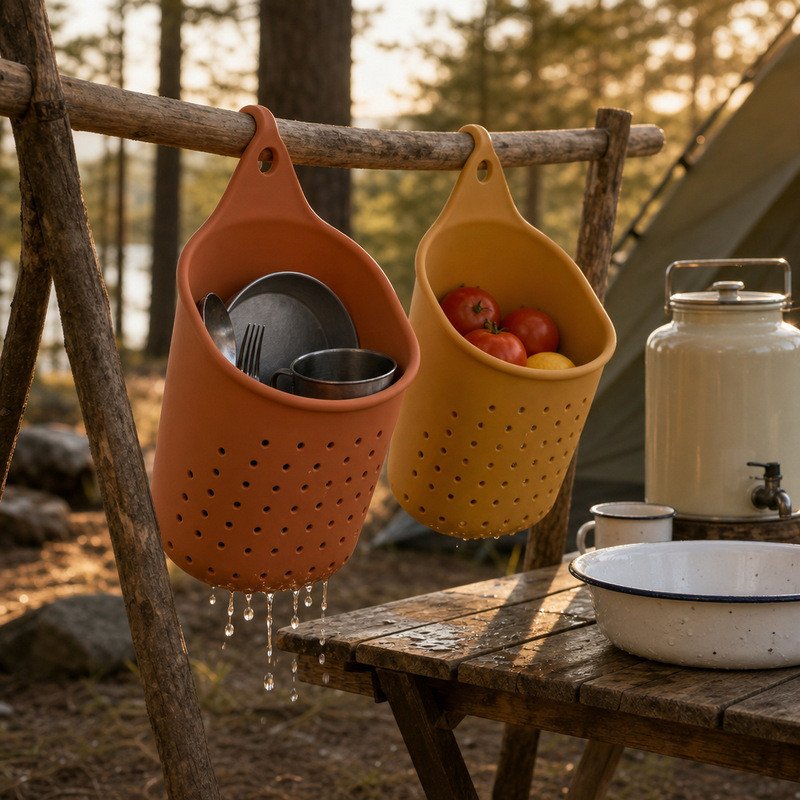
Portable use removes every assumption a kitchen test makes. The rail is a stick, the ground is not level, and the bag may hang at an angle for an hour. A base whose drainage depends on the product hanging vertically will fail here first.
That is an argument for a base with a genuine low point rather than a gentle fall, and for holes that are distributed around the low region instead of concentrated on one side of it.
What Should Buyers Confirm Before Custom Mold Development?
- Bag dimensions, capacity and the expected loaded weight, so the base deflection can be modelled.
- The contents the bag must retain, in the smallest size that matters, which sets the aperture.
- Whether the product hangs on a rail, a hook or a door, and at what angle it will sit.
- The required retained-water performance, expressed as a measured quantity rather than "drains well".
- Whether a collection channel or a continuous curve is acceptable, given the cleaning method.
- The cleaning instruction the product will carry, because the test has to match it.
- Colour, texture and whether texture is allowed on the inside of the base, where it changes both drainage and cleaning.
One material note belongs in the same conversation. A drain bag holds food residue, so the compound and the finished article have to meet the food-contact requirement of the market it is sold into. In the United States, rubber articles intended for repeated food contact are covered by 21 CFR 177.2600, which lists permitted elastomers and adjuvant substances rather than approving "silicone" as a category. The wording matters when a buyer asks for a declaration: what is being declared is a specific formulation against a specific regulation, and it should be confirmed for the material actually specified. If the project is a private label launch rather than a single part, which custom features justify the tooling cost sorts the feature list by where the cost lands.
Conclusion: Design the Bottom and Drainage Holes as One System
The base shape sets where water gathers, the holes decide where it leaves, and the wall thickness decides whether either of those survives a loaded week. Treated separately, each can look correct and the product can still hold water.
The cheapest correction is a loaded-shape review before tooling: apply the load in the model, find the lowest point, and confirm there is a hole under it. That single check catches most of the drainage complaints that otherwise arrive six weeks after launch.
Why does my hanging drain bag hold water even though it has plenty of holes?
Because the holes are not at the lowest point once the bag is loaded. The base deflects, the fall reverses, and water sits against a seam with no aperture under it. More holes in the same pattern will not fix a shape problem.
Should the base be flat or curved?
A curved base keeps a drainage direction when it deflects, because it has no flat region to invert. A flat base is easier to tool and clean but needs structure to stay flat under load, which usually means a thicker spine and a shallow fall built in.
Does a thicker base drain better?
Not directly. A thicker base resists bowing, which helps the fall survive, but it also raises the lip of each hole and leaves a deeper film behind. The gain comes from stiffness in the right place, not from uniform thickness.
How do you measure retained water in a drain bag sample?
Weigh the bag dry, run a fixed volume of water through it in its installed position, drain for a set time such as sixty seconds, and weigh again. The difference in grams is a practical measure of retained water and is comparable between samples.
Sources and related reading
- How hole layout affects water flow — the same flow reasoning applied to a supported base.
- Designing a drain bag for easier cleaning — why the lowest internal point and the lowest external point must coincide.
- Elastic recovery, creep and permanent set — why drainage performance changes over the first weeks of use.
- 21 CFR 177.2600 — Rubber articles intended for repeated use — the US food-contact rule that applies to a reusable drain bag.
The drainage behaviour described here is design reasoning, not measured flow data for a specific product. Retained water depends on the actual base geometry, the contents, the surface finish and the installation, and should be measured on your own sample.
Working on a drain bag or sink basket?
Send the base section, the contents the product must retain, and the way it will be mounted. Those three answers usually decide the base shape and the hole pattern before a tool is quoted.
- Email: nani@fromrubber.com or karl@fromrubber.com
- WeChat / WhatsApp: +86 18676210913
- FromRubber, Dongguan Bohao Electronic Technology Co., Ltd. — custom silicone parts for kitchen and household products. Sink baskets and drain bags are developed alongside the rest of our kitchen silicone product range.