How Can Manufacturers Prevent Uneven Bristle Height in Mass-Produced Silicone Facial Cleansing Pads?
The first bulk order arrives at the brand's warehouse and passes incoming inspection. 3 weeks later the retailer sends back photographs: on the shelf, under a raking spotlight, the tips of the cleansing pad read like a comb with a few teeth pushed down. Nothing in the inspection report was out of tolerance. The part simply does not look like the sample that was approved.
That gap is what this article is about. In a silicone facial cleansing pad, bristle height is not one dimension that either passes or fails. It is a distribution across a few hundred small features, and the customer sees the distribution, not the average.
What Causes Uneven Bristle Height in Silicone Facial Cleansing Pads?
The quick answer: four separate mechanisms produce the same visual symptom, and they are usually mixed together in one part. Cavity depth sets the ceiling of what is possible, silicone flow decides whether each cavity is actually filled to that ceiling, mold closing decides whether the tip gets a clean edge or a smeared one, and demolding decides whether the tip stays straight after the mold opens. Fixing only one of them moves the defect rather than removing it.
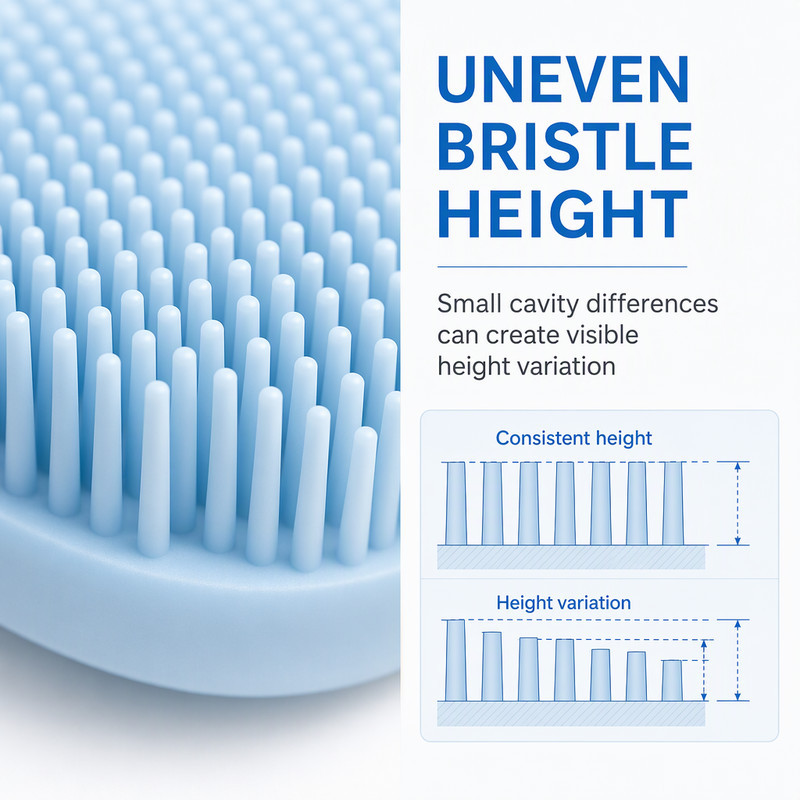
Before changing anything, measure the pad as a map instead of as a sample. Take readings at a grid of points across the cleaning surface and mark them on a sketch of the part. The shape of that map is more informative than the spread of the numbers.
A random scatter with no direction usually points to cavity machining or to a worn mold. A steady gradient from one edge to the other points to temperature difference across the plate, or to the material reaching one side of the cavity later than the other. A ring pattern that follows the outer rows points to venting and flow path length. A single low patch that repeats in the same place on every part points to a damaged cavity or a blocked vent.
Inconsistent Mold Cavity Dimensions Can Affect Bristle Length
Each bristle is formed by a hole. The depth of that hole, measured from the base surface to the bottom of the cavity, is the nominal height of the bristle, and the tolerance on that depth is the tolerance on the product. On a pad with 300 bristles, a cavity depth spread of a few hundredths of 1 mm is invisible in isolation and obvious in a row, because the eye compares neighbouring tips at a glancing angle.
Silicone Flow Problems Can Affect Thin Bristle Structures
Silicone does not flow like water into a narrow hole. In compression molding the compound is placed in the cavity and the press closes; material has to move sideways and then upward into each bristle cavity. Bristle cavities are dead ends, so the last air and the last material arrive together, and the tip is the least-vented point of the whole part.
Uneven Mold Closing and Flash Can Change the Appearance of Bristle Tips
Flash at a bristle tip is not just a cosmetic annoyance; it changes the perceived height. A thin skirt of silicone around the tip catches light differently from the tip face, so a flashed bristle reads as both shorter and duller. Closing problems also produce a second effect: where the plates do not meet evenly, the cavity depth itself changes from one side of the plate to the other.
Demolding Stress Can Cause Some Bristles to Bend or Remain Distorted
A bristle released from a deep cavity is subjected to friction along its whole length. If the part is peeled from one edge, the bristles at that edge experience a bending moment before the rest of the pad has moved. Soft silicone recovers from that bend most of the time; it recovers less when the part is still warm and has not developed full green strength, which is why the same tool can produce straight bristles in the morning and leaning bristles after a press has been running hot for 2 hours.
How Should Manufacturers Design Molds for Consistent Bristle Height?
Mold design is where the problem is cheapest to solve. Once the tool is cut, the only remaining levers are compound, temperature and handling, and none of them can correct a cavity that is out of depth. The design decisions below are the ones that determine whether the process has any chance of holding height.
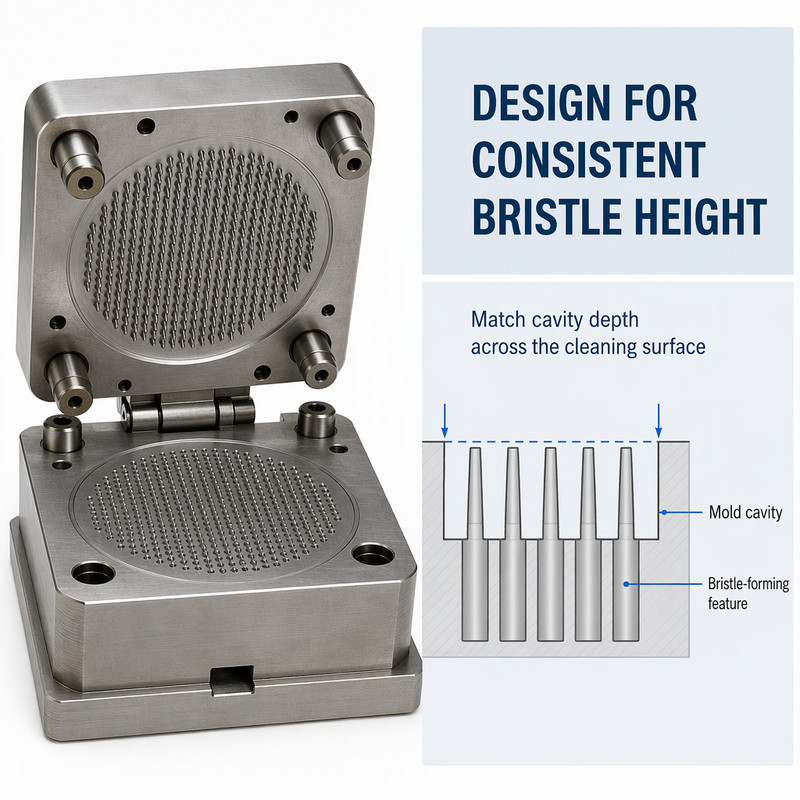
The starting point is a single reference surface. If the base of every bristle cavity is machined from one datum, depth variation across the plate is limited to machining accuracy. If cavities are produced in separate operations, or the plate is polished between operations, the datum moves and the height band widens.
A second design decision is symmetry. A plate with an even number of identical cavities arranged symmetrically around the material placement point fills more evenly than a plate with an irregular layout, because the flow path to each cavity is similar in length. That is a layout question, not a precision question, and it costs nothing at the design stage.
Finally, decide where the air goes before deciding where the material goes. Venting at the perimeter of a dense bristle field is easier to maintain than venting inside the field, and it keeps flash away from the tips that the customer will photograph.
Maintain Consistent Cavity Depth Across the Entire Cleaning Surface
Write the cavity depth tolerance on the tool drawing, state the datum, and require the toolmaker to report measured depth per cavity. Where the pad has a curved or domed cleaning surface, the depth must be measured normal to the local surface, not along the press axis, or the outer bristles will be systematically longer than the inner ones.
Optimize Bristle Diameter, Spacing, and Root Geometry
A bristle is a short column. Its resistance to bending rises steeply with diameter and falls steeply with height, so a design that adds 10% to the diameter gains far more stiffness than a design that adds 10% to the hardness. Spacing works the other way: bristles that are close together support each other during filling, because the material in the gap between them conducts heat and pressure, but they also trap air in the same gap.
Consider Mold Venting Around Dense Bristle Areas
Air has to leave through the same narrow gap the material is entering. Vents placed at the perimeter of the bristle field, connected by a shallow channel, let the air escape ahead of the compound instead of being compressed into the tips. The vent depth has to be shallow enough that silicone does not follow the air out; that balance is set during trial, not by rule of thumb.
Evaluate Multi-Cavity Consistency Before Mass Production
In a multi-cavity tool, each cavity behaves as its own small process. The cavity nearest the material placement point sees hotter, fresher compound; the furthest cavity sees compound that has already begun to cure. During the trial, measure bristle height separately for each cavity, and compare the average of each cavity to the grand average rather than to the drawing. A cavity that sits consistently above or below the others has a depth problem. A cavity that scatters has a venting or flow problem. More on how mold construction and parting lines influence the visible result is covered in our note on silicone beauty tool mold design and parting lines.
Which Production Factors Should Be Controlled to Reduce Bristle Height Variation?
Once the tool is right, height variation becomes a process discipline problem. The three factors below are the ones that move first in a shop that is running well and then starts to drift.
Keep Silicone Material Preparation Consistent
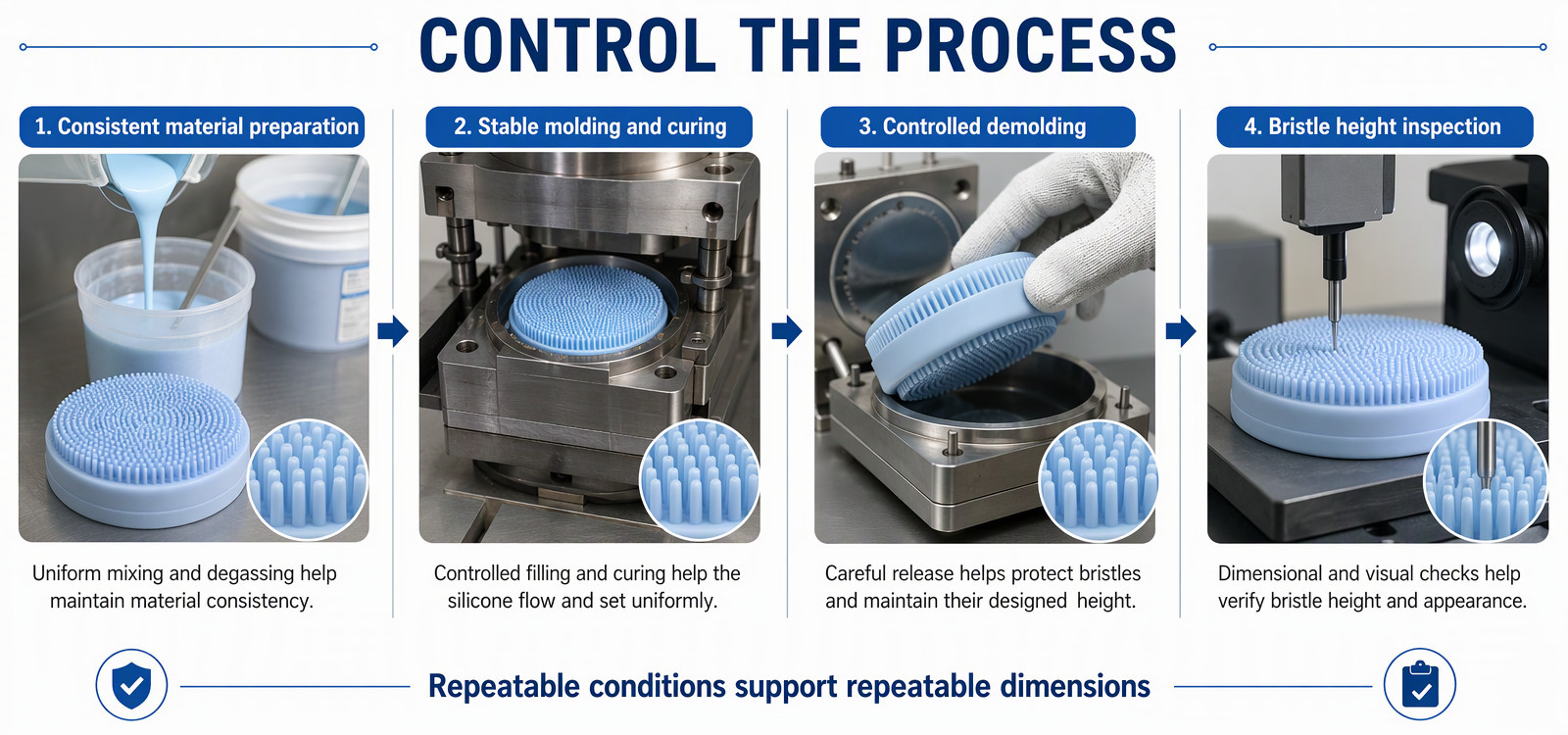
Two batches of the same compound are not identical. Filler dispersion, catalyst concentration and the age of the catalysed mix all change how the material flows in the first seconds of closing. A mix that has been standing longer is thicker, fills the outer rows later, and produces the gradient pattern described earlier.
The practical controls are simple and boring: record the batch, keep the catalysed mix within a defined working window, control the temperature of the compound before it goes into the cavity, and do not top up a nearly empty container with fresh material in the middle of a run. Hardness measurement of the cured part is a useful cross-check because it detects mix-ratio drift before it becomes a visible defect; work on in-process Shore hardness monitoring of cast silicone rubbers has shown that hardness readings vary measurably between positions on the same casting, which is why the measurement position has to be fixed.
Optimize Molding Temperature, Pressure, and Curing Conditions
Temperature does two jobs at once: it softens the compound so it can enter the bristle cavities, and it starts the cure that will freeze the shape. Raising the temperature helps filling and shortens the cycle, but it also shortens the time available for filling, and it increases the difference in cure state between the edge and the centre of a large plate.
Establish Repeatable Demolding Procedures
Demolding is the least documented step and the one most dependent on the operator. Two people can release the same part with different results, because one lifts the pad evenly and the other levers it from a corner.
How Can Manufacturers Inspect Bristle Height Consistency Before Shipment?
Inspection is not there to catch defects; it is there to prove that the process is still the process that was approved. That requires a measurement plan that can be repeated by different people and compared over months.
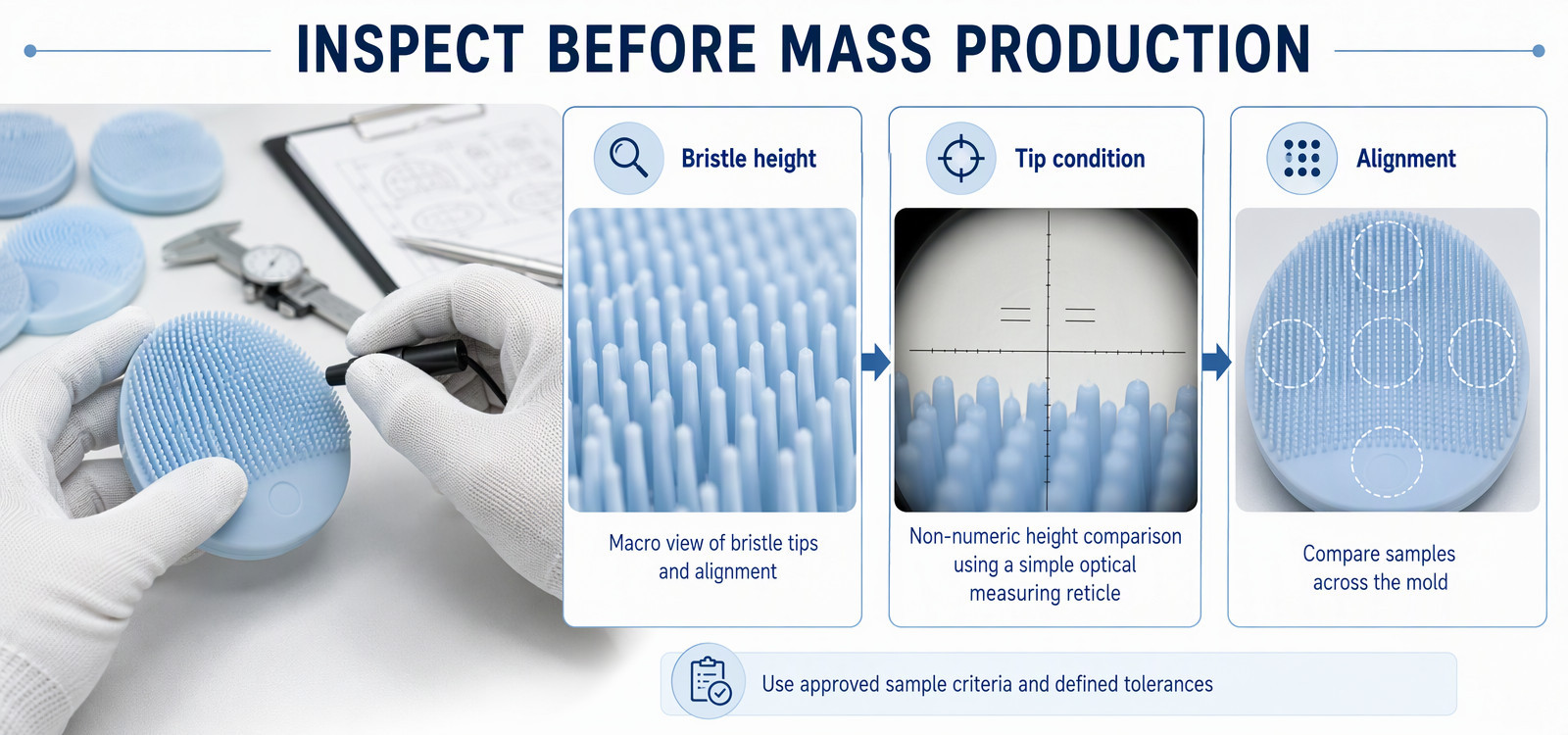
Use Sampling Measurements to Compare Bristle Heights
Select measurement points before production starts, and keep them fixed: centre, four quadrants, the outermost row, and one point per cavity in a multi-cavity tool. Measuring a random selection of bristles each time produces numbers that cannot be compared, because the population being sampled keeps changing.
Inspect Bristle Alignment and Tip Appearance
Measurement will not catch a leaning bristle if the tip happens to be at the right height. Visual inspection under low-angle light shows alignment, tip flatness, flash and contamination in a way that a number cannot.
Compare Production Samples Against the Approved Reference Sample
During production, compare the current part to the reference under the same light and at the same distance. If a dispute arises later, that comparison is the only evidence both sides will accept. Dimensional tolerances for molded rubber parts should be written on the drawing rather than agreed verbally, and our note on avoiding uneven thickness in silicone makeup tools explains why thickness and height tolerances interact on thin-walled beauty parts.
What Should Buyers Confirm Before Ordering Custom Silicone Facial Cleansing Pads?
Most height disputes trace back to a specification that was never written down.
- Bristle height, diameter and the acceptable band around each, with the measurement method named.
- Silicone hardness with the scale stated, plus any requirement on feel or rebound.
- Mold structure: number of cavities, cavity layout, and how cavity identity will be traced.
- Bristle density, row spacing and the edge layout of the cleaning field.
- Appearance limits for flash, tip rounding and colour, expressed against the reference sample.
- Sample approval procedure, including how many samples and from which cavities.
Frequently Asked Questions About Silicone Facial Cleansing Pad Manufacturing
Why do silicone facial cleansing pads have uneven bristle heights?
Usually because four causes overlap: cavity depth differences in the tool, incomplete filling of narrow cavities, uneven mold closing at the plate edges, and bending during demolding before the part has enough green strength. Measuring height as a map across the pad rather than as a single sample shows which of the four is dominant.
Can mold design affect the height of silicone cleansing bristles?
Yes, and it sets the limit. Cavity depth, the datum used to machine it, the symmetry of the cavity layout and the position of vents all determine the height band the process can hold. No press setting can correct a cavity that is machined to the wrong depth.
Does silicone hardness influence bristle height consistency?
Indirectly. Softer compounds fill narrow cavities more easily but bend during release and take a set. Firmer compounds hold shape but may fill tips incompletely. Hardness should be chosen with bristle diameter and height, then confirmed on a trial tool.
How can manufacturers reduce bent bristles during demolding?
By releasing the part evenly instead of peeling it from one edge, allowing enough cooling before release, and designing a small root fillet with adequate draft. Where geometry permits, an ejector is more consistent than manual removal.
What should buyers inspect before approving mass production?
First-article parts from every cavity, measured at fixed points and compared with the approved reference under the same light. Check height band, tip condition, alignment and colour, then confirm the same inspection will be repeated in production.
Consistent Bristle Height Starts With Better Mold Design and Production Control
Bristle height is one of the first things a buyer sees under shop lighting. The order of work matters: cavity depth and tool datum first, then venting and layout, then compound and process settings, then a demolding procedure that does not depend on who is on shift. Inspection only confirms that all four are still in place.
FromRubber builds tooling and molds silicone beauty tools for brands, importers and OEM buyers, including cleansing pads, brushes, holders and mixing bowls. Tooling, molding and secondary operations are handled in our own plants in Dongguan, which means a cavity correction and its trial sample stay with one team. Send drawings, bristle specifications or a reference sample through the inquiry form for a manufacturing review, or reach us on WeChat and WhatsApp at +86 18676210913.
Sources and further reading
- Zhao, Y. and Allanson, D. (2015). Use of Shore Hardness Tests for In-Process Properties Estimation/Monitoring of Silicone Rubbers. Modern Mechanical Engineering. Measured hardness varies between positions on the same cast silicone part, which is why measurement position must be fixed. scirp.org
- Lee, C. et al. (2019). Using Micromachined Molds, Partial-curing PDMS Bonding Technique, and Multiple Casting to Create Hybrid Microfluidic Chip for Microlens Array. Shows that part thickness uniformity is governed by mold micromachining and the casting sequence rather than by post-processing. pmc.ncbi.nlm.nih.gov
- FromRubber technical notes: mold design and parting lines, uneven thickness in silicone makeup tools.