Custom Silicone GPS Tracker Covers for Pet Brands: What to Confirm Before Mold Development
A mold is the one part of a product development project that cannot be talked into being something else. Software can be patched, packaging can be reprinted, a color can be re-annotated. A cavity cut 0.8 mm too deep is a new cavity. That is why the cheapest hour in a silicone project is the one spent confirming requirements before steel is ordered — and why the most expensive hour is the one spent discovering a missed requirement after the first sample.
For a custom silicone GPS tracker cover, the missed requirements are fairly consistent. They concern the device revision, the collar, the material, the branding, and the commercial terms around the tool. None of them are exotic. All of them are easy to leave implicit.
Start from requirements, not from a render
A concept image is a communication tool, not a manufacturing input. It shows what the product should look like from one angle under one light. It does not show wall thickness, draft, undercut geometry, cavity floor flatness, or how the cover releases. A supplier who quotes from a render is quoting a mood, and the price will change once the geometry appears.
Before mold development starts, the requirement set divides into five groups. If any group is blank, the project is not ready, however good the drawing looks.
| Group | What has to be decided | What it changes later if missed |
|---|---|---|
| Device compatibility | Exact tracker model, housing revision, corner radii, port and button positions | Cavity geometry and sometimes the whole mold |
| Collar attachment | Architecture, collar width and thickness range, mounting position | Channel size, wall sections, part size |
| Material behavior | Hardness, recovery, color, cleaning and exposure conditions | Process window, shrinkage allowance, cycle time |
| Appearance and brand | Logo method and position, texture, color count, parting-line limits | Mold construction and secondary operations |
| Volume and quality | Prototype quantity, production forecast, inspection expectations | Cavitation, tool material, sampling plan |
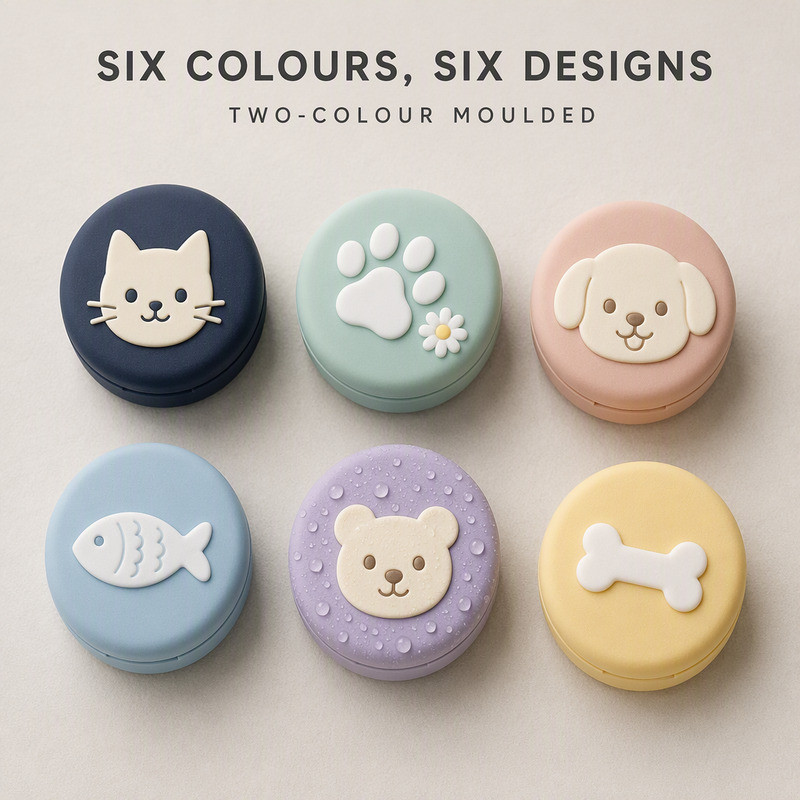
Color is the easiest example of a requirement that looks cosmetic and behaves structurally. Two-color molding, as in the set above, is not a printing step applied after the fact. The second color is a separate cavity, a separate shot, and a bond between two compounds. It changes tooling cost, cycle time, and the way the parting line has to be placed.
A brand that asks for a two-color cover late in the process is not asking for a color. It is asking for a second tool and a different process route, and the schedule moves accordingly.
Pin the device revision, not just the model name
Tracker housings change. A supplier updates a charging port, adds a lanyard groove, or softens a corner radius, and the model number stays the same. A cover designed against the previous revision will fit the new device in the way a shoe fits a slightly different foot: it goes on, and then it does not behave.
Record the revision and supply one physical unit. Measure the features that the cavity actually touches: overall length, width and thickness; corner radii; any curvature across the back; the height and position of buttons and ports; seam lines; and any groove or hook the cover might engage. Then state the access requirement in words as well as dimensions. “Charging cable must connect without removing the cover” is a requirement. A 12 mm opening is only one way to meet it.
If the brand plans a device refresh within the product’s life, say so now. A cavity can sometimes be designed with enough corner clearance to span two revisions; more often it cannot, and knowing early prevents a tool from being cut for a device that will be obsolete in nine months.
Define the collar attachment in mechanical terms
“Fits a standard collar” is not a specification. The attachment method has to be chosen, and the choice constrains everything downstream.
- Closed channel. Most secure on the collar, requires threading the strap, cannot be added without unfastening the collar.
- Open channel or clip-on. Faster to fit, depends on the opening not spreading under load, and needs a latch or lip that survives cycles.
- Sleeve over the strap with elastic section. Tolerates collar variation, loses preload over time.
- Separate loop or strap. Independent of collar thickness, adds an assembly step and a second part to inspect.
Whichever route is chosen, the collar range is the input that constrains it. The logic of matching a molded channel to a thickness range is the same one behind matching a rubber grommet to panel thickness and hole size. The buyer has to supply the collar range: minimum and maximum width measured at the mounting position, compressed thickness, edge construction, and the hardware the holder must pass. A collar range that spans more than a few millimeters usually means two holder sizes rather than one compromise.
Choose the material against the use, not the datasheet headline
Hardness is the number everyone quotes, and it is the least predictive on its own. Durometer hardness measures resistance to indentation under a defined indentor; it does not describe how a part recovers after being stretched over a device every night [2]. For a cover that is opened repeatedly, elastic recovery and compression set matter at least as much, because they determine whether the lip still sits where it did in week one [3].
Where the part is stretched during installation, tensile behavior and elongation at break describe how much strain the compound will take before it splits at a corner [4]. A compound that reads well on a hardness chart and poorly on elongation is a compound that will tear at the thinnest section.
The use environment belongs in the same conversation. Outdoor collars see UV, rain, mud and repeated washing. Indoor cat collars see less sunlight and more handling. Neither case justifies the words “waterproof” or “food grade” unless the specific compound and the specific test support them. Claims should follow evidence, not the other way round.
Settle appearance before the parting line is fixed
Cosmetic requirements are not separate from tooling; they are tooling constraints expressed in visual language. Logo position decides where the parting line can run. Surface texture decides how flash will show. Color count decides whether the part needs a second cavity. Acceptable color variation decides how the compound is bought and how the batch is inspected.
Three questions resolve most of it. Is the logo embossed, debossed, printed or molded in a second color? Which faces are “A” surfaces that cannot carry a witness line? What variation in color is acceptable between batches, expressed as a physical reference rather than a word? A brand that answers these three before tooling avoids the most common post-sample argument, which is not about fit at all.
Review moldability while the CAD is still editable
Moldability review is cheaper as a conversation than as a tool modification. The items worth checking are consistent across silicone parts:
- Wall thickness variation, especially where a thin lip meets a thick body.
- Draft on cavity walls and on any surface that has to release.
- Undercuts and retaining lips, and how each one will be demolded.
- Narrow openings and thin edges that will tear at ejection.
- Parting-line placement and the flash it will leave on functional surfaces.
- Shrinkage allowance on the dimensions that decide fit, not on the outer profile only.
Shrinkage deserves its own line in the review because it is the quiet variable. Molded rubber dimensions are specified as tolerance classes rather than exact values for a reason [1]. A cavity dimension that matters for fit should be identified as a critical dimension, given a tolerance class, and inspected on the sample. Dimensions that do not matter should be allowed to move.

Field use is where the requirement list gets tested. A cover that works on a city pavement may be asked to survive a mountain trail, wet grass and a dog that swims. That does not mean the part needs a different material in every case. It means the review should identify which load path is dominant, and which dimension controls it.
On a wide collar under tension, the channel carries the load and the cavity mostly carries the device weight. On a narrow collar, the holder is smaller and the same pull produces higher local pressure at the edge. Two products, two critical dimensions, one requirement document if it is written properly.
Decide which dimensions are critical to quality
Not every dimension deserves inspection. A cover has perhaps six features that decide whether it works, and a dozen that decide whether it looks right. Mixing them produces inspection reports that are long and unhelpful.
| Feature | Why it matters | How to check | What to agree |
|---|---|---|---|
| Tracker cavity length and width | Controls insertion force and lateral movement | Calipers at the cavity mouth and floor | Nominal with a stated tolerance class |
| Corner radii | Mismatch concentrates strain and causes rocking | Radius gauge or profile projection | Match to device sample, not to drawing |
| Retaining lip height | Sets how much material holds the device face | Section cut on a sacrificial sample | Minimum engagement depth |
| Collar channel height | Controls sliding force and rotation | Pin gauge through the channel | Range covering thickest collar sample |
| Overall thickness | Affects comfort and how the holder sits on the neck | Calipers at the highest point | Maximum, not nominal |
| Logo position | Visible alignment and brand consistency | Optical comparison with artwork | Positional tolerance and allowed rotation |
Numbers in the right-hand column are the buyer’s decision, not the molder’s. A supplier can recommend a class and explain the cost of tightening it, but the acceptance criteria belong in the purchase specification, or they will be renegotiated at the first dispute.
Run the sample approval as a sequence, not an event
Sample approval works better as a staged process with a written gate at each step:
- Requirements and drawing review, with the device and collar samples in hand.
- Design-for-manufacturing review, with moldability notes returned to the buyer.
- CAD approval, including the critical dimensions and their tolerances.
- Tooling quotation with the scope of revisions stated explicitly.
- First sample production, with dimensional report and photographs.
- Fit and function evaluation on real devices and real collars.
- Revision and re-sampling if needed, with the change recorded.
- Written sample approval before mass production.
The step most often skipped is the fourth. “Includes one revision” means different things to different suppliers. Confirm how many revision rounds the tooling price covers, what counts as a revision rather than a new requirement, and who pays for a change caused by a device revision on the buyer’s side. That conversation is uncomfortable before the order and considerably more uncomfortable afterwards.
Travel cases and carriers are a good reminder that the same cover may be used in environments the drawing never mentions. A cat in a carrier is pressed against a mesh panel for hours; the holder is loaded sideways rather than hanging. If the channel is sized only for a hanging load, sideways pressure can rotate the cover until the device faces the mesh.
None of this requires a new part. It requires the requirement document to say where the product will be used, so the review can decide whether rotation resistance is a nice-to-have or a design driver.

Commercial terms belong in the same document
Tooling ownership, storage, maintenance and access are not administrative details. They decide what happens when the product succeeds, when the brand changes supplier, or when the mold needs a repair five years later. Confirm who owns the tool, where it is stored, what maintenance is included, what the expected production life is, and how a repair is quoted. Confirm the confidentiality position on drawings and device samples, since a tracker housing under NDA is common in this category.
Also confirm the boring things that cause delays: prototype quantity and whether prototypes are for fit only or for user trials, the production forecast that the cavitation is based on, packaging and labelling requirements, and the inspection documentation that will accompany each shipment.
The pre-tooling checklist
- Tracker sample or CAD file, with the housing revision named.
- Device features that must remain accessible, described in words and dimensions.
- Collar samples at both ends of the range, with measured width and compressed thickness.
- Attachment architecture and the removal gesture it implies.
- Material hardness, color reference and any cleaning or exposure requirement.
- Logo artwork, method and position; list of A-surfaces and parting-line limits.
- Critical dimensions with tolerance classes and inspection method.
- Prototype quantity, sample approval sequence and revision scope.
- Production forecast, tooling ownership and maintenance terms.
- Packaging, labelling and shipment documentation.
Questions buyers ask before a tool is ordered
Do I need a 3D drawing to get a quotation?
A quotation can be given from a description, but it will be a range. A dimensioned drawing or a device sample plus a sketch narrows the range enough to be useful, and it is the minimum needed to review moldability.
Can the manufacturer develop the initial design?
Many can, and it is often faster than a brand learning silicone design rules from scratch. What the brand still has to own is the requirement: which device, which collar, which user behavior, which claims.
What causes most mold revisions?
Changed requirements after sampling: a new device revision, a color added late, a logo moved, a collar range widened. Genuine tooling errors happen, but requirement drift is more common.
Should a physical sample be approved before mass production?
Yes, and it should be approved against written criteria rather than a general impression. A signed sample with a dimensional report is the reference that settles later disputes.
Who should define the critical fit dimensions?
The buyer, with the molder’s input on what is achievable. The molder can explain how a tolerance affects cost and process; the buyer decides which fit conditions the product must satisfy.
Tools remember what the brief forgot
Most of the cost in a custom silicone cover is decided before the first sample exists: the device revision, the collar range, the attachment method, the material, the color count, the critical dimensions. Confirming those six things does not guarantee a good product, but skipping any one of them almost guarantees a second tool or a compromised first one.
A mold does not make a product waterproof, pet-safe or certified. Those claims depend on the compound, the test and the market, and they should be written only after the evidence exists.
FromRubber, the export brand of Dongguan Bohao Electronic Technology Co., Ltd., reviews drawings, device samples and functional requirements for custom silicone covers and holders, and flags the molding risks that are cheap to change on paper. If you are preparing a brief, send the device sample data, collar measurements and target use to nani@fromrubber.com or karl@fromrubber.com. WeChat and WhatsApp: +86 186 7621 0913. Our custom silicone rubber parts page outlines the processes involved, and silicone product applications covers how similar parts are used in the field.
Sources
- ISO 3302-1:2014 — Rubber: Tolerances for products, Part 1: Dimensional tolerances, ISO.
- ASTM D2240-15(2021) — Standard Test Method for Rubber Property: Durometer Hardness, ASTM International.
- ASTM D395-18(2025) — Standard Test Methods for Rubber Property: Compression Set, ASTM International.
- ISO 37:2024 — Rubber, vulcanized or thermoplastic: Determination of tensile stress-strain properties, ISO.