
How do you design a durable keypad for industrial measuring instruments?
Industrial measuring instruments — calibrators, power quality analyzers, flow computers, field testers — punish their keypads in ways consumer products never do: gloved hands, solvent wipes, temperature swings from -40°C to +85°C, and 8-hour shifts of constant parameter entry. Durable keypad design is not about "stronger material"; it is about a sequence of engineering decisions where each one is anchored to a real operating condition. Here is the sequence, in the order we run it at FromRubber.
Step 1: Write the environmental spec before touching CAD
Every durable keypad starts as a list of threats: what chemicals touch it, what temperature extremes it sees, whether it faces washdown or rain, and how many presses per shift it endures. This list drives all downstream choices. Two rules of thumb that save projects:
Step 2: Mechanical feel — force, travel, and snap ratio
Step 3: Sealing, contacts, and legends — the durability trio
Sealing: IP54 is fine for bench instruments; IP65/IP67 for field and washdown requires a molded sealing rib or integrated gasket with controlled bezel compression — not a stick-on foam strip, which is where most water-ingress failures originate. One-piece molded keypads with integral seals eliminate the secondary joint entirely.
Contacts: carbon pills (10–200 Ω, 1–5M cycles) cover 90% of instrument circuits. But if your instrument switches below 1V / 1mA — weak microprocessor pull-ups, for instance — specify gold-plated pills or metal domes (below 0.5 Ω) to prevent dry-circuit contact failures that no amount of mechanical durability can compensate for.
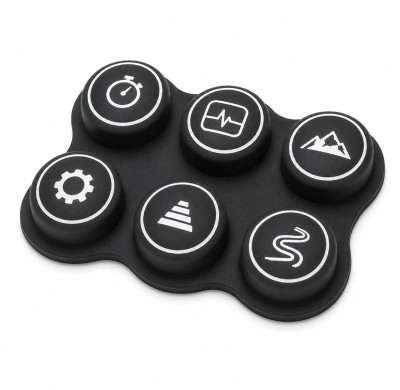
Legends: laser engraving through a top coating, finished with a PU or UV clear coat, is the durable choice for instruments — permanent marking that survives solvents and 1M+ cycles, and it enables LED or light-guide-film backlighting for dim plant environments.
Step 4: Validate — a design is not durable until it is tested
The validation stack we run before releasing any instrument keypad to production: force-displacement curves on every key (batch consistency), 1M-cycle life testing at 2 Hz with 110% rated force, temperature cycling -40°C to +85°C, UV aging for outdoor units, salt spray for marine exposure, and chemical wipes with the customer's actual cleaning agents.
Case study: a flow computer keypad for an outdoor petrochemical site
An integrator needed a keypad for a flow computer mounted on a skid at a desert gas processing site: 60°C daytime ambient, occasional hydrocarbon splash, operators in heavy gloves, and a 10-year service life requirement. Their first supplier had delivered a 40 Shore A consumer-feel keypad whose keys tore at the web within 14 months and whose legends ghosted under degreaser.
FromRubber redesigned around the environment: 65 Shore A compound for web tear resistance, 300 gf actuation with a 1.5 snap ratio for gloved use, molded perimeter seal rib for IP65, laser-etched legends under matte PU coating (degreaser-tested), and gold-plated pills because the flow computer's MCU inputs switched at 0.8V. Prototype tooling ran in three weeks; the design passed 1M cycles plus 500 thermal cycles with force drift under 10%. The skid units have now logged four field years with zero keypad replacements.
The data: design targets for durable instrument keypads
The recurring lesson from teardowns we run at FromRubber: instruments fail at interfaces — the seal joint, the legend, the contact — almost never at the silicone body itself. Spend your design effort there, in that order, and the keypad will outlive the instrument's firmware.
Related questions
Are you looking for a rubber and plastic product customization solutions manufacturer?
We can quickly provide customers with market analysis, technical support and customized services.Sign Up Out Newletter
