Stop Settling for Fading Embroidered– Switch to Vibrant, Washable Silicone Patches
Embroidery fades because its colour sits on the surface of a thread, where UV, detergent and abrasion can reach it. Washable silicone patches carry colour inside the material itself — the compound is mass-pigmented before moulding — so there is no surface dye layer to lose. Tested to 100 industrial laundry cycles at 60 °C, a silicone patch retains about 98% of its original colour vibrancy, while embroidered decoration can lose up to 60% of its colour density within 20 washes.
That difference is a material property, not a finish. It changes what a brand has to specify: pigment and ΔE tolerance instead of thread numbers, backing chemistry instead of stitch density, and a delamination test instead of a colour-fastness claim.
Why mass pigmentation does not fade
In embroidery, colour is applied to yarn and then exposed. Detergent attacks the dye boundary, UV breaks the chromophore, and friction abrades the fibre surface; each mechanism removes colour a little at a time, and the loss is permanent because nothing replaces it. Moulded silicone works differently: pigment particles are dispersed through the whole section, so wear removes material without exposing an undyed core.
The matrix also resists the mechanisms themselves. Silicone is UV-stabilised, hydrophobic and chemically inert against normal detergent chemistry, so the three routes that dull thread are largely closed. The colour does not migrate, bleed into adjacent areas, or leave white fibre showing at a worn edge.
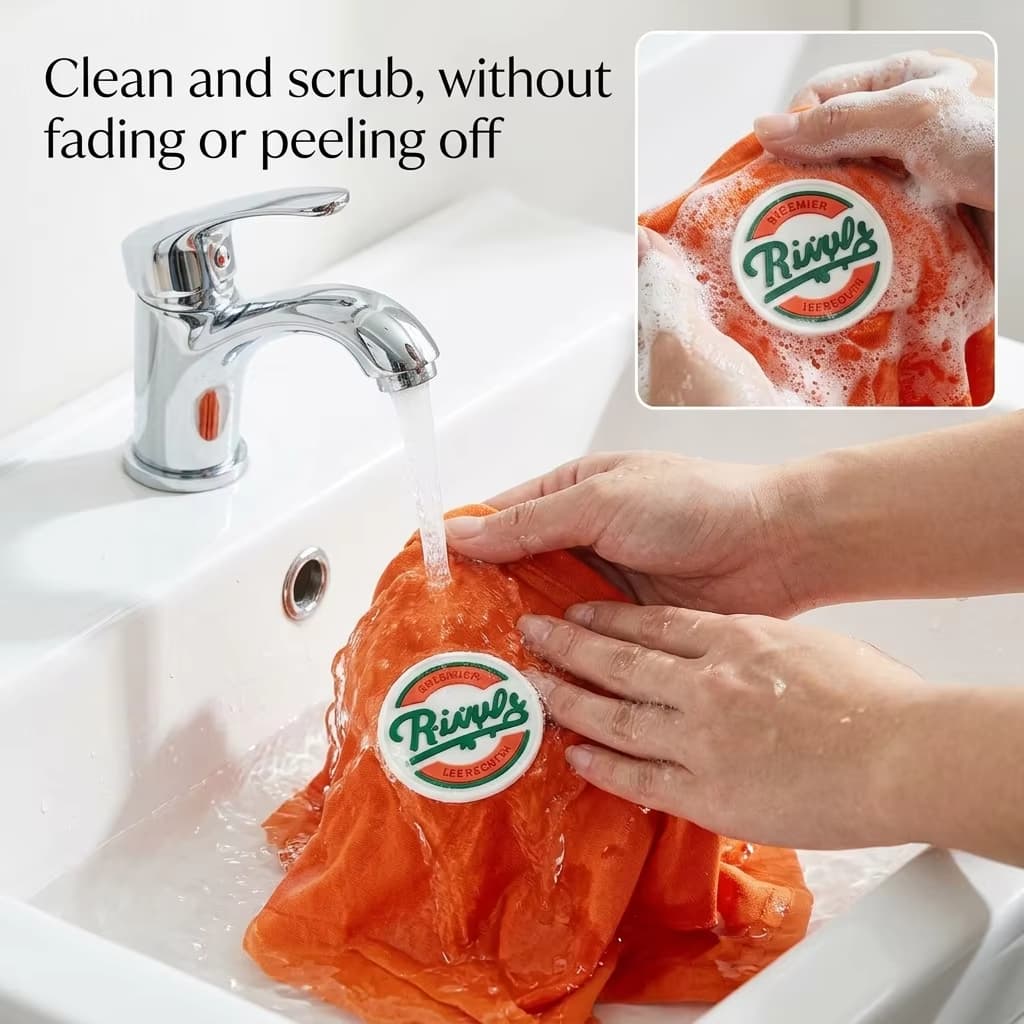
The comparison that matters is not first-day appearance but appearance after 50 washes.
Wash performance, measured side by side
The figures below are the ones worth putting in a brief, because they describe behaviour after wear rather than at approval.
| Property | Washable silicone patches | Embroidery |
|---|---|---|
| Colour retention at 50 washes | 97% | 40–50% |
| Colour density at 20 washes | No measurable loss | Up to 60% lost |
| Fraying or thread pull | None — the part is moulded | Common after 10–15 wears |
| Backing comfort | Soft, skin-friendly | Stiff, especially on caps |
| UV resistance | UV-stabilised compound | Poor; fades in sunlight |
| Sampling lead time | 5–7 days | 14–21 days |
Sampling speed is in the same table for a commercial reason: a 5–7 day moulded sample lets a range be approved inside a season calendar, while a three-week embroidery strike-off usually lands after the buy has been locked.
Colour matching beyond thread charts
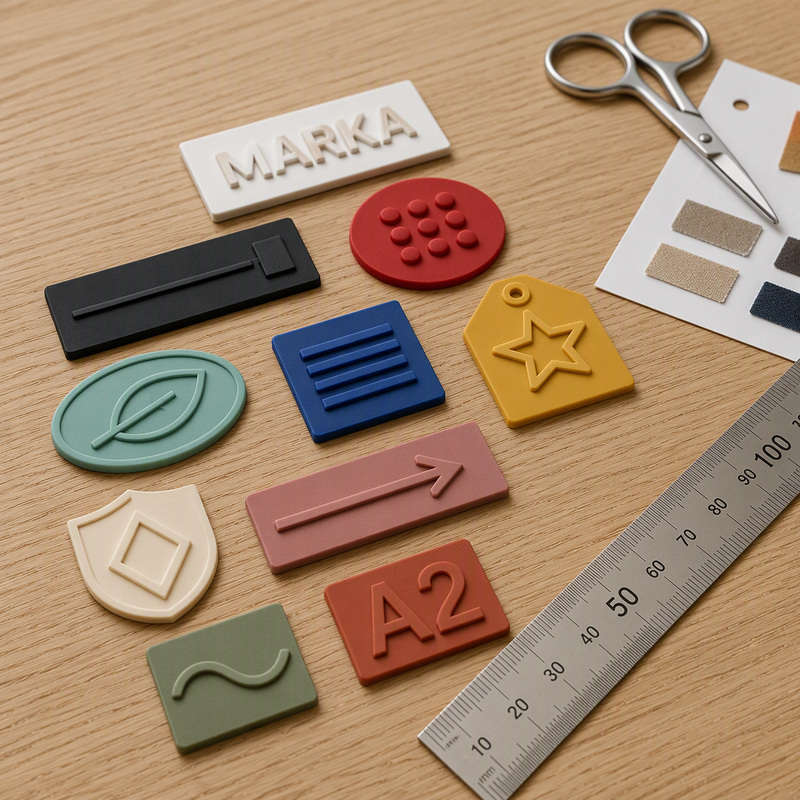
Thread ranges stop at roughly 200–300 colours and vary between dye lots, so a brand colour is usually an approximation that drifts across seasons. Pigmented silicone is matched to any Pantone solid, metallic or neon with ΔE below 1.5, which is the point at which the emblem still reads as the same colour beside packaging and print.
Texture and special effects
Finish is a tool decision: matte, gloss, brushed, sand-grain or leather-like surfaces are moulded, not coated, so the texture cannot wear through. Special effects behave the same way — glow-in-the-dark, reflective, metallic and pearlescent pigments are compounded into the material rather than applied over it, which is why they survive laundering that would strip a printed layer.
Pigment is compounded before moulding, so texture and effect last as long as the part.
The parts that fail are not the colour
When a silicone patch fails in service it is usually the interface with the garment, not the emblem. Tear resistance comes from an embedded polyester scrim inside the moulded section; without it, a thin patch concentrates stress at the stitch or bond line and splits.
Abrasion is measured rather than assumed: 10,000 rubs to ASTM D3884, plus salt spray and humidity exposure for outdoor and marine ranges. Industrial laundering at 60 °C and UV exposure equivalent to two years outdoors are the two conditions that separate a compound built for apparel from a general-purpose one.
Test the backing, not just the patch. A sample that passes 100 wash cycles as a free part can still lift at the edge when heat-sealed to a stretch fabric — approve the bonded assembly on the actual garment.
Specifying a washable patch that stays on
Backing choice follows the fibre. Heat-seal suits cotton, polyester, nylon and blends that tolerate the press cycle. Pressure-sensitive adhesive covers trims that cannot be pressed and short runs. Sew-on remains correct for caps, heavy workwear and anything laundered industrially, where a mechanical attachment outlasts any bond.
Three numbers keep the order predictable: the fabric and its stretch behaviour, the wash temperature and cycle count, and the patch size and edge treatment. A bevelled edge distributes flex on stretch fabric; a thin border lifts. Moulded patches also allow complex shapes and undercuts without the stitch-density limits that constrain embroidery, and low minimums — around 100 pieces — make a small capsule run viable.
Sampling runs in four steps: artwork in AI, EPS or PDF; a 3D colour sample in about five days; approval of texture, gloss and backing; then 10–15 days for production.
Edge treatment and backing decide whether a patch survives the garment's wash life.
Questions brands ask about washable silicone patches
How many washes will the colour survive?
Around 98% of original vibrancy after 100 industrial cycles at 60 °C, and 97% colour retention at 50 washes. The limiting factor is normally the backing or the fabric, not the pigment.
Can a silicone patch replace embroidery on caps?
Yes, and caps are one of the stronger cases: there is no stiff backing against the forehead and no thread to fray at the curve. A sew-on or heat-seal backing is chosen by the cap construction, and a low profile keeps the crown shape.
Does a moulded patch cost more per unit?
Typically $1.20–$3.50 against $0.80–$2.00 for embroidery. Embroidery rejection runs 5–8% against under 1% for moulded parts, and fading drives returns, so a 10,000-unit programme usually favours silicone on total cost.
Can we keep the current artwork?
Usually yes, and it can be improved. Moulding holds finer lines and undercuts than stitch density allows, so artwork is redrawn to the tool rather than simplified for thread — approve that redraw on the 3D sample.
Approve colour on silicone, not on paper
Send artwork, the fabric and the wash regime. We will mould a 3D sample with the backing matched to that garment, so colour, texture and adhesion are approved on the real assembly.
Review the washable silicone labels range, or start from silicone patch options for raised emblems.