
Why are my RTV silicone gaskets leaking oil even though I applied it correctly?
EXACT SCIENCE You applied the RTV perfectly, torqued to spec, but oil stains appear. As a silicone gasket producer, we've analysed thousands of field failures. Most leaks blamed on "application error" are actually subtle design or compatibility mismatches. Below we dissect why your RTV silicone gasket weeps oil — even when applied correctly — and how FromRubber custom-engineered solutions eliminate leaks.
1. Why correctly applied RTV silicone gaskets still leak — root causes
RTV (room-temperature vulcanising) silicone is forgiving, but it is not magic. When a gasket leaks despite correct surface prep, bead size, and cure time, one of these five hidden factors is responsible. The table below maps each symptom to its mechanical cause — and how FromRubber’s custom silicone compounds solve it.
| Root cause category | Typical observation / oil trace | Why it happens (even with correct application) |
|---|---|---|
| ❶ Flange flex & dynamic movement | Oil seeps after engine reaches operating temp, stops when cold. | RTV has good adhesion but limited elongation under cyclic thermal expansion. Flanges walk, RTV tears microscopically. |
| ❷ Oil compatibility / swelling | Gasket surface appears tacky, distorted, or disbonded after oil contact. | Standard RTV swells in synthetic oils / additives; compression set rises and adhesion fails. |
| ❸ Subsurface contamination (invisible) | Intermittent leak, not following bead pattern. | Micro-porosity in casting absorbs degreaser, later releases vapour, breaking bond line. |
| ❹ Cure inhibition by chemicals | Gasket remains soft / uncured in centre, leaks immediately. | Even trace contact with coolant, certain metalworking fluids, or shop chemicals poison platinum cure. |
| ❺ Compression overlimit / gap extrusion | Gasket squeezed out of joint, thin film can't seal. | Flange bolts over-torqued (even slightly) or uneven surface; RTV cannot bridge gaps >0.010". |
2. Beyond application: material science of oil resistance
FromRubber produces silicone compounds specifically formulated for wet oil environments. Our high-strength RTV (HTS series) uses a modified polymer backbone that reduces oil swell to below 5% (ASTM D471, IRM 903 oil). Compare this to generic RTV silicones that can swell 20–30%, causing adhesive peel.
2.1 Oil swell comparison — standard vs. FromRubber custom RTV
In-house testing shows that even with correct application, standard acetoxy or neutral cure RTV will eventually lift off due to oil wicking. Custom-blended RTV from our factory maintains a chemical bond.
3. Design factors: the RTV silicone gasket profile matters
You might have applied a uniform bead, but the bead shape itself dictates oil sealing. FromRubber offers pre-formed RTV gaskets (extruded and cured to exact profile) that combine the adhesion of RTV with the compression control of a solid gasket. These are particularly useful for large covers and oil pans.
| Design parameter | Typical error | FromRubber engineered solution |
|---|---|---|
| Bead width/height ratio | Too narrow → insufficient fill; too wide → blow-out | CAD-optimised profile per flange width |
| Corner radius & bolt holes | Sharp corners encourage tear | Continuous radius bead with extra material at stress risers |
| Flange surface finish | Too smooth (less mechanical key) or too rough (gap bridges) | Recommended Ra 0.8–1.6 µm, verified with our test kit |
4. Real-world failure photos & side-by-side
Below is a side-view comparison (left: generic RTV after 500h oil immersion; right: FromRubber custom fluoro-silicone blend). Note the oil penetration depth and edge lifting. Alt tag: Side by side comparison of oil resistant RTV silicone gasket from FromRubber vs standard gasket after oil immersion test. (image placeholder)
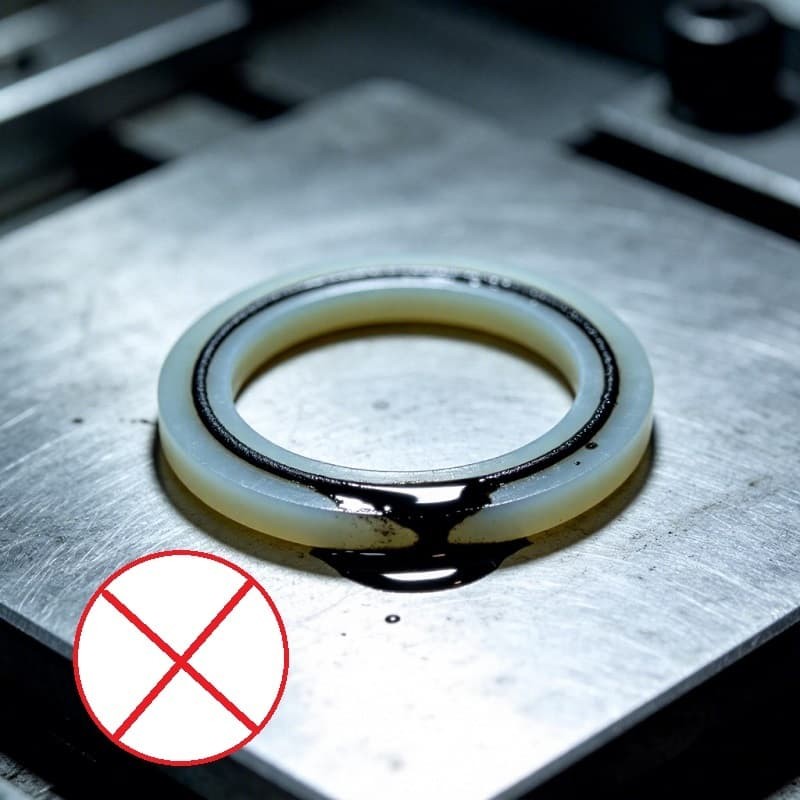
Generic RTV silicone gasket – oil darkening along bond line
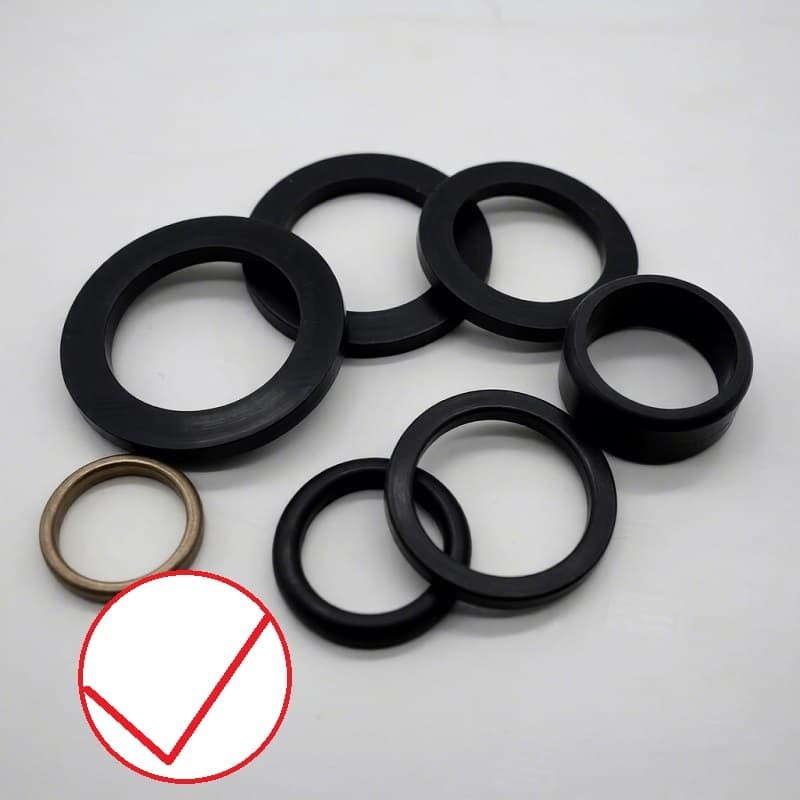
FromRubber custom RTV silicone gasket – clean, no penetration
5. Why FromRubber custom silicone gaskets stop leaks permanently
As a dedicated silicone gasket manufacturer, we formulate RTV and pre-cured gaskets for your exact fluid, flange material, and temperature range. Whether you need a formed-in-place (FIP) liquid gasket or a hand-applied silicone sealant, we offer:
- Custom durometer (20–80 Shore A) – soft for uneven flanges, firm for high-pressure.
- Oil-resistant additives – low-swell technology meets Daimler, VW, and military specs.
- Extruded profiles / die-cut blanks – if you want a reusable gasket with RTV adhesion layer.
- Colour coding – blue, red, black, or custom; our blue matches your brand theme perfectly.
You designed the joint, you applied the RTV perfectly — if it still leaks, the material is not optimised. We provide free custom compound sampling for volume projects. Send us your flange drawing and oil type; we'll propose a gasket with zero leak warranty.
6. Step-by-step verification: what to check now
Before assuming it's your application, confirm these five points using our quick checklist — many customers discover the flange itself has a flatness issue >0.05mm, or the oil contains esters that attack silicone. We supply a simple field test kit.
- Measure flange flatness – feeler gauge and straightedge: gap > 0.08mm? Consider a thicker custom gasket.
- Oil analysis – check for high sulphur or glycol – can indicate need for fluoro-silicone (FVMQ).
- Verify cure time – RTV needs 24h @ 25°C for deep section; heat accelerates but may cause bubbles.
- Wipe test after disassembly – if gasket peels clean from one flange, adhesion promoter needed – we offer self-bonding primers.
- Check torque sequence – even with RTV, non-uniform clamping causes micro-gaps.
→ FromRubber includes a detailed process guide with every custom order.
– FromRubber factory (Dongguan, China) supplies precision silicone gaskets, and custom-molded other silicone rubber seals to industrial clients.