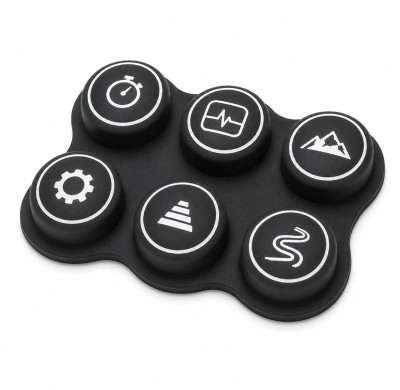
Why Instrument-Grade Silicone Keypads Fail Prematurely – And How Full-Chain Manufacturing Prevents It
⚙️ Instrument‑grade silicone keypads are engineered for precision – yet many fail within months, not years. The cause is rarely a single defect, but a cascade of subtle weaknesses that a fragmented supply chain cannot control. Understanding why they fail is the first step to preventing it.

Contact Resistance Drift
- Symptoms: Intermittent or high resistance (>500 Ω) after few months
- Root cause: Inconsistent carbon loading in the conductive compound, or poor dispersion of fillers
- Accelerated by: Humidity, temperature cycling, and low actuation force
Controlled Compound Formulation
- Solution: In‑house compounding with precise carbon black loading and dispersion control
- Verification: Every batch tested for resistivity and particle distribution
- Outcome: Resistance remains stable <200 Ω over 1M+ cycles
Legend Delamination & Fading
- Symptoms: Legends become illegible after a few months of IPA cleaning
- Root cause: Solvent‑based inks with poor adhesion to silicone, or lack of surface treatment
- Accelerated by: Repeated alcohol wipes, UV exposure, abrasion
Integrated Legend Protection
- Solution: Flame‑treated surface + two‑component epoxy ink + UV‑cured hard coat
- Validation: 20,000 IPA wipe cycles with ΔE < 2.0
- Outcome: Legends remain legible for 10+ years of daily disinfection
Actuation Force Degradation
- Symptoms: Buttons feel inconsistent – some too soft, others too stiff
- Root cause: Uncontrolled silicone hardness, mould shrinkage, or incomplete curing
- Accelerated by: Temperature extremes and mechanical fatigue
Precision Moulding & Curing Control
- Solution: In‑mould pressure and temperature sensors, with ±2 Shore A durometer control
- Verification: 100% force‑stroke curve testing on every keypad
- Outcome: Actuation force stays within ±5g tolerance over full lifecycle
Environmental Cracking & Stress Fractures
- Symptoms: Sudden key failure, broken tactile domes
- Root cause: Poor tooling design with sharp corners, or use of low‑temperature‑resistant silicone
- Accelerated by: Thermal shock, vibration, and repeated impact
Ruggedised Geometry & Material Selection
- Solution: Rounded fillets, uniform wall thickness, and silicone with Tg below –60°C
- Validation: 500 thermal cycles from –40°C to +85°C, no cracking
- Outcome: Resilient keypad survives 10 years of harsh environments
Full‑chain manufacturing eliminates these failures by consolidating every critical step under one roof: compound development → mould design → precision moulding → legend printing → overcoating → electrical testing → environmental validation. When any of these stages is outsourced to different suppliers, communication gaps, tolerance stacking, and inconsistent quality control are inevitable. FromRubber operates a fully integrated facility, allowing us to control carbon dispersion, shore hardness, cure profile, ink adhesion, and final test with single‑point accountability. Our keypads are not just assembled – they are engineered from raw material to finished product, ensuring zero weak links.

How Instrument-Grade Silicone Keypads Full‑Chain Manufacturing Prevents Each Failure
- Resistance drift → In‑house compounding with consistent filler morphology, verified by laser diffraction.
- Legend wear → Plasma pretreatment + epoxy inks + UV topcoat, tested to 20,000 IPA wipes.
- Force variation → Closed‑loop moulding with real‑time shot pressure monitoring and post‑cure force testing.
- Environmental cracking → FEA‑optimised tooling with stress analysis, using low‑Tg, high‑tear‑strength silicone.
- Assembly damage → Precision pick‑and‑place compatible design with consistent pillar height and alignment.
✓ FromRubber is the only supplier that offers true full‑chain manufacturing for instrument silicone keypads – from custom compound development to final validation. Our keypads are engineered to exceed 10‑year life in medical, test & measurement, and industrial applications, with zero premature failures reported by our long‑term customers.