Why Does Digital Multimeter Silicone Keypad Web Thickness Matter?
A multimeter keypad is one part, but it is not one mechanism. Press the HOLD key and the neighbouring RANGE key can move a little with it, because the two buttons are joined by a sheet of silicone that is thinner than anything else in the assembly. That shared sheet is the connecting web, and its thickness decides how much of one press leaks into the next key.
Web thickness is usually written on the drawing as a single number, often inherited from an older project. On a six-key keypad with generous spacing, almost any value works. On a compact instrument where the keys are close together, the web becomes a structural element with three jobs at once: it holds the buttons in position, it lets each button move, and it has to survive being the thinnest section in the mold.
This article looks at what the web does mechanically, why the usual fix of "make it thinner for a softer feel" backfires, and how to specify it so that the mold can actually produce it.
What Is Web Thickness in a Digital Multimeter Silicone Keypad?
The connecting web is the continuous silicone membrane between button bodies. It is not the base of the keypad and it is not the button wall. It is the bridge: the region where the material thins down between two adjacent buttons so that each button can deflect without dragging the whole sheet with it.
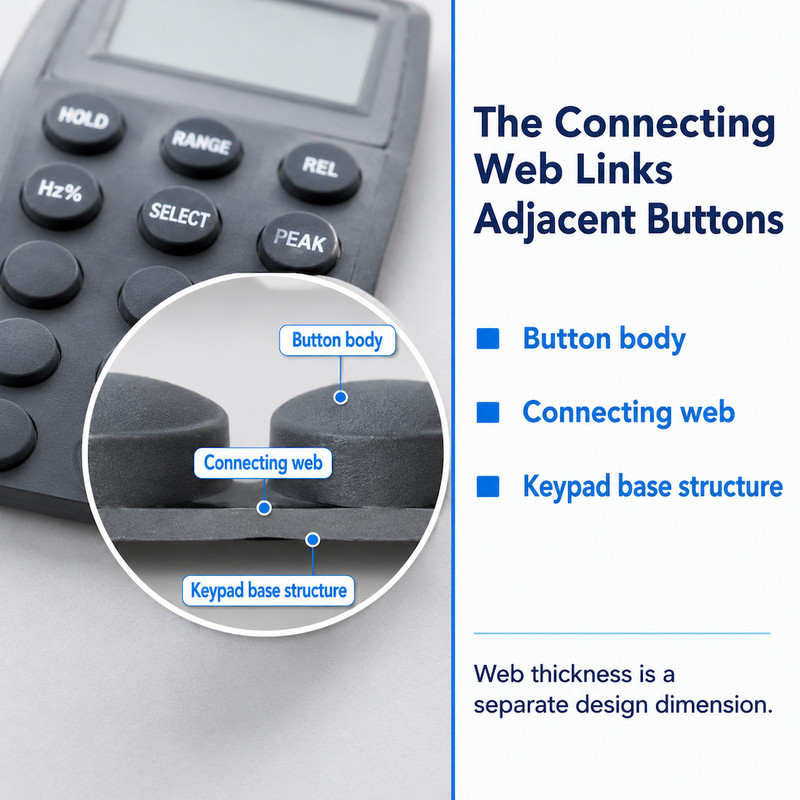
On a multimeter keypad the web typically runs at a fraction of the button wall thickness, and it is the dimension that changes most when a layout is compressed. Push the keys closer together and the web gets shorter and, in most drawings, thinner, because there is less room to ramp down from the button body.
That is why web thickness is a layout consequence as much as a design choice. It cannot be set independently of spacing, and it cannot be corrected in the mold without changing the button positions.
How Does the Connecting Web Join Individual Silicone Buttons?
The web forms a continuous sheet that carries the buttons, the spacing between them and the seal against the front panel. Mechanically it behaves like a plate with holes: the buttons are stiff islands, the web is the flexible field between them, and the stiffness of that field depends on its thickness cubed. Halve the thickness and the field becomes roughly eight times more compliant in bending, which is why small drawing changes produce large feel changes.
It also carries the return path. After a press, the web helps pull the button back to its rest position, in parallel with the dome or the button wall. A web that is too stiff keeps the button slightly loaded; a web that is too soft lets it sit low.
Why Is Web Thickness Different From Button Wall Thickness?
The wall is a vertical structure that resists the press and defines the button height. The web is a horizontal structure that defines the button's position and its isolation from its neighbours. They fail differently: a thin wall collapses or loses height, a thin web tears at the transition or lets the button tilt.
They also see different loads. The wall sees the full actuation force on every press. The web sees a fraction of that force, but it sees it in bending and it sees it in every direction, because the adjacent buttons are also being pressed at other times.
How Does Silicone Keypad Web Thickness Affect Button Performance?
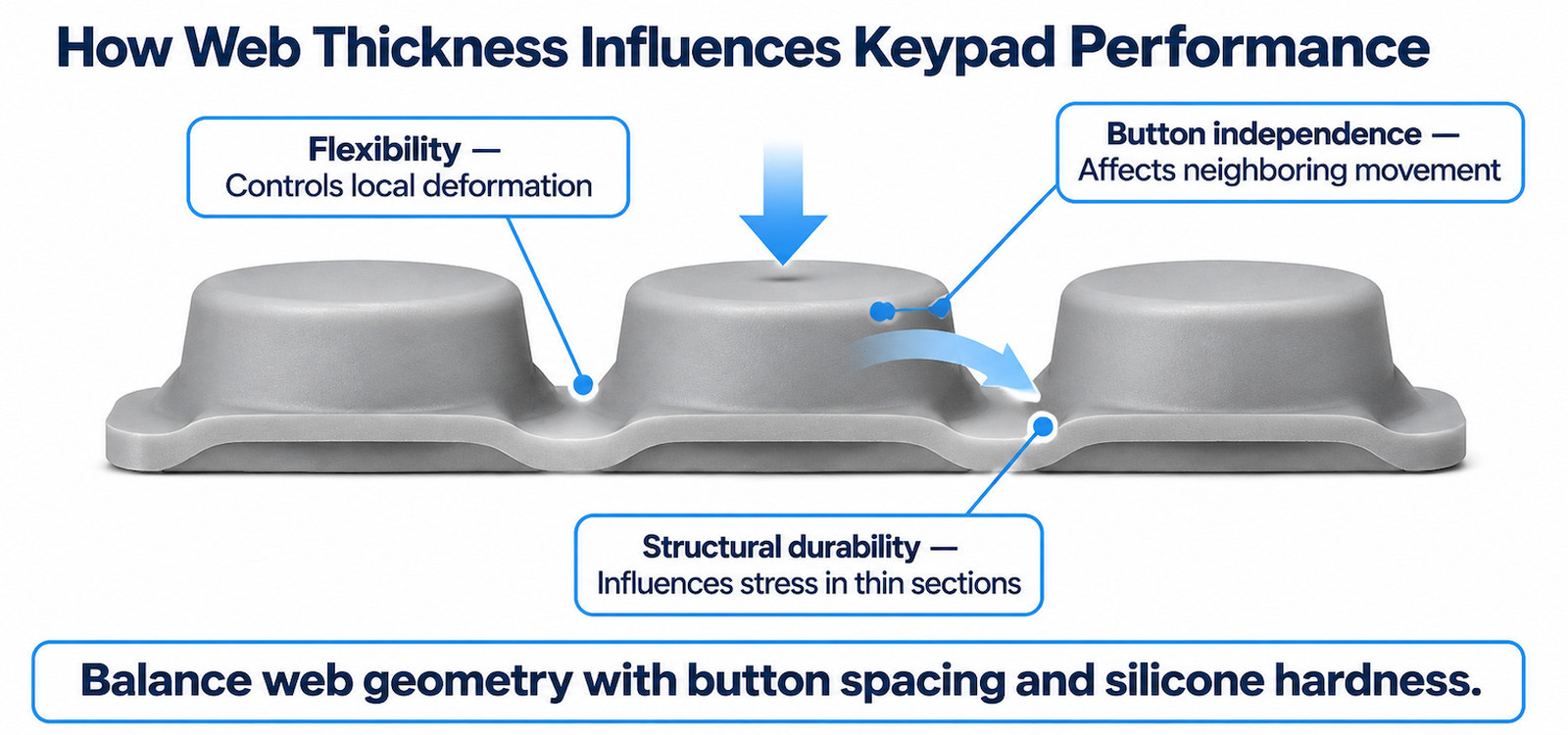
Three performance properties are set by the web: how much effort a press needs, how isolated the press is, and how long the web lasts at the transition. All three move in opposite directions as thickness changes, which is why the number has to be chosen rather than copied.
Why Can Thick Connecting Webs Make Buttons Harder to Press?
A thick web adds resistance around the button base, so the button has to drag a stiffer field with it as it deflects. On a small keypad this shows up as a key that is easy to move with a fingertip but hard to move with a thumb at an angle, because the angled press loads the web in shear as well as bending.
It also raises the force of the whole row, not just the pressed key. Because the web is continuous, thickening it changes the feel of every key on the part, including keys that were previously acceptable.
How Can Thin Webs Improve Flexibility but Create Structural Risks?
Thinning the web is the fastest way to make buttons feel lighter, and it is the most common reason a keypad tears in the field. The web is already the thinnest section, so it fills last, cools first, and is the most sensitive to any variation in material flow. At the transition to the button body, a thin web creates a stress riser that grows with every press.
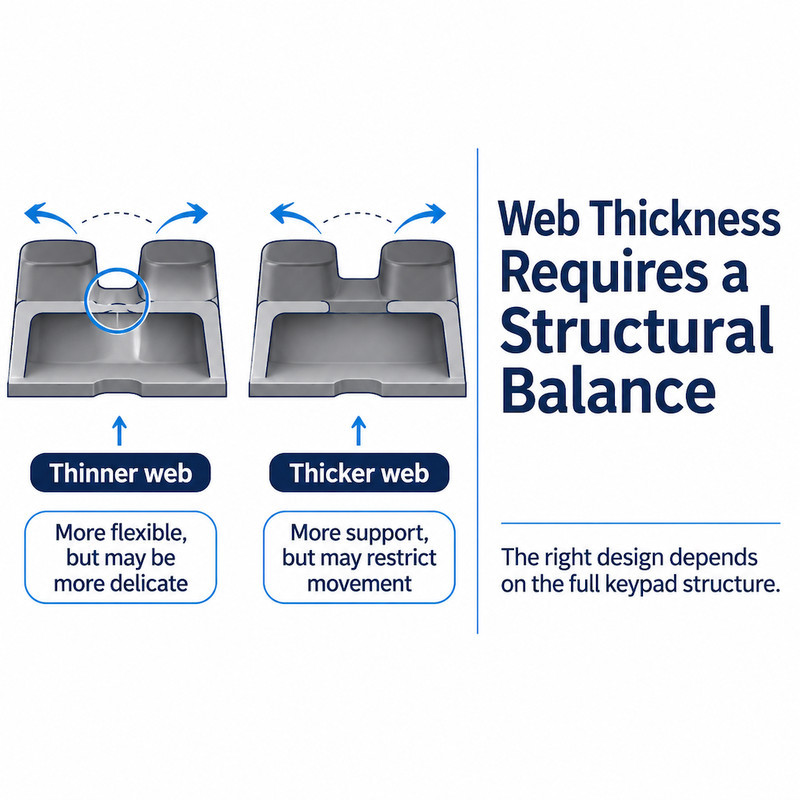
Thin webs also reduce the sealing function. If the keypad is the seal against the front panel, the web is part of that seal, and a web that deflects too far under pressure can lift at the edge. On an instrument that has to meet a defined ingress rating under IEC 60529, that matters as much as the feel.
The practical limit is not a single thickness but a ratio: the web should stay thick enough to fill and to survive the transition, and thin enough to isolate the keys. Ratios in the range of one third to one half of the button wall are a common starting point for a compact keypad, but the number has to be confirmed on a prototype because spacing changes the effective stiffness.
How Does Web Thickness Affect Independent Button Movement?
This is the property that users notice without being able to name. Press one key and watch the neighbouring key: if it dips, the web is transmitting load, and the user will feel a soft edge on every press. On a multimeter, where keys are pressed in sequence while the probes are held in place, that soft edge translates into a missed step or a double step.
Isolation is improved by three things: more spacing, a thicker web at the neck, and a local relief, such as a groove or a raised rib, that interrupts the load path between two buttons. Relief features cost mold time but they buy isolation without making the whole keypad stiff.
What Design Factors Should Be Considered When Setting Web Thickness?
How Do Button Spacing and Layout Affect Connecting Web Geometry?
Spacing sets how much material is available to ramp from the button body down to the web. With generous spacing, the ramp can be long and gentle, and the web can be thin without a stress riser. With tight spacing, the ramp is short, the transition angle is steep, and the same nominal thickness produces a much higher local stress.
This is why two keypads with identical web thickness can behave differently. The drawing dimension is the same; the transition geometry is not.
How Does Silicone Hardness Change Web Flexibility?
Hardness scales the web's stiffness in the same way it scales the wall's. A harder compound makes the same web stiffer, so a design that was tuned on a 50 Shore A compound will feel different on a 60 Shore A compound, even though nothing in the geometry changed.
The mistake to avoid is compensating for a stiff web by softening the compound. That lowers force everywhere, including the wall, and it can make the buttons slow to return.
How Do Button Height and Base Structure Influence Web Design?
A taller button puts more bending moment into the web when the key is pressed at an angle, so the web has to be either thicker or better relieved. A short button transmits less moment but gives less travel, and the web then has to be softer to keep the press light, which brings back the tear risk.
The base structure is the third element. If the keypad has a flat continuous backing, the web is supported and behaves predictably. If the backing is cut away under the button field, the web carries more of the load and the whole keypad becomes softer than the drawing suggests.
What Problems Can Incorrect Web Thickness Cause During Manufacturing?
Why Can Thin Web Areas Create Molding and Demolding Challenges?
Thin sections are hard to fill because the material cools as it travels. In a multi-cavity tool the last cavities to fill are the ones with the thinnest webs, and they show it as a short edge, a slight thickness difference or a visible flow mark. Demolding is the second problem: a thin web has low tear strength when it is still warm, so ejection has to be gentle and well supported, or the part is damaged before it is ever used.
Both problems get worse as the keypad gets larger, because the flow path to the far cavities gets longer while the web gets thinner.
How Can Poor Web Transitions Cause Uneven Deformation?
A sharp inside corner at the web-to-button junction concentrates strain. Under repeated pressing, that corner is where a crack starts, and the crack then propagates across the web. Even before it cracks, the corner creates a local stiff spot, so the button does not deflect evenly and the key feels tilted.
A radius of a few tenths of a millimetre at that junction removes most of the effect, and it is one of the cheapest changes available at the drawing stage. It is also one of the hardest changes to make after the cavity is cut, because it means re-machining the tool.
How Can Manufacturers Validate Silicone Keypad Web Thickness?
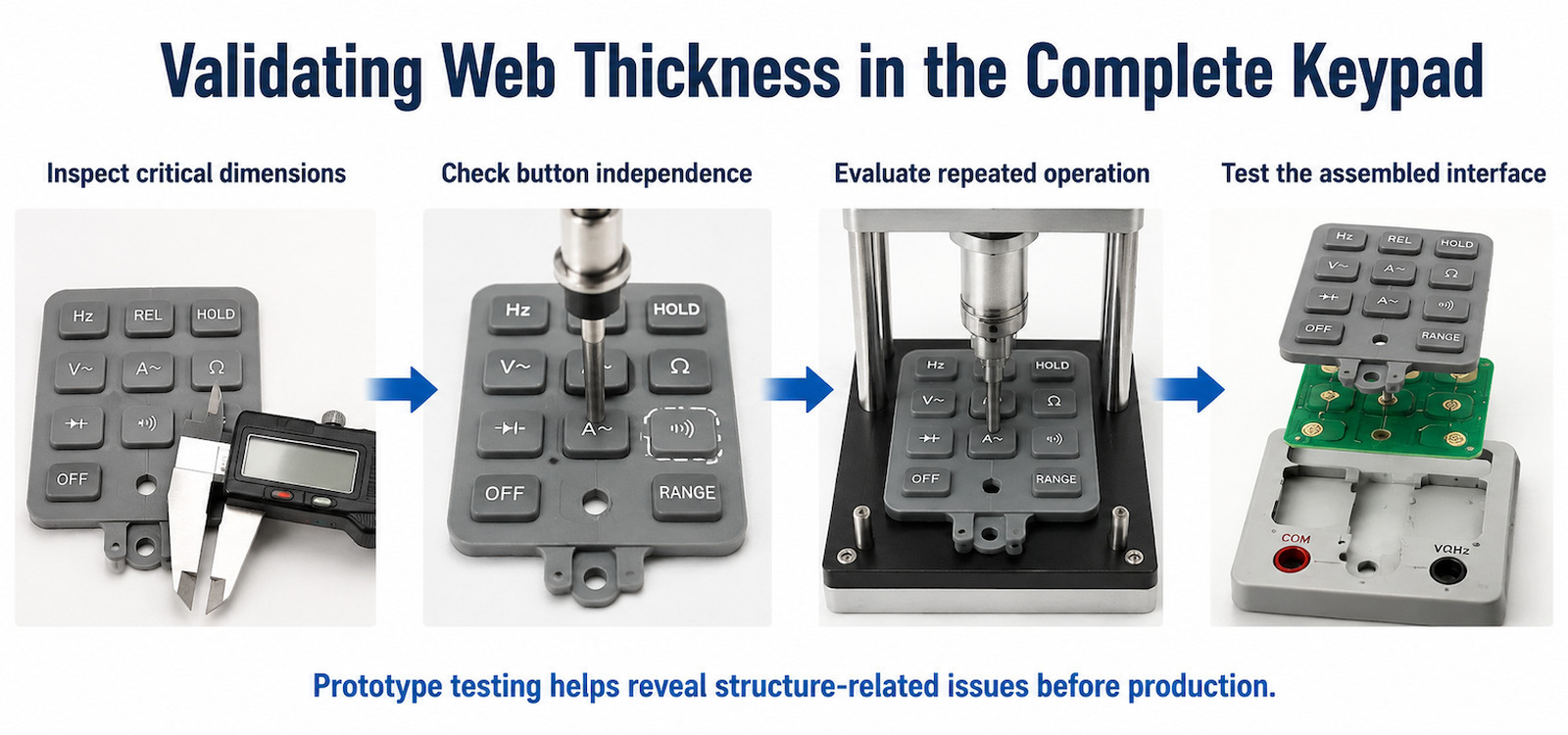
Validation has to look at the web as part of the assembly, not as a material sample. The measured thickness can be correct while the assembled behaviour is wrong, because the front panel and the PCB constrain the part.
Which Mechanical Tests Help Evaluate Web Performance?
Four tests cover the main risks. A dimensional check on the web at several positions across the keypad catches cavity variation. A neighbour-movement check, pressing one key and measuring the displacement of the adjacent key, quantifies isolation. A repeated-press run with periodic inspection catches the transition cracking. A tear or tensile check on a witness coupon from the same batch catches material problems that would not show up in a short functional test.
For instruments that are stored under load, a compression set check is worth adding, because a web that takes a permanent set will leave the whole keypad sitting slightly low.
Why Should Web Thickness Be Tested in the Complete Keypad Assembly?
Because the assembly changes the boundary conditions. The front panel clamps the keypad, the PCB sets the gap under the domes, and the housing may preload the edges. A web that is isolated on the bench can become coupled once the part is clamped.
This is the failure pattern behind keypads that work during bench testing and fail after assembly, which is described in this note on a controller keypad that works during testing but fails after assembly. The same mechanism applies to a multimeter.
What Should You Provide When Requesting a Custom Digital Multimeter Keypad?
Which Drawings and Specifications Help Manufacturers Evaluate Web Design?
The review is faster with six items: overall keypad dimensions, button spacing and height, the intended web thickness or the current sample, silicone hardness or durability target, PCB and switch interface drawings including pad size and travel, and the operating conditions, including cleaning and any ingress requirement.
If the project is a replacement for an existing keypad, a sample of the current part is more useful than a drawing, because the web can be measured and the feel can be compared.
How Can Custom Manufacturing Help Optimize Keypad Structure?
The useful contribution is a structural review before the cavity is cut: whether the intended web can be filled at the planned cavity count, where the transitions need radii, and whether local relief is needed to isolate adjacent keys. After tooling, the work shifts to dimensional consistency and to assembly-level validation.
FromRubber builds keypads and meter keypads in-house, with tooling, moulding and printing in the same plant, so a web change can be assessed against the existing cavity before a new tool is committed. The custom silicone rubber meter instrument keypad page shows the construction used for handheld instruments, and the design and technical support page covers the review sequence.
Where the problem is a key that sticks rather than a key that feels heavy, the starting point is different: button sticking in multimeter keypads comes from the interface between the button and the front panel as often as from the web.
Questions Buyers Ask About Keypad Webs
Can the web be thinned to make the keys lighter without changing the mold?
Only by removing material from an existing cavity, which is a tooling change with limited room. The web is usually already close to its minimum for the cavity spacing, so the realistic options are a new cavity insert or a change in compound.
Why do adjacent keys move when I press one?
Because the web is transmitting load. The fix is a combination of spacing, web thickness at the neck and local relief between the two keys. Increasing hardness alone will stiffen the whole keypad without fixing the coupling.
Is a thinner web always softer?
Softer in bending, yes, but not always in the press. A very thin web can bottom out against the PCB or the front panel, which makes the last part of the travel feel hard. The available gap under the web matters as much as the thickness.
What thickness should we specify?
Specify a ratio to the button wall and a tolerance, not a bare number, and state the isolation requirement as a measurable check on the prototype. The final value depends on spacing, hardness and the gap under the keypad.
The Number That Decides the Row
Web thickness is easy to treat as a drafting detail because it is small and because it never appears in a product photograph. In practice it is the dimension that decides whether a multimeter keypad feels like six separate keys or one soft sheet, and it is the dimension most likely to be inherited from a project where the buttons were further apart.
Setting it deliberately takes one extra review at the drawing stage and one prototype measurement. Leaving it to inheritance takes a tooling change and a field complaint.
Sources and notes. Ingress protection ratings are defined in IEC 60529:1989 with amendments 1:1999 and 2:2013. The stiffness relationships described here are standard mechanics of thin plates and are given as design guidance, not as measured data; the practical ratios must be confirmed on a prototype of the actual keypad. No external test reports are cited, because the relevant evidence is the assembled-part validation described above.
FromRubber, Dongguan Bohao Electronic Technology: custom silicone keypads for multimeters and handheld instruments. Send the keypad drawing with the web section marked and we will review the transitions and the cavity layout before tooling. WhatsApp and WeChat: +86 18676210913.
Published by the FromRubber keypad engineering team.