Why Are Some Silicone Quotations Fast And Some Slow?
Two buyers send the same request to the same factory and one gets a silicone quotation the same afternoon while the other waits three days. The difference is almost never the salesperson. It is how much of the part has already been decided.
A quote is a small engineering calculation wrapped in a price. This article shows what that calculation needs, which missing inputs stall it, and how to read two quotes that use different assumptions.
What a Silicone Quotation Actually Calculates
Underneath the price there are five calculations: part volume and weight, material grade and colour, mould cost and cavity count, cycle time and labour for secondary operations, and the yield assumption. Each depends on data the buyer holds.
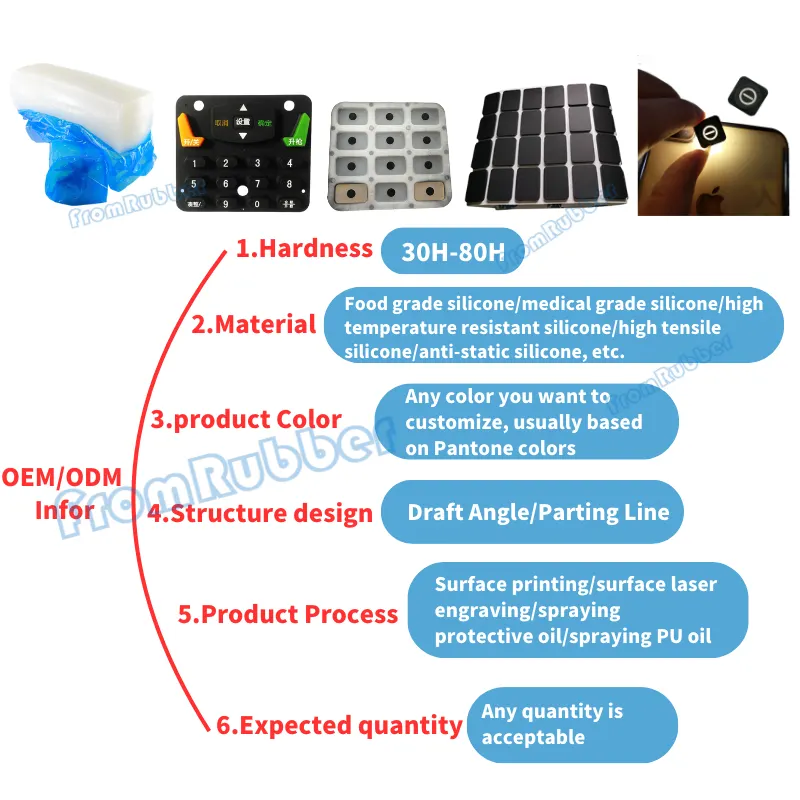
Part volume comes from a 3D model. Material comes from the application. Cavity count comes from the annual volume and the target unit price. Secondary operations come from the drawing: printing, coating, laser etching, deflashing, adhesive backing, assembly. Yield comes from experience with similar geometry, which is why the same drawing can be quoted differently by two factories with different equipment.
When any of those five is missing, the estimator has to assume, and a professional estimator would rather ask than assume. That question is what the buyer experiences as delay.
Why a Silicone Quotation Takes Three Hours or Three Days
| Input | Present | Missing |
|---|---|---|
| 3D model (STEP or IGES) | Volume and weight calculated directly | Estimator waits or estimates from photos |
| 2D drawing with tolerances | Mould and inspection scope clear | Tolerance assumptions become a risk margin |
| Material and hardness | Compound selected, price known | Quote carries a range or a placeholder |
| Colour and finish | Pigment and process costed | Colour quoted as an extra later |
| Annual volume and batch size | Cavity count optimised | Cavity count defaults to a safe low number |
| Secondary operations | All steps costed once | Quoted as options, so the total is unclear |
The inputs that make a silicone quotation fast
Fast quotes come from buyers who send a STEP file, a drawing with tolerances, a hardness and material, a colour reference, an annual volume and a list of secondary operations in one message. That package typically takes an estimator a couple of hours because nothing has to be asked twice. The same part without the drawing takes days, not because the work is harder but because the queue is now waiting on an email.
Practical tip: Send the application as well as the drawing. A seal for a static joint and a seal for a moving joint can share a drawing and need different compounds. That sentence takes ten seconds to write and usually prevents one round of re-quoting.
How to Compare Two Silicone Quotation Documents
Compare five lines, not one. Unit price at the stated volume, tooling cost and tool life, material grade actually quoted, secondary operations included, and the payment and packing terms. A quote that is ten percent cheaper on unit price but excludes deflashing or inspection is not cheaper.
Also compare the volume basis. A unit price quoted at 10,000 pieces and one quoted at 2,000 are not comparable, and a price that steps down steeply usually signals a high tooling charge recovered in the first band.
The most common hidden difference is material grade. Two factories can both quote a 60 Shore A silicone where one is a general-purpose compound and the other a high-tear or medical grade. Ask for the compound family in writing, then compare.
When a Silicone Quotation Looks Too Low
A quote that undercuts the market by a wide margin is usually one of four things: a lower-grade compound, a single-cavity tool that will not support the volume, secondary operations moved to the buyer, or a tolerance that will not be met in production.
None of these is necessarily dishonest, but all of them change the total cost. The check is to ask what the quote assumes: which compound, how many cavities, which operations, and what the first-article report will cover. A supplier who can answer those four questions in writing is quoting a real process.
Where the requirement is genuinely simple, a low quote is simply a low quote. The distinction is whether the assumptions are stated, which is also the fastest route to a useful answer on your next enquiry. Our project information checklist lists the data that shortens the loop.
What to send for a same-day silicone quotation
- STEP or IGES model, plus a 2D drawing with the tolerances that actually matter.
- Material family and hardness, or the application if the material is still open.
- Colour reference and surface finish, including any printing or laser etching.
- Annual volume, first order quantity and how the parts will be packed.
- Any assembly, adhesive backing or sub-component the part must accept.
Is a silicone quotation binding?
Tooling cost is usually firm once the drawing is frozen. Unit price is normally valid for a stated period and for a stated volume band, because compound prices and volumes move. Ask for the validity period explicitly.
Why does the same part cost more at a second factory?
Different cavity count, different press size, different secondary operation scope, or a different compound family. Two quotes are only comparable when those four are the same.
A fast silicone quotation is not a favour, it is a consequence of a complete request. Send the model, the drawing with tolerances, the material and hardness, the colour, the volume and the secondary operations, then ask each supplier which compound, cavity count and operations their price assumes. The comparison becomes arithmetic instead of opinion.