Top 5 Injection Molding Defects in Mouse Enclosure Manufacturing (And How to Fix Them)
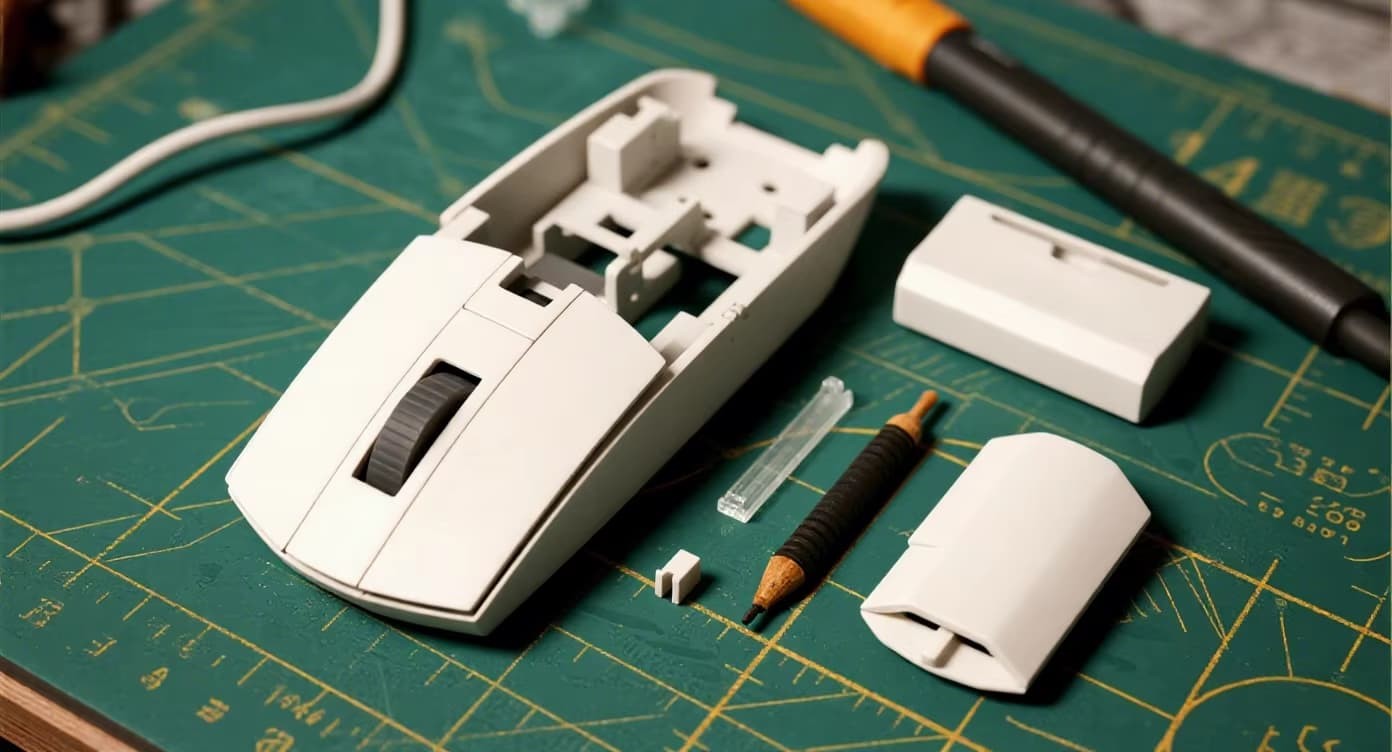
Even the most experienced manufacturers encounter molding defects when producing complex mouse enclosures — from gaming mice with thin walls to ergonomic office mice with intricate button cutouts. At FromRubber, we've analyzed thousands of rejected parts to identify the top 5 defects and, more importantly, how to fix them permanently. This guide covers root causes and actionable solutions backed by real case studies.
Mouse Enclosure : Sink Marks (Denting on Thick Zones)
Appearance: Small depressions or dimples on the external glossy surface, usually above internal ribs, screw bosses, or button support posts.
Root Cause: Uneven wall thickness where thicker sections (e.g., 2.5mm boss) shrink more than the nominal 1.2mm wall, creating surface sinks during cooling.
FromRubber Fixes:
- Redesign rib thickness ≤60% of nominal wall (e.g., 0.7mm rib on 1.2mm wall).
- Use gas-assisted injection or core-back to create hollow bosses.
- Optimize packing pressure & time: increase holding pressure to 80-90% of injection pressure for 3-5 seconds longer.
- Mold texture (VDI 12-18) on the inner side reduces visible sink marks.
✅ Real result: A gaming mouse with deep side buttons – after rib thinning and extended pack time, sink mark rejection rate dropped from 18% to 0.5%.
Mouse Enclosure : Weld / Knit Lines (Visible Line on Surface)
Appearance: A thin line, often V-shaped or discolored, where two melt fronts meet — commonly around scroll wheel openings or side button cutouts.
Root Cause: Melt fronts cool down before merging, resulting in incomplete molecular entanglement; intensified on high-gloss surfaces.
FromRubber Fixes:
- Move gate location – fan gate or sequential valve gate to eliminate merging.
- Increase melt temperature (260-280°C for PC/ABS) and mold temperature (80-100°C).
- Adopt variotherm (dynamic mold heating) – eliminates weld lines completely.
- Use high-flow resin grades (MFR > 25 g/10min).
✅ Real result: For a glossy black esports mouse, variotherm reduced weld line visibility to zero; SPI-A1 finish passed without rework.
Mouse Enclosure : Short Shots (Incomplete Filling)
Appearance: Missing material at the end of the cavity — typically at the far edge of the mouse bottom shell or thin front lip.
Root Cause: Insufficient injection pressure, low melt temperature, poor venting, or too-small gate.
FromRubber Fixes:
- Increase injection pressure & speed gradually (Moldflow simulation sets optimal).
- Add additional venting (0.02-0.03mm depth) near last-fill areas.
- Enlarge gate or runner diameter by 15-20% for better flow.
- Check machine shot capacity – use larger barrel if needed.
✅ Real result: An ultra-thin battery cover (0.9mm wall) was short-shot at 45% – after venting and raising melt temp by 18°C, fill completed in 97% of cycles.
Mouse Enclosure : Warpage / Dimensional Distortion
Appearance: Bowed, twisted or uneven mouse shells causing poor assembly fit (top and bottom cover gap).
Root Cause: Non-uniform shrinkage due to anisotropic material behavior, unbalanced cooling, or improper gate location.
FromRubber Fixes:
- Design uniform wall thickness (±0.1mm variation).
- Add conformal cooling channels (3D-printed inserts) for even heat dissipation.
- Reduce holding pressure and adjust cooling time (increase by 20-30%).
- Use glass-filled grades only in low-warp formulations – or core-unfilled polymer for cosmetic parts.
✅ Real result: A wireless charging mouse bottom plate had 0.8mm bowing; after conformal cooling redesign, warpage reduced to 0.12mm — well within tolerance.
Mouse Enclosure : Flow Marks & Surface Streaks
Appearance: Wavy patterns, cloudiness, or halo-like rings near the gate or along flow path on glossy mouse top shell.
Root Cause: Inconsistent melt front velocity (hesitation or jetting), low mold temp, or degraded material.
FromRubber Fixes:
- Use progressive injection velocity profile (fast fill initial, then slow to avoid jetting).
- Raise mold surface temperature to 65-85°C for ABS/PC resins.
- Enlarge gate land length and change to pin-point or submarine gate.
- Dry resin thoroughly (moisture < 0.02%) to eliminate splay marks.
✅ Real result: A pearlescent white mouse exhibited severe flow marks until we installed a hot runner with optimized velocity profile. 100% defect-free since change.
📊 Quick reference: defect vs. solution matrix
| Defect | Most effective fix | Timeline to solve |
|---|---|---|
| Sink marks | Rib thickness ≤60% wall + extended packing | 3-5 days (mold mod) |
| Weld lines | Gate relocation / variotherm | 2-4 weeks (hot runner) |
| Short shots | Venting + higher injection speed | 1-2 days |
| Warpage | Conformal cooling & uniform wall | 2-3 weeks |
| Flow marks | Velocity profile + higher mold temp | Same-day process adjustment |
FromRubber — Your mouse enclosure defect-killing partners
We provide DFM reports with defect risk analysis before steel cutting. With 14 injection presses (40-550T), in-house mold trial lab, and CMM inspection, we guarantee ≤1% defect rate for high-gloss and textured mouse shells. From prototype to million-unit production — every defect is engineered away.
FromRubber ISO 9001:2025 certified — Custom injection molds for gaming peripherals, medical enclosures, and consumer electronics.