Top 10 Silicone Pet Bowl Manufacturers for Custom Shapes and Private Label Brands
A bowl looks like the simplest silicone product in the catalogue. It is also the item most likely to come back from a mould shop with a polite note: the shape you drew cannot be demoulded, the rim will fold under load, or the base will rock on a tile floor. Custom silicone pet bowls fail on structure long before they fail on colour.
This comparison of silicone pet bowl manufacturers is for brands and product developers who want a bowl that is genuinely theirs — a different outline, wall section, rim, base or feeding pattern — not a stock bowl with a printed logo. The ten manufacturers below publish bowl-related silicone production or custom bowl services. Each entry separates what the company documents from what a buyer still has to confirm, because in this category the gap between a product photo and a production drawing is where most projects lose money.
Why a Logo on a Stock Bowl Is Not Product Development
Printing a logo changes the surface. It does not change the object. A buyer who wants shelf differentiation is usually asking for one of four deeper changes, and each carries a different tooling consequence.
Outline and footprint
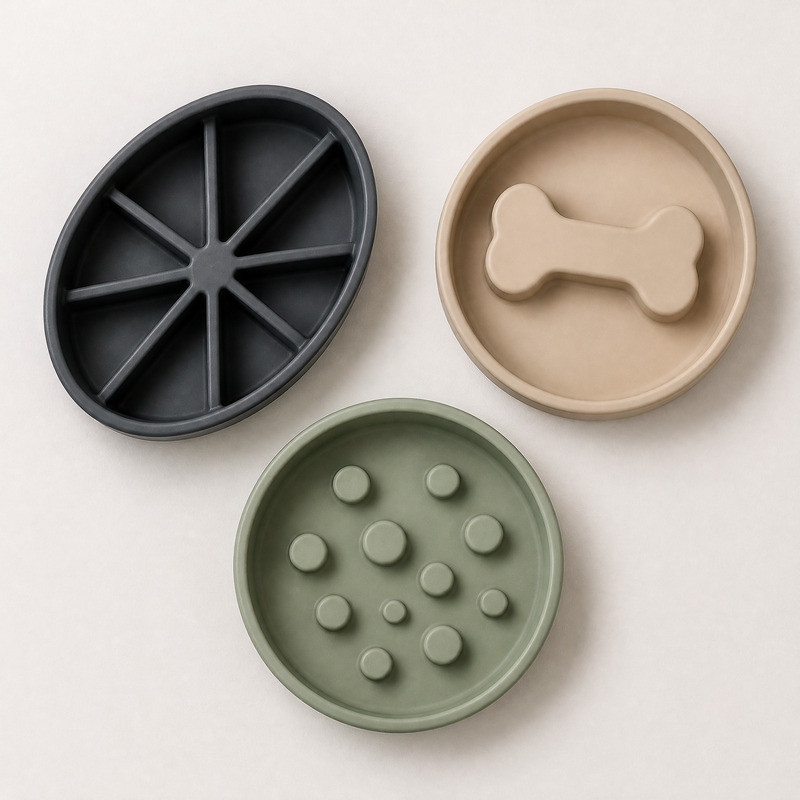
A bone, paw or asymmetric outline needs a new cavity and often a new parting line. Corners tighter than the material can flow will thin the wall at the radius, which then tears in use.
Wall and rim section
The rim is the stiffest part of a bowl and the first place a mould reveals its quality. A thick rim with a thin wall creates a stress line; a uniformly thin wall feels flimsy and may not hold shape when lifted with food inside.
Base geometry
A bowl tips when the centre of mass moves outside the base footprint. A narrow base with a tall wall looks elegant and behaves badly. Wide bases resist tipping but consume shelf space and material.
Feeding pattern
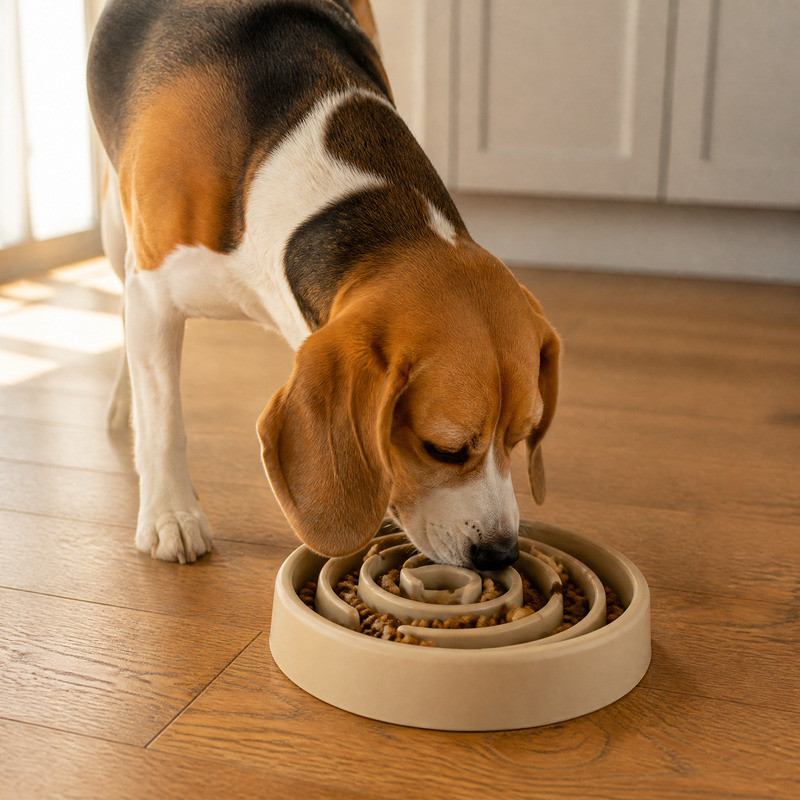
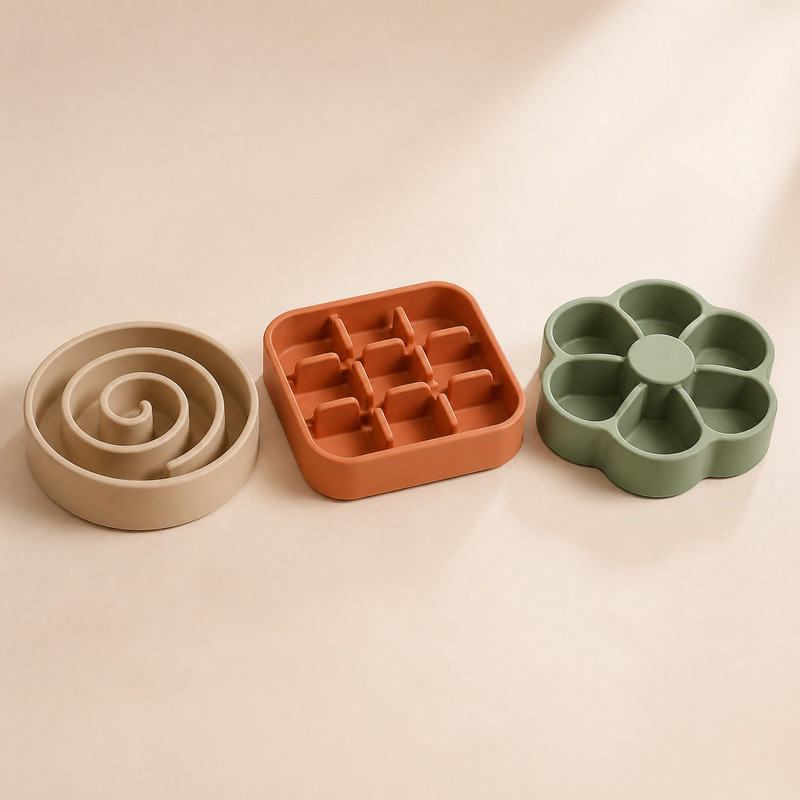
Maze ridges, dividers and pockets are functional geometry. They add surface area, slow the animal down, and create cleaning corners that a sponge cannot reach if the internal radii are too tight.
What a Bowl Manufacturer Can Actually Customise
Shape and dimensions
Round, oval, rectangular and organically shaped bowls are all feasible within limits set by draw ratio and wall thickness. The correct starting point is a section drawing, not a mood board. Capacity should be specified as usable volume at a defined fill line, because nominal volume and usable volume diverge once the rim and maze are added.
Collapsible and travel structures
A collapsible bowl is a stack of controlled folds. The wall must be thin enough to fold and thick enough not to crease permanently. The base ring and the rim ring usually need a different hardness from the folding wall, which means either dual-material moulding or a carefully designed single compound with variable section thickness.
Logo and colour
Embossed, debossed and printed logos behave differently. A debossed logo below the food line collects residue. An embossed logo on the inside of a bowl interferes with licking. The safe zone is usually the outer wall or the base underside, and the depth should be tied to the wall thickness rather than chosen aesthetically.
Private-label packaging
Sleeve, colour box, header card, barcode area and carton configuration are usually decided after the tool, which is backwards. Packaging affects stacking, drop performance and the retail price the bowl can carry. Decide it before the drawing is frozen.
Ranking Method
The weighting is product-specific. A broad pet catalogue earns nothing if the company cannot show bowl work.
- Direct silicone pet bowl evidence — 30%. Bowls, slow feeders or feeding bowls currently published.
- Custom shape and structure support — 25%. Non-standard geometry, wall or base customisation.
- Private label, logo and colour — 20%. Branding and packaging options.
- Tooling and sampling evidence — 15%. Mould development, prototype and approval steps.
- B2B order and documentation — 10%. MOQ, export support, material references.
Each criterion is scored 0–5 and weighted. Public pages were reviewed on 20 October 2026. Where a bowl is implied by a category page but not shown as a product, it is marked as unverified rather than counted as bowl evidence.
Comparison Table: Silicone Pet Bowl Manufacturers and Customisation
| Company | Documented bowl range | Custom shape | Logo / colour | Tooling evidence | Score |
|---|---|---|---|---|---|
| JOYI Silicone | Slow feeder bowls, lick bowls, pet bowls | Shape and feeding pattern | Emboss, print, engraved; Pantone | Mould making, 7-step sampling | 4.35 |
| Xiamen Guzhan | Custom silicone pet bowl, 200–1200 ml | Shape, size, non-slip base | Print, deboss, emboss; Pantone | Tooling and 7–10 day sampling stated | 4.10 |
| Guangdong Yumingsheng (YMS) | Feeding bowls, slow feeder mats, travel bowls | Structural design and CMF | Colour, logo, packaging | In-house tooling, prototyping | 4.00 |
| Pawseed Pet Products | Suction bowl, lick-and-feed bowl, slow feeder | Shape and suction base | Logo printing, Pantone | Mould opening and sampling | 3.95 |
| FromRubber | Custom moulded silicone; pet bowl work described in articles | Geometry, wall, multi-colour | Moulded logo, printing, laser | In-house mould shop, 32 presses | 3.70 |
| NEWTOP Custom Silicone | Lick bowl, foldable bowl, feeding bowls | Moulded customisation | Logo and colour support | Prototyping and testing stated | 3.60 |
| SM (Dongguan Sanmao) | Collapsible bowls, feeding mats | Open/collapsed profile, wall geometry | Colour and marking | Tooling and moulding in one base | 3.55 |
| Dongguan Yuankang | Collapsible bowl, slow feeder bowl | Shape and logo | Pantone, engraved or printed | Mould development, prototyping | 3.45 |
| ZXRubberPlastic | Slow feeder, travel bowls listed | Size and pattern | Logo, colour, packaging | Sample- and drawing-based OEM stated | 3.10 |
| Naike Silicone | Silicone dog bowl, cat bowl, slow feeder bowl | Footprint, edge profile | Moulded branding, Pantone | DFM and sample plan published | 3.05 |
Where a category page lists a bowl but does not show a product page, the entry is scored on the category statement only and flagged for confirmation.
Five Decisions That Determine Whether the Bowl Works
1. Stability under load
Test the bowl on the surface it will meet: tile, laminate, carpet, crate tray. A silicone base grips smooth surfaces through friction and conformity; on carpet it does nothing. Suction cups help on non-porous surfaces and fail on textured ones. Neither is universal.
2. Wall thickness versus flexibility
Thin walls fold and travel well but transmit force to the rim, which can crease. Thick walls hold shape but feel rigid and cost more material. The practical answer is often a variable section: thicker base and rim, thinner wall.
3. Capacity and fill line
Usable volume shrinks when a maze is added. Specify the volume at the fill line and the freeboard above it. A bowl that holds 400 ml to the brim may hold 300 ml before spilling during eating.
4. Logo position and depth
Depth should be a fraction of wall thickness, not an absolute number copied from another project. A logo on the outer wall survives cleaning better than one inside the food zone.
5. Cleaning geometry
Internal radii, draft on maze walls, and the gap between dividers decide whether the bowl can be cleaned by hand. Tight corners are a customer complaint waiting to happen.
The Ten Manufacturers, Reviewed
1. JOYI Silicone (Dongguan Joyi New Material)
Publishes a dedicated slow feeder and lick bowl range alongside a lick mat OEM programme, with shape, texture, size, colour and logo listed as customisable. The documented process runs from requirement discussion through 3D drawing, mould making, sampling, production and trimming. Mould making is quoted at roughly 15 working days, production 10–25 days.
Bowl fit: slow feeders and lick bowls with a defined retail channel.
Confirm: whether bowl moulds are cut in-house, MOQ for a new outline, and the cleaning validation method.
2. Xiamen Guzhan Industry & Trade
Publishes an explicit custom silicone pet bowl page with 200–1200 ml capacity options, Pantone colour matching, and print, deboss or emboss logos. Stated terms include 1,000-piece MOQ for printing, 7–10 day samples and 20–25 day lead time. The company describes itself as industry and trade, so the manufacturing role needs confirmation.
Bowl fit: straightforward custom bowls where size range and logo options matter more than complex geometry.
Confirm: whether moulding is in-house or placed with a partner factory, and the mould ownership terms.
3. Guangdong Yumingsheng Precision Manufacturing (YMS)
Combines solid silicone compression and liquid silicone injection with in-house design, tooling and prototyping. Its pet portfolio includes feeding bowls, slow feeder mats and travel items, and the site describes structural engineering and CMF work before tooling. Capacity and certification figures are company-reported.
Bowl fit: bowls that need a structural redesign or a mixed silicone-plastic construction.
Confirm: specific bowl tooling record and the actual MOQ for a new shape.
4. Pawseed Pet Products Co., Limited
Lists several bowl formats, including a C-shape bowl with a strong suction cup, a round lick-and-feed slow feeder and a two-mode lick bowl. The site states OEM/ODM with prototype development, mould opening and packaging customisation, from a Dongguan address.
Bowl fit: suction-stabilised bowls and combined lick-and-feed formats.
Confirm: which bowl moulds are owned, and the suction performance test method on the intended surface.
5. FromRubber (Dongguan Bohao Electronic Technology)
A custom silicone and plastic manufacturer in Dongguan with an in-house mould shop, 32 presses across two plants, and documented work in multi-colour moulding, printing and laser engraving. Bowl-specific content appears in its pet articles, including a slow feeder bowl branding guide; a public bowl catalogue is not published, so the bowl evidence is partial. Its pet supplies page describes the market rather than a bowl range.
The company states that pet silicone orders can start at 1,000 pieces and scale to bulk, using smaller presses for compact or low-volume parts and larger presses for large or high-volume parts. For a brand testing one bowl shape before committing to a range, that press mix is often the difference between a viable first order and an uneconomic one.
Bowl fit: bowls where the tool is the risk — deep draws, thick-to-thin transitions, multi-colour rims, moulded logos.
Confirm: current bowl tooling experience and the dimensional report format.
6. NEWTOP Custom Silicone
Lists a lick bowl, a foldable bowl and feeding bowls among a broad pet range, with OEM/ODM and prototyping stated. The site does not publish a factory address, so the manufacturing location is unconfirmed and the company appears here on product relevance only.
Bowl fit: foldable travel formats and lick bowls within a multi-SKU order.
Confirm: factory location, which bowl moulds exist, and how a custom outline would be quoted.
7. SM (Dongguan Sanmao Electronic Technology)
Approaches pet products as component projects, and its collapsible bowl page asks buyers to define diameter, open and collapsed profile, wall geometry, rim and hanging feature before tooling. That is the correct order of decisions for a folding bowl. The company operates from Chang'an Town, Dongguan.
Bowl fit: collapsible bowls and bowls that are part of a multi-part assembly.
Confirm: bowl production history and which secondary processes stay in-house.
8. Dongguan Yuankang (Dongguan City Yuankang Silicon Metal Products)
Publishes a pet range that includes a collapsible bowl and a slow feeder bowl, with custom mould development, logo engraving or printing, Pantone matching and private-label packaging. The company states more than 17 years in silicone manufacturing and references ISO 9001, BSCI and Sedex.
Bowl fit: a bowl plus mat plus accessory programme from one supplier.
Confirm: certification scope for the bowl compound and current tooling availability.
9. ZXRubberPlastic
Lists silicone slow feeder bowls and portable travel bowls with custom logo, size, texture and packaging options, and states OEM/ODM support from samples, drawings or product ideas. The company describes 40+ years of experience and a rubber, silicone and plastic scope. Location and plant details were not verifiable from the pages reviewed.
Bowl fit: travel and slow feeder formats at catalogue level.
Confirm: manufacturing site, bowl-specific tooling, and MOQ.
10. Naike Silicone
Publishes a structured lick mat programme and related feeding products, including silicone dog bowl, cat bowl and slow feeder bowl pages. Its specification language is unusually precise — footprint, corner radius, perimeter height, usable spread area — which suits buyers who want a documented approval chain. The company is based in Quanzhou, Fujian.
Bowl fit: bowls developed alongside a mat programme with shared colour and packaging.
Confirm: bowl-specific tooling and production scale; terms are quoted per project.
Bowl Problems to Resolve Before Production
- The sample is rounder than the drawing. Shrink compensation was estimated, not calculated. Ask for a T1 dimensional report.
- The bowl is too flexible. Wall thickness was reduced to save material without recalculating rim stiffness. Test with food load, not empty.
- The base slides. Friction depends on surface and contact area. A suction base is not a universal fix.
- The rim deforms in the dishwasher. Compound, cure and wall section interact. Confirm the intended temperature range and test it.
- The logo loses detail. Feature depth fell below what the compound can fill. Simplify before cutting steel.
- Colour differs from the reference. Pigment lot and cure temperature shift shade. Set a tolerance and a light source.
- The carton does not fit. Packaging was designed from a nominal dimension, not the measured part.
- The reorder differs. No golden sample was retained. Keep one signed sample with both parties.
For the drawing stage, FromRubber's guide to reading a silicone product drawing and its explanation of cavity count versus cost apply directly to bowl tooling decisions.
What to Put in a Custom Bowl RFQ
- A section drawing or a reference sample, plus the target outline.
- Target animal, size range and intended feeding scenario.
- Outer dimensions, usable volume and fill line.
- Wall thickness range and rim geometry.
- Base type: flat, textured, suction, or separate ring.
- Logo artwork, position and preferred process.
- Colour reference and acceptable tolerance.
- Material requirement and destination market documentation.
- Packaging format, carton configuration and barcode placement.
- First order quantity, annual forecast and target launch date.
Frequently Asked Questions
Can silicone pet bowls be made in custom shapes?
Yes, within moulding limits. Draw ratio, wall thickness, corner radius and demoulding direction decide what is feasible. A shape that is too deep relative to its opening will need a different parting line or a softer compound.
Can a manufacturer develop a new bowl mould?
Most of the companies above state mould development. Ask whether the tool is cut in-house, who owns it, and whether a prototype tool can be modified into the production tool.
What affects the MOQ for custom silicone pet bowls?
Cavity count, tool size, colour changes, packaging and whether a mould already exists. A single-cavity tool on a small press supports lower volumes; a multi-cavity tool needs a larger order to be economic.
Can silicone dog bowls use embossed or debossed logos?
Yes. The depth must be tied to wall thickness, and the position should avoid the food contact zone. Printed logos are an alternative where multicolour artwork is required.
What should buyers check before ordering private-label bowls?
The golden sample, colour tolerance, logo depth, packaging artwork, barcode placement, carton drop performance and the reorder specification. All should be approved before mass production starts.
How can buyers verify the silicone material and product documentation?
Request the compound data sheet, hardness, and the test relevant to the market. For the United States, 21 CFR 177.2600 covers rubber articles for repeated use; in the EU, Regulation (EC) No 1935/2004 sets the framework; in Germany, the LFGB applies.
What information is needed for a custom bowl quotation?
Drawing or sample, dimensions, volume, wall and base requirements, logo, colour, material, packaging, quantity and target date. Without the first four, any quotation is an estimate.
The Bowl Is a Structure Before It Is a Brand Asset
Choose the manufacturer whose evidence matches the hardest part of your design. If the difficulty is the maze, look for cleaning geometry experience. If it is the fold, look for collapsible bowl tooling. If it is the rim and logo, look for mould depth control. The company with the widest catalogue is rarely the right answer to a specific structural problem.
FromRubber develops custom silicone and plastic parts in Dongguan, including mould design, sampling and production at both small-batch and bulk scale. Buyers can send a bowl drawing, sample or concept to nani@fromrubber.com or karl@fromrubber.com for a feasibility review. WeChat and WhatsApp: +86 18676210913.
Sources and Research Notes
- Manufacturer product and process pages cited inline, reviewed 20 October 2026.
- 21 CFR 177.2600 — Rubber articles intended for repeated use.
- Regulation (EC) No 1935/2004 on materials and articles intended to come into contact with food.
- Lebensmittel- und Futtermittelgesetzbuch (LFGB).
- FromRubber references: drawing guide, cavity count and cost, slow feeder bowl branding.
Scores reflect published evidence only and do not represent audited capability or pricing.