Tactile Hardening in Drone Remote Silicone Keypads After UV Aging: Long-Term Effects of Weather-Resistant Formulation on Crosslink Density and Rebound
The controller passes the indoor bench test at day one and the UV test at day 500, and then two things diverge. The Shore hardness has moved by a couple of points, which looks acceptable on the report, but the pilot says the return-to-centre key now feels dead. Hardness and feel are not the same measurement, and on an outdoor remote the difference is what generates the complaint.
Why UV Exposure Matters for Drone Remote Silicone Keypads
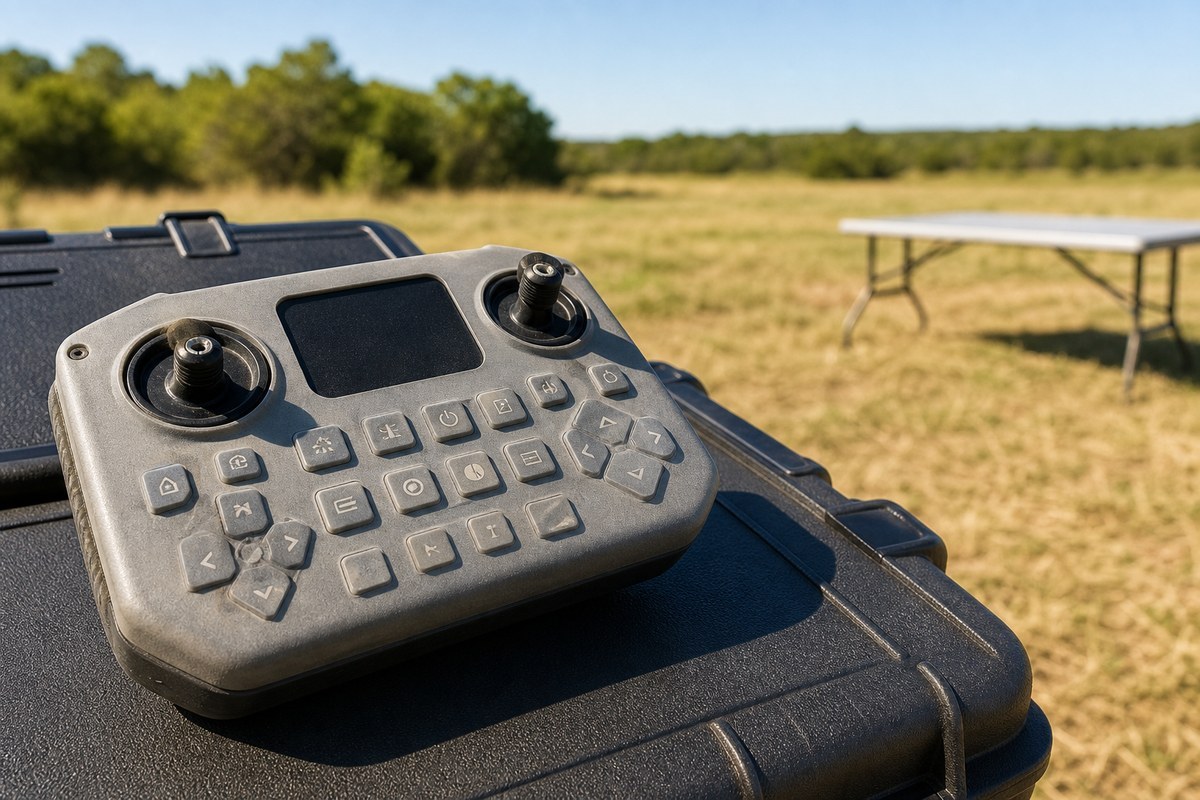
A drone remote is unusual among controllers because its keypad is genuinely an outdoor component. It is used in direct sun, stored in a case that can reach a high internal temperature, and exposed to the full seasonal range without the protection of a housing or an interior temperature. The relevant stressors are ultraviolet radiation, elevated surface temperature, and repeated wetting and drying from humid air, sweat and rain.
What makes the combination difficult is that these stressors interact. Surface temperature accelerates every photochemical process, moisture changes what happens at the surface, and the repeated heating and cooling cycle progressively works any low-molecular-weight material toward the surface. A dry UV test at a controlled temperature will not reproduce the same result as an outdoor cycle at the same radiant dose.
It is also worth being precise about the dose. "Outdoor use" covers a wide range, and a controller used in Northern Europe for a season has seen a fundamentally different exposure from one left on a dashboard in the tropics. Validation conditions should follow the intended market, not a generic assumption.
Sun on a keypad is a surface problem
Ultraviolet radiation is absorbed within a very shallow depth of the material. That is why UV aging on a silicone keypad shows up as a change in the outermost layer long before it becomes a bulk property change, and why surface appearance and surface feel degrade ahead of any number the datasheet tracks.
What Tactile Hardening Means in a Silicone Keypad
Tactile hardening is a description of what the user perceives, and it is assembled from several measurable quantities:
- Increased perceived hardness, which is the sensation at the fingertip
- Increased actuation force, the force needed to reach the switching point
- Reduced rebound, where the key returns more slowly or with less energy
- Slower recovery, so a key pressed repeatedly does not fully reset between presses
- Changed tactile feedback, including a less defined collapse point
The reason this matters is that Shore hardness and perceived tactile hardness are related but not identical. Shore hardness measures resistance to indentation on a flat specimen with a defined presser foot. The tactile feel of a key is dominated by the bending stiffness of the web, the geometry of the dome, the compression ratio at travel end, and the rebound of the material. A keypad can show a modest hardness increase and a large perceived change, because the geometry amplifies the material change.
How UV Aging Can Change Silicone Keypad Properties
UV Exposure and Polymer Network Changes
Ultraviolet radiation carries enough energy to break chemical bonds. In a silicone network, the practical consequences are a combination of additional crosslinking at some sites, chain scission at others, and oxidation of organic substituents on the polymer backbone. Which dominates depends on formulation, on the presence of stabilisers, and on temperature and moisture.
The result at the surface can be an embrittled layer that behaves differently from the bulk, while the bulk remains comparatively unchanged. That surface layer is where tactile change usually begins.
Crosslink Density and Mechanical Response
Crosslink density controls the mechanical response of the network, so any change in it shows up across several properties at once: hardness, elasticity, rebound, elongation and compression behaviour. Additional crosslinking generally raises hardness and reduces elongation and rebound. Scission generally softens the material but can also raise compression set, because a broken network does not recover elastically.
Why UV Resistance Is a Formulation Issue
Outdoor durability is a formulation outcome, not a single additive. It depends on the base polymer, the choice and loading of fillers, the cure system, the stabiliser package, the geometry of the part, the surface condition, and the exposure conditions. A stabiliser can meaningfully extend service life, but its effect cannot be separated from those other variables when predicting a specific product's lifetime.
Why Weather-Resistant Formulation Can Change Tactile Feel
There is a real tension between outdoor durability and tactile quality, and it deserves to be stated plainly. Improving UV resistance usually means changing the additive package and sometimes the filler system. Those changes affect hardness, elasticity, rebound, surface durability and colour stability, and some of them shift the feel in ways a user notices on the first press.
The trap is assuming a simple causal chain, where adding a UV stabiliser automatically hardens the keypad. That is not how it works. The honest formulation position is that weather resistance and tactile feel have to be optimised together, on the finished geometry, rather than treating the stabiliser as a drop-in addition that leaves everything else untouched.
How Silicone Keypad Geometry Influences Tactile Hardening
Two keypads made from the same batch of the same formulation can feel completely different after aging, purely because of geometry. The parameters that matter are button diameter, wall thickness, dome geometry, travel, compression ratio, the stiffness of the supporting web, and the design of the return structure.
Wall thickness is the most commonly underestimated. A slightly thicker wall raises the bending stiffness of the whole key, so the same material change produces a larger force increase. Compression ratio compounds it: a key that is already close to its compression limit at full travel has no further compliance to give once the material stiffens, so the perceived change is discontinuous.
A single key tells you more than a panel
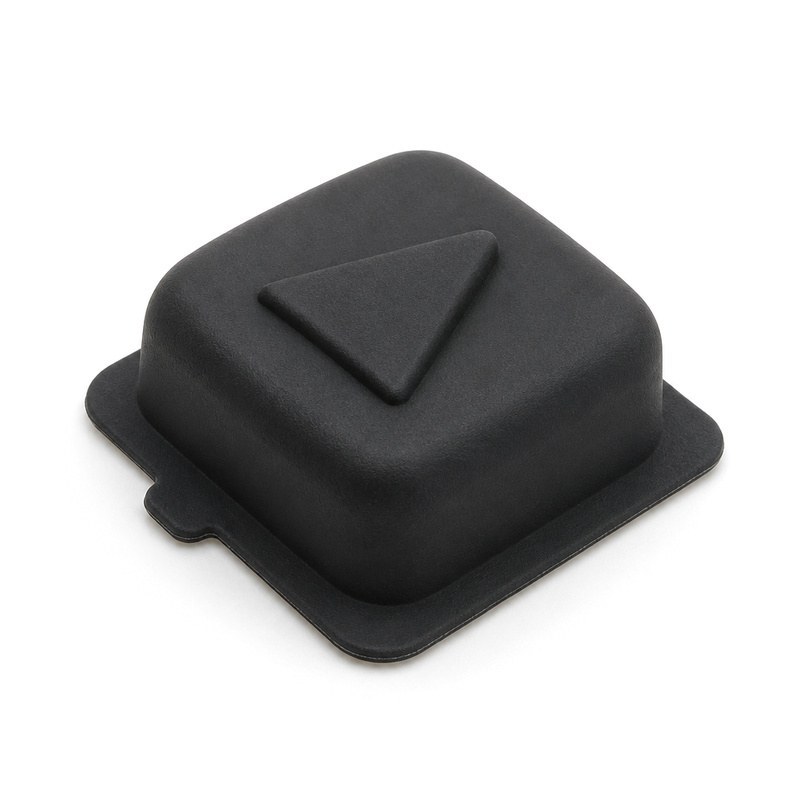
Where a keypad uses one key form repeatedly, its behaviour after aging is easier to read than on a mixed panel. A single moulded key with a defined flange shows the interaction between the material change and the geometry most clearly, because there are no neighbouring keys to mask the force change.
How to Test Drone Remote Silicone Keypads After UV Aging
Establish an Initial Mechanical Baseline
Measure hardness, actuation force, travel, rebound and appearance before exposure, on the finished keys. Retain at least one unaged sample in the dark as a reference, because comparison against a stored reference is more reliable than comparison against a remembered number.
Define the UV Exposure
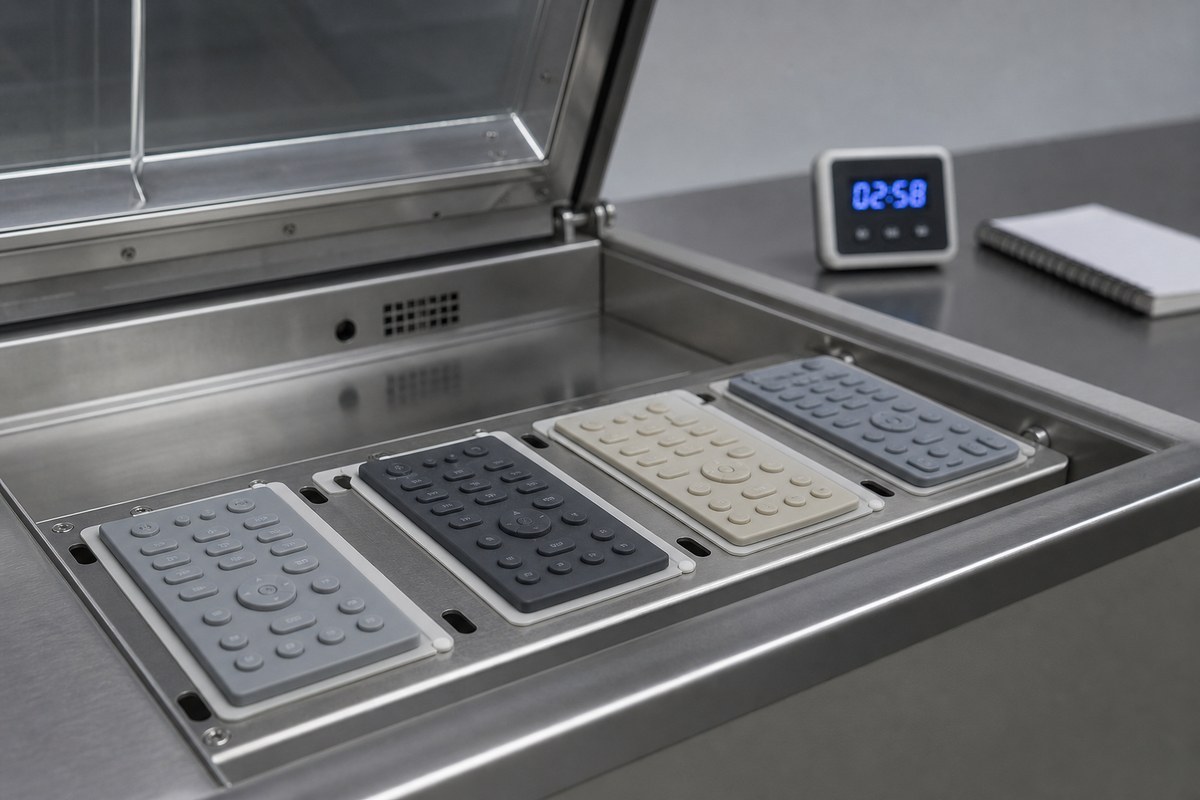
Exposure intensity, chamber temperature, duration and the test cycle all need to be stated. ISO 4892-2:2013 describes methods for exposing specimens to xenon-arc light in the presence of moisture to reproduce weathering effects, which is the usual starting point for a laboratory weathering specification. A single universal exposure cannot be prescribed, because the relevant condition depends on the intended market and use.
Compare the Right Measurements After Aging
Compare hardness change, actuation force, rebound time, the tactile force curve, surface appearance, cracking and colour change. The force-displacement curve is the most informative single output, because it captures the effect of both material stiffening and geometry in one trace.
| Measurement | What it shows | Why it is needed |
|---|---|---|
| Shore hardness | Material-level hardness change | Separates material drift from geometry effects |
| Actuation force | Force to reach the switching point | Directly relates to the user's complaint |
| Travel | Mechanical movement available | Confirms the compression window is intact |
| Rebound | Return performance | Explains slow or incomplete reset |
| Force-displacement curve | Overall tactile behaviour | Shows where in the stroke the change occurred |
How to Balance UV Resistance With Tactile Performance
Balancing the two is a sequence rather than a single decision. It starts with base polymer selection for the exposure environment, then a weather-resistant formulation developed with the target hardness, then a crosslinking balance that preserves rebound, then geometry optimisation to remove the amplification, then surface treatment if appearance matters, and finally accelerated aging validation on the finished part.
The target should be stated as stable tactile performance after aging, not as maximum UV resistance. A keypad that survives the exposure and feels wrong is a failed validation, even if the hardness number passed.
Keypads for outdoor controllers follow the same custom silicone rubber keypad route as indoor ones; the difference sits in the formulation and in the validation plan. The exposure and interface inputs we ask for before quoting are listed under technical support.
Common Reasons a Drone Remote Silicone Keypad Feels Harder After Aging
The list below is ordered roughly by how often each appears when we are asked to investigate a field complaint:
- Material aging, particularly additional crosslinking near the surface
- Crosslink or network changes that reduce rebound before they change hardness
- Surface degradation producing an embrittled outer layer
- Excessive thermal exposure, especially storage in a closed case in the sun
- Geometry-related force increase, where a thick wall amplifies a small material change
- Compression set from keys held at high compression in storage or transport
- Changes in a coating or surface treatment that alter the surface feel
- Environmental contamination, including sunscreen and insect repellent residues
Recommended Validation Workflow for Outdoor Drone Controller Keypads
A workable workflow, and the one we follow on outdoor programmes, is: design review, material selection, prototype moulding, baseline tactile testing, UV aging, post-aging tactile testing, environmental cycling, assembly testing, then production validation. The value of the sequence is that each stage is compared against the one before it, so when a change appears, the stage that introduced it is known.
| Stage | What is compared |
|---|---|
| Design review | Target tactile force, travel and compression ratio against available geometry |
| Material selection | Candidate compounds against the intended exposure environment |
| Prototype moulding | Moulded dimensions and feel against the design intent |
| Baseline tactile testing | Force, travel, rebound and force-displacement curve before aging |
| UV aging | Exposed samples against retained unaged reference parts |
| Post-aging tactile testing | The same five measurements, repeated on aged parts |
| Environmental cycling | Combined temperature, humidity and light exposure |
| Assembly testing | In-housing behaviour, including any pre-load the housing applies |
| Production validation | Batch-to-batch consistency of the accepted configuration |
Where the useful answer usually comes from
On outdoor programmes, the single most informative test is the force-displacement curve taken before and after aging on the same key form. It separates a real material change from a geometry amplification, and it shows whether the change happened at the start of the stroke or at the end. That determines whether the next action is in the formulation or in the tool.
Accelerated weathering equipment and a retained reference sample are the two things that make this repeatable. Without the retained reference, the comparison becomes a memory, and memories are not a specification.
FAQ
Can UV exposure make a silicone keypad harder?
It can, mainly through additional crosslinking and oxidation in the shallow surface layer. The measured hardness change is often modest while the perceived change is larger, because key geometry amplifies small material changes into noticeable force increases.
Why does a silicone button lose rebound after aging?
Rebound depends on the elasticity of the network rather than on hardness alone. Network changes that reduce elastic recovery, and compression set from keys held compressed during storage, both reduce rebound even when the hardness reading is almost unchanged. That is why both measurements are needed.
Does UV-resistant silicone have to be harder?
No, and treating it that way is a common mistake. Weather resistance is a formulation outcome involving the base polymer, fillers, cure system and stabiliser package. A stabilised compound can be formulated to the same target hardness, but the tactile result still has to be validated on the finished geometry.
How does crosslink density affect silicone keypad rebound?
Rebound depends on the network's ability to store and return elastic energy. Additional crosslinking tends to stiffen the network and reduce elongation, while scission lowers elastic recovery and raises compression set. Both directions end up reducing rebound once they pass the material's optimum.
How should drone remote silicone keypads be tested for UV aging?
Define the exposure in terms of intensity, temperature, duration and cycle, keep retained unaged reference parts, and measure the same set of properties before and after. ISO 4892-2:2013 describes xenon-arc exposure methods in the presence of moisture and is a common basis for the laboratory specification.
What measurements are useful for evaluating tactile changes after UV exposure?
Shore hardness, actuation force, travel, rebound time and the force-displacement curve, taken together with surface appearance, cracking and colour change. The force-displacement curve is the most informative single measurement because it shows both the magnitude and the location of the change within the stroke.
FromRubber is a silicone keypad manufacturer in Dongguan, China, working with outdoor and handheld product teams on keypads where weather exposure and tactile feel have to be balanced together. If you have an outdoor controller with a tactile complaint after aging, send the exposure conditions, the measured force data and a reference sample where possible to nani@fromrubber.com or karl@fromrubber.com, or contact us on WeChat and WhatsApp at +86 18676210913. Further design and material notes are collected in our silicone keypad technology articles.
Sources
- ISO 4892-2:2013, Plastics — Methods of exposure to laboratory light sources — Part 2: Xenon-arc lamps. https://www.iso.org/standard/55481.html
- ISO 188:2023, Rubber, vulcanized or thermoplastic — Accelerated ageing and heat resistance tests. https://www.iso.org/standard/80468.html
- ISO 48-4:2018, Rubber, vulcanized or thermoplastic — Determination of hardness — Part 4: Indentation hardness by durometer method (Shore hardness). https://www.iso.org/standard/74969.html