Switching to Industrial Silicone Panels? Read This First
The purchase order says silicone. The drawing says silicone. Six months later the panel feels wrong and nobody can say why. Switching to industrial silicone panels is not a material swap — it is a design-system swap, and the companies that treat it as a drop-in replacement pay for it in field returns, rework, and a second tooling round that should have been the first.
What a silicone panel actually is (and what it is not)
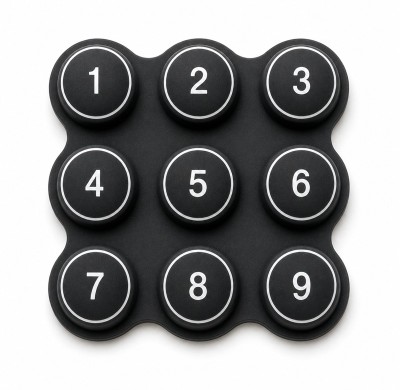
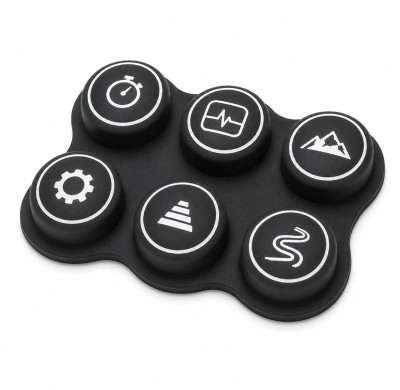
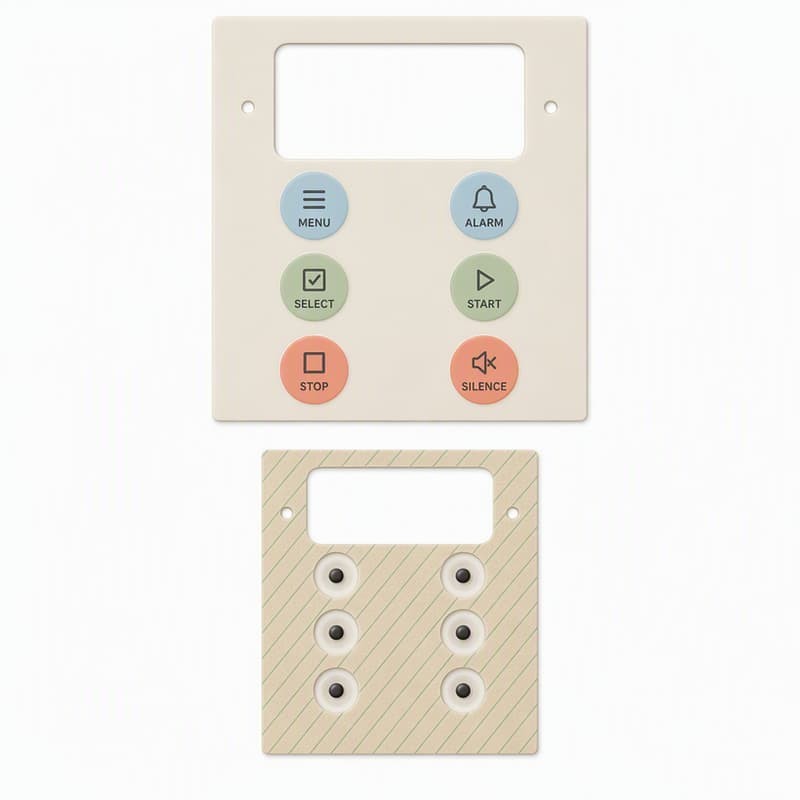
A silicone panel is a one-piece molded elastomer pad that carries the keys, the sealing, and often the legends, mounted to a faceplate or directly to the housing. It is not a membrane switch with a silicone top layer, and it is not a set of individual keycaps. The distinction matters because every failure mode changes. A membrane switch fails at the adhesive layer; a silicone panel fails at the web geometry. If you switch materials without switching the design rules, you import the wrong failure model — and the wrong fixes.
The four things that change when you switch
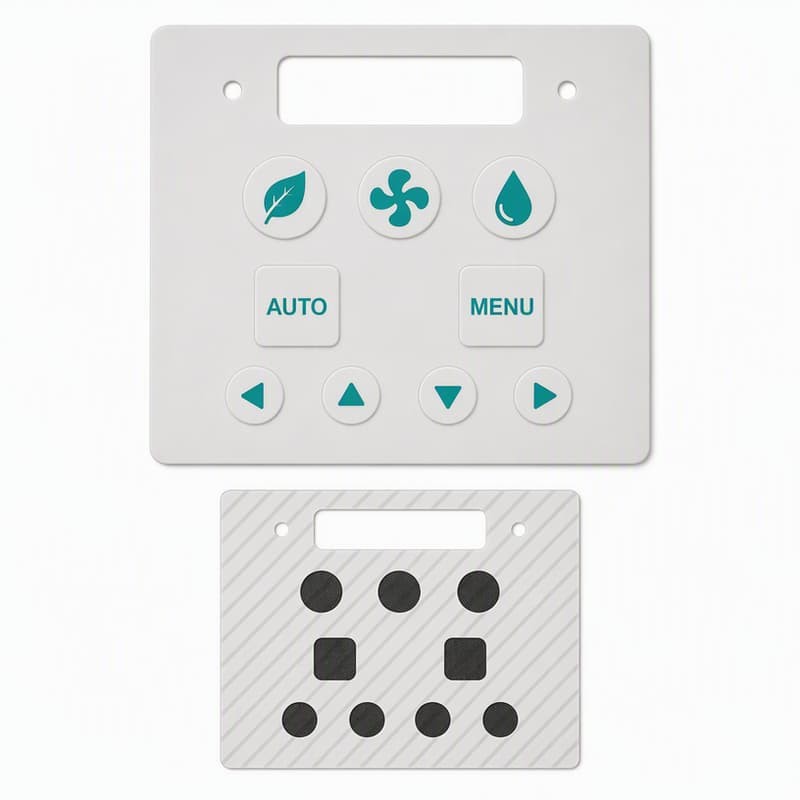
Sealing becomes integral instead of assembled. A molded pad seals every key opening in the same part — no per-key gasket, no adhesive seam. But it only seals if the pad geometry and the housing are designed together.
Tactile feel becomes a geometry problem. The snap comes from the web and dome, not from a metal dome under a membrane. Force-travel-snap has to be specified and measured on finished parts.
Tooling becomes a real cost and lead time. Silicone panels are molded; the tool is steel, and changes cost money and weeks.
The PCB interface changes. A silicone pad lands on conductive pills that close a circuit on the customer's board. The keypad maker does not build the PCB, and the tolerance handoff has to be owned by someone.
Sealing — integral, but only if you design for it
With a correctly designed pad, IP65 and better is reachable (IEC 60529 defines the classes and the water-spray test) [1]. The catch is that sealing is a system property. The pad, the housing pocket, the fasteners, and any gasket all have to agree. A pad designed for IP65 mounted in a housing with a sharp edge or an uneven pocket will leak at the edge, not at the key. Specify the sealing class, the test condition, and the mated housing — not just "silicone pad."
Tactile feel — specify the curve, not the hardness
The most common mistake when switching is to write "60 Shore A" on the drawing and assume that defines the feel. It does not. Hardness is a material property measured on a slab (ISO 7619-1, ASTM D2240) [2]; the feel of a key is set by web thickness, dome profile, and travel. A 60 Shore A pad with a 0.4 mm web feels completely different from a 60 Shore A pad with a 0.7 mm web.
Specify peak actuation force (the working band is 125–150 g for industrial panels), snap ratio (40–60% reads as crisp), and the tolerance — then verify on finished parts with a force-travel curve [3]. A hardness number alone will not catch a mushy key, and a mushy key is the number-one complaint after a switch.
Tooling — it is molded, so the tool is the product
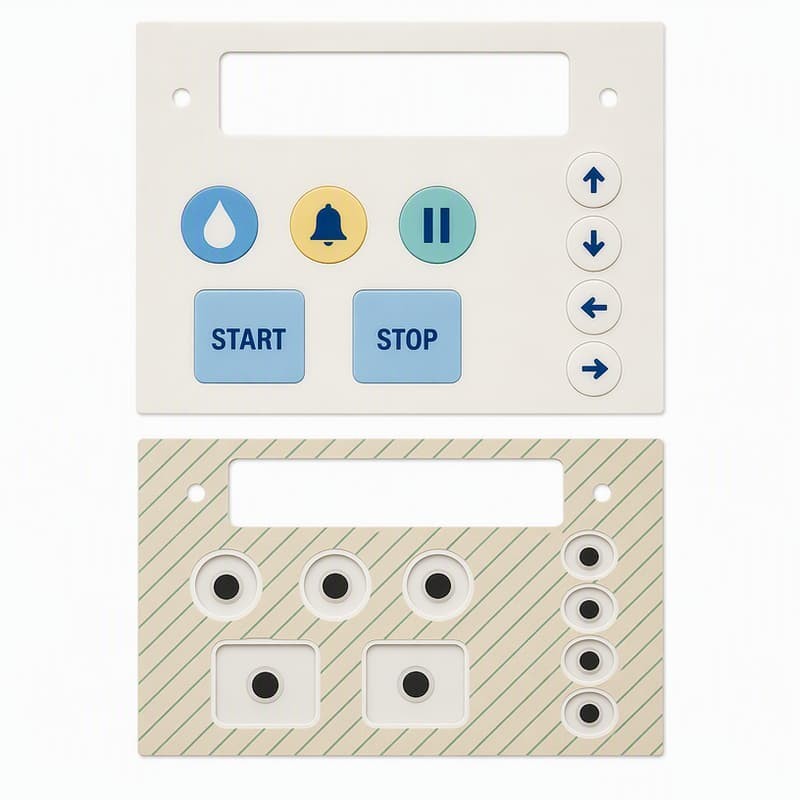
Silicone panels are molded, which means the first article is not a 3D print you can tape to a board. The tool is steel, the lead time is real, and every design change after tool cut costs money and weeks. The companies that switch well do a force-travel review and a prototype or soft tool before cutting the production tool. The companies that switch poorly cut the production tool from a CAD file and discover the feel on the first article — then pay for the second tool that should have been the first.
The PCB interface — define the handoff
A silicone keypad does not include the PCB. The pad lands on conductive pills (carbon, typically) that close a circuit on the customer's board. The interface has tolerances: pill diameter, contact resistance target, pad-to-board gap, and who owns each dimension. If the keypad maker and the PCB designer do not agree on the contact resistance target, the pad can pass the keypad maker's test and fail on the board. Write the interface into the spec: pill type, contact resistance (initial and after cycles), and the stack-up. This is also where we draw a clear line: FromRubber builds the keypad, not the PCB, and the spec has to say which side owns each tolerance.
Case — a packaging line controller that switched
A packaging equipment maker switched their line controller from a membrane switch to a silicone panel because the membrane adhesive was failing in a dusty, washdown environment. The first silicone articles looked right and sealed well, but the keys felt mushy — no click. The force-travel curve showed a snap ratio below 30%. The web had been designed too thick, carried over from the membrane switch's rigid top layer.
We re-profiled the web to 0.45 mm, adjusted the dome, and the snap ratio came back to 48%. The second tooling round was the cost of treating the switch as a material swap. The panel has been in the field for two washdown seasons without a sealing or feel complaint. The lesson was not that silicone was the wrong choice — it was that the design rules had to switch with it.
The checklist before you switch
- Sealing class per IEC 60529, tested mated to the actual housing.
- Force-travel-snap specified with tolerance, verified on finished parts.
- Tooling plan: prototype or soft tool before production steel.
- PCB interface written down: pill type, contact resistance, stack-up ownership.
- Legend durability and the cleaning agents the panel will see.
- Material compliance: UL 94, RoHS, REACH where required [4].
- A feel sample agreed before the production tool is cut.
FromRubber makes custom silicone keypads and panels for industrial, appliance, and medical customers. We do not build PCBs — we build the pad that has to land on yours, and we document that interface instead of blurring it. If you are switching a panel to silicone, send us the requirement list and the housing drawing, not just the material callout — we will tell you where the design has to change before the tool is cut.
Sources and test references used in this article:
- IEC 60529, Degrees of protection provided by enclosures (IP Code), current edition.
- ISO 7619-1, Rubber — Determination of indentation hardness — Part 1: Durometer method; ASTM D2240, Standard Test Method for Rubber Property — Durometer Hardness.
- Diamond HMI, Rubber Keypad Design Guide: actuation force 125–150 g with snap ratio 40–60% recommended for tactile industrial keypads.
- UL 94 (flammability), Directive 2011/65/EU (RoHS), Regulation (EC) No 1907/2006 (REACH).