Silicone Pet Boots: How Much Stretch Is Enough for Easy Wearing?
A slip-on silicone pet boot usually fails in one of two places. At the door, where the paw will not go in without a fight. Or two streets later, when the boot has quietly rotated and come off mid-stride. Both failures get blamed on "the silicone", and in most projects I have seen, neither is a material problem. They are decided by two dimensions and one force curve that nobody wrote down before the mold was cut.
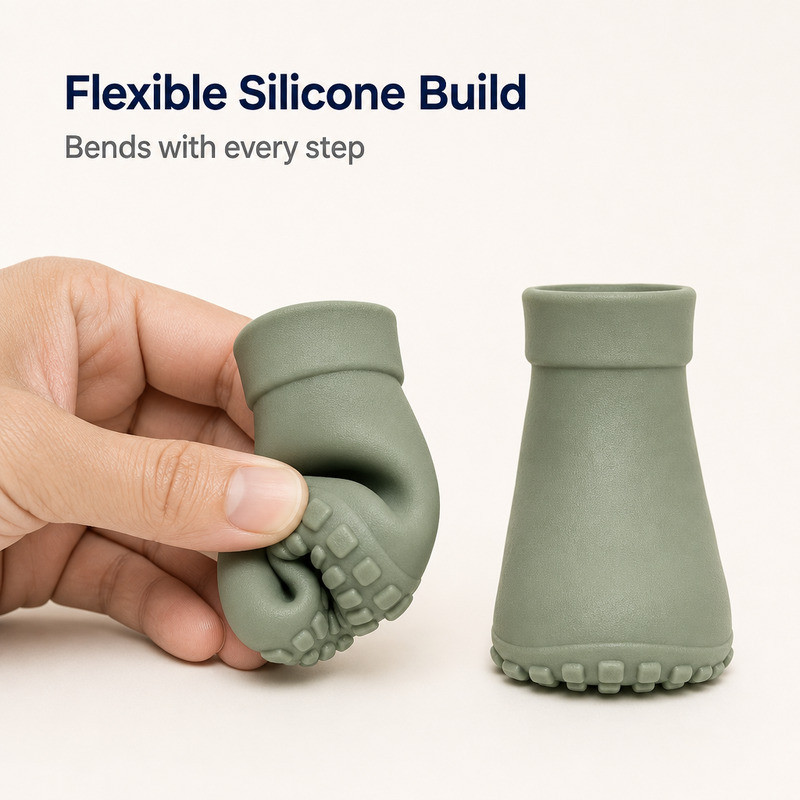
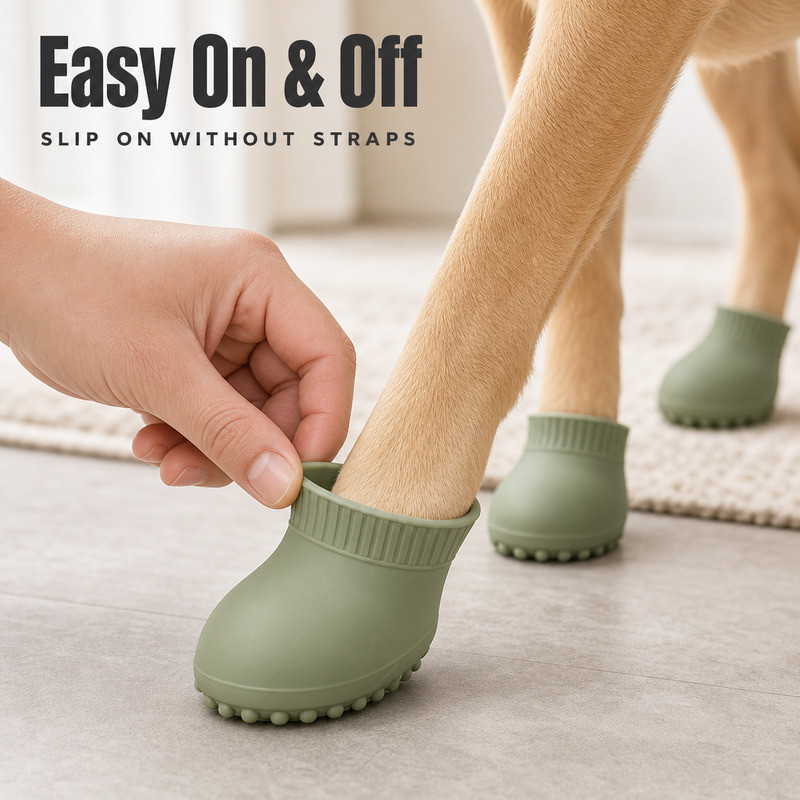
A boot like the one above can feel wonderfully soft between your fingers and still be miserable to put on a dog. That is the first thing worth unlearning. Softness is what your hand reports when it presses a wall; stretch is what happens when a ring of material has to open up around something wider than itself. They are related, but they are not the same measurement, and confusing them is the most common reason a "soft" sample comes back from the field with complaints.
This article is written for the people who have to sign off on that sample: product developers, brand owners, and sourcing staff working with a silicone factory on a custom pet boot. It is about the opening, and about the numbers that decide whether the opening works.
What makes silicone pet boots easy or difficult to put on
The opening has to clear the widest part of the paw
Watch someone put a boot on a dog and you will see the real requirement. The paw does not slide in nose-first like a foot into a shoe. It compresses slightly, the two outer toes spread, the pad flattens under pressure, and the whole bundle passes through the rim at an angle. The dimension that matters is not paw length. It is the widest cross-section of the paw at the moment of entry, plus whatever clearance the rim needs to pass over the nails without catching.
Too small an opening and the owner pushes harder, the dog pulls back, and the boot gets a reputation after two uses. Too large an opening and entry is lovely, but the same rim that let the paw in lets it out again on a turn. There is no opening size that is generous for entry and tight for retention at the same time. The design has to buy one with geometry rather than with size.
Soft silicone does not automatically mean easy wearing
A rim behaves like a ring in tension. When the paw pushes through, the material has to stretch along the circumference, and the force required rises with the cross-section of that ring. A 2 mm rim and a 4 mm rim made from the same compound at the same hardness will feel identical in your hand and behave completely differently on a paw. The thick one resists opening, and it also holds its shape better once the boot is on. You cannot tune one without moving the other.
Local stiffness matters just as much as the compound. A decorative bead rolled around the rim, a raised logo, a reinforced band where the boot meets the ankle: each of these is a stiffer ring sitting on a softer wall, and each one raises insertion force at exactly the place the owner is gripping. If a sample is hard to put on, look at the geometry before you ask for a softer compound.
Paw shape and boot geometry have to work together
In most breeds the front paws are wider and blunter than the rear, and the difference is large enough to matter at the opening. A single opening dimension applied across a size run of slip-on silicone pet boots will therefore be slightly loose on the back feet and slightly tight on the front, or the other way round depending on which paw you measured. That is not a defect. It is a decision that has to be made on purpose and written into the size table.
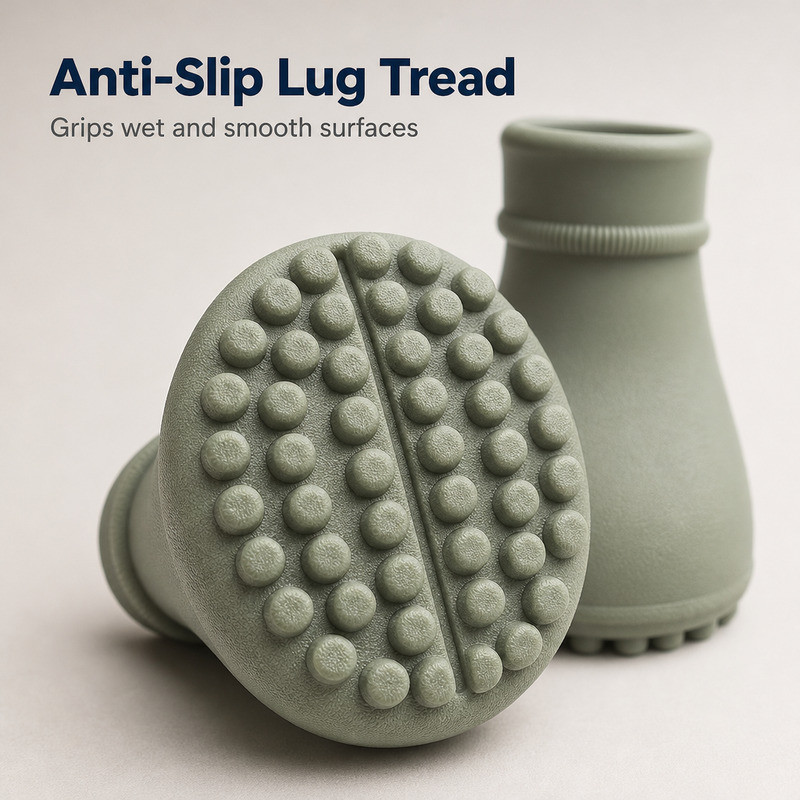
The cavity has to agree with the paw, too. A round cavity on an oval paw leaves two slack pockets at the sides, and slack is where rotation starts. When I look at a boot design, I want to see the cavity drawn around a real paw outline, not a circle scaled up and down.
How much stretch should a silicone boot opening have
Search for a number and you will find plenty of confident answers. None of them survive contact with a real paw, because "how stretchy" is not one property. It is three questions wearing the same coat. It is also the reason buyers who set out to source pet rubber boots end up arguing about millimetres of opening rather than about material names.
| Question people ask | What actually needs to be measured | Where the number comes from |
|---|---|---|
| "How much does the silicone stretch?" | Elongation at break of the cured compound | Tensile test to ISO 37, run on a cured sheet, not on the boot |
| "Will the paw go in?" | Force needed to open the rim to the required clearance | Bench pull on the finished part, at the real expansion distance |
| "Will it still stay on in a month?" | Residual deformation of the rim after repeated cycles | Measure the opening, cycle it, measure it again |
Those three numbers move independently. A compound with excellent elongation can still produce a boot that fights the paw, because the rim is thick. A rim that opens with almost no effort can still fail retention, because nothing in the geometry holds it. And a boot that measures correctly on day one can drift out of tolerance after fifty wearings if the compound has poor recovery.
Start with the paw, not with a percentage
Take the widest circumference around the paw, at the point where it has to pass the rim, and add the clearance the rim needs for the nails. That total is the expanded circumference the opening must reach. Now measure the relaxed opening. The difference between the two is the expansion the design demands, and that is the number worth putting on the drawing.
As an illustration only: if a paw measures 62 mm around at its widest and the rim needs about 8 mm of clearance to pass without catching, the opening has to reach roughly 70 mm. A relaxed opening of 58 mm therefore has to deliver about 12 mm of expansion, around 20 percent of its own circumference. Whether that is easy or hard depends entirely on how much material is in the rim, which is the next section.
Evaluate stretch as a range, not a single value
Every size in the run asks for a different expansion from the same rim geometry, because the opening grows more slowly than the paw. A size run built by scaling a single 3D model up and down keeps the wall proportional, but paw width does not scale proportionally with paw length across breeds. Small, wide-chested dogs and long, narrow-footed dogs break the assumption in opposite directions. This is why a design that tests beautifully at the middle of the range can be awkward at both ends.
Check whether the opening returns to its intended shape
Every time the paw goes in and out, the rim loses a little of its original dimension. The loss is small per cycle and large over a season, and it is the reason a boot that fit in March is described as "stretched out" by June. What actually happened is that the rim took a permanent set.
This is not a failure of the compound, or not only that. A rim carrying a lot of strain at the corners will accumulate set faster than a rim that opens with less effort, even when both are made from the same batch. It is also the same mechanism behind silicone paw cleaner cups losing their shape after repeated use, where the whole body is doing the work every time a paw goes through it. Measure the opening before cycling, after twenty insertions, and after fifty, on the same part. If the numbers drift, the design is asking for more expansion than the section can recover from.
Which design features affect stretch around the opening
Wall thickness changes the force before it changes the feel
Thickness is the cheapest lever and the easiest to misuse. Adding material to the rim increases retention and slows down opening at the same time. Halving the rim thickness halves the force needed to open it, roughly speaking, but it also reduces the elastic energy available to close back around the paw, and it moves the tear risk to the thinnest section.
There is a second-order effect worth knowing. In compression molding, a very thin rim cools and cures differently from the thick sole below it, and the transition between the two is where dimensional scatter lives. If one boot in a batch fits differently from its neighbour, compare the rim thickness at four points before you blame the compound.
Rounded edges reduce where stress piles up
Sharp internal corners concentrate strain. When a rim is stretched fifty times a day, that concentration is what turns into a small crack, and the crack always starts at the same corner. Generous radii at the rim edge and gradual transitions from rim to sidewall are not cosmetic details; they are the difference between a part that survives a season and one that fails at the fourth month.
Reinforcement has to be paid for somewhere
A reinforced rim, a bead, a doubled band: all of them work. All of them also raise insertion force, and the cost lands on the person kneeling on a wet pavement at seven in the morning. If retention is the problem, adding stiffness to the rim is one answer. Shortening the boot so it grips lower on the leg, adding a soft internal rib, or changing the cavity shape to match the paw are others, and they do not make the boot harder to put on.
The boot body should not fight the opening
An opening does not stretch in isolation. If the ankle section is narrow, the sidewall is stiff, or the cavity tapers sharply, the rim cannot open freely because the material behind it is holding on. Optimising the rim on a bench and then attaching it to a rigid body produces a part that measures well and wears badly. Review the whole silhouette in one drawing.
A useful comparison from the paw itself. The canine paw pad is not a uniform cushion. A 2016 finite-element study of the German shepherd paw pad describes a hard outer stratum corneum sitting over a much softer layer of dermal papillae, with a stiffness difference of several orders of magnitude, arranged so that load is transferred to the hard layer while the soft tissue is protected. The pad works because the stiff part and the soft part are placed deliberately. A boot rim built as one uniform band above a thin wall has the opposite arrangement, and that is often why it feels wrong even when every dimension is on drawing.
How to test whether a silicone pet boot is easy to put on
Use representative paw sizes, not a convenient hand
A wooden last or a printed paw model at the top, middle, and bottom of the intended size range will tell you more in an hour than a week of handling the sample. Push each last through in the direction a real paw enters, not straight down the axis, because the angle changes which part of the rim takes the load.
Count cycles, not successes
One clean fit proves the part can be worn. It does not prove the part can be worn on a Tuesday in November after three months in a cupboard. Run a fixed number of insertion and removal cycles, measure the opening before and after, and record the change. That single number, the residual change in opening circumference, predicts retention far better than any visual assessment.
Look for whitening before you look for tears
Stretched silicone that has been overworked turns pale at the highest-strain area before it splits. Whitening at the rim corners after cycling is an early warning that the geometry is asking too much of the material. It is much cheaper to fix at sample stage than after the mold is cut.
Common stretch-related problems in custom pet boot development
The opening stretches easily but the boot slips off
This one is usually misdiagnosed as "too soft". The material is rarely the culprit. When a boot that opens beautifully will not stay on, look at four things in order: the opening is larger than the paw needs, the boot is too short to grip below the widest part of the paw, the cavity is round where the paw is oval, and the inside surface is smooth enough to slide. Harder compound is the fifth option, and it is the one that makes the boot harder to put on without fixing the reason it came off. The mechanics are not unique to boots either; the same reasoning explains why a silicone tracker holder creeps off a dog collar even when it feels tight in the hand.
The boot fitted during sampling but is difficult in real use
Sample paws are clean, dry, and cooperative. Real paws are damp, sandy, and attached to a dog that would rather be elsewhere. Beyond that, the sample itself may not represent production: a first-shot sample is often made in a slightly different cavity condition from the run that follows, and the rim is exactly the feature that shows it. Ask for the measurement record of the sample you approved, with the points marked, so the production part can be compared against the same points rather than against a memory.
The opening tears after repeated stretching
Tears are a geometry story more often than a compound story. A sharp transition, a thin section next to a thick one, a notch left by the parting line, or a rim that has to deliver more expansion than its cross-section can support will all produce the same failure. Tear strength is measured to ISO 34-1 on a test piece, and the value tells you how the compound behaves in a lab specimen; it does not tell you whether the corner in your 3D model is kind to that compound. Both have to be reviewed, and the drawing usually gets there first.
What to confirm with a manufacturer before tooling
The conversation that saves the most money happens before the steel is cut, and it is short if you bring the right information. For custom silicone pet boots, a handful of numbers do almost all of the work, and they are the ones below.
- Paw dimensions, three of them: length, width across the outer toes, and circumference at the widest point, measured on real dogs rather than taken from a breed chart.
- The size range you intend to sell, not just the size you are sampling. The middle of the range is where the design is easiest; the ends are where it is tested.
- An opening specification with a tolerance, plus the expansion distance it has to achieve. Without the second number, the first one is only a wish.
- Wall thickness at the rim, stated separately from the thickness of the sole and the sidewall, because they do different jobs.
- The hardness you want, and the reason for it. Hardness measured to ISO 48-4 is a starting condition, not a performance guarantee.
- An agreed insertion and removal method, with the number of cycles and the acceptance limit written down before the first sample is opened.
One more thing worth raising early: who owns the tolerance call. If the drawing says the opening is nominal and the mold produces something a little different, someone has to decide whether that difference is acceptable. That decision is much easier to make with a measurement protocol agreed in advance than with a shipment on the dock.
The short version
The right amount of stretch is the amount that lets a real paw pass a real rim with a reasonable push, then returns close enough to its original shape that the boot still grips after a month of use. That is a range, it changes with size, and it is decided by wall thickness and rim geometry far more than by the word "soft" on a datasheet. Test it with paw models, count the cycles, measure the change, and put all three numbers on the drawing.
FromRubber moulds custom silicone parts for pet product projects, including thin-wall covers and slip-on shapes, and we work through opening geometry, wall sections, and sample evaluation with the people who will sell the product. If you have a paw drawing, a reference sample, or a size range and no drawings at all, the useful next step is a short review of the opening before anything else gets decided. Drawings, paw measurements, and target sizes can go to nani@fromrubber.com or karl@fromrubber.com; WeChat and WhatsApp are the same number, +86 186 7621 0913. FromRubber is the brand of Dongguan Bohao Electronic Technology Co., Ltd., based in Dongguan, Guangdong, where the tool shop and the moulding floor sit in the same operation.
Questions that come up in every project
How stretchy should a silicone pet boot opening be?
Stretchy enough to reach the clearance the paw needs, and no more. The working number is the force required to open the rim to that clearance, not the elongation at break of the compound. Measure both the relaxed opening and the expanded opening on the finished part, and keep them on the drawing.
Does softer silicone make pet boots easier to put on?
Sometimes, but it is an expensive way to solve the problem. A softer compound lowers the force needed to open the rim, and it also lowers the force that closes it again, which can cost you retention. Reducing rim thickness locally, or reshaping the entry so the paw meets a radius instead of a wall, usually does more for wearing effort without touching the compound.
Why does a silicone pet boot stretch easily but still slip off?
Because entry and retention are separate mechanisms. Entry depends on how much force the rim takes to open; retention depends on where the boot grips, how much contact area it has, and whether the cavity matches the paw shape. A generous opening with a short body and a round cavity will always rotate, no matter how good the compound is. There is more on this in our notes on the design details that decide fit and retention.
Can wall thickness affect how easily a pet boot stretches?
Yes, and it is the strongest lever you have. The rim behaves as a ring in tension, so the force needed to open it rises with the amount of material in that ring. Changing the thickness of the rim changes wearing effort and retention at the same time, in opposite directions, which is why the two should be evaluated together rather than tuned one after the other.
How can manufacturers test the opening before mass production?
With a set of paw models covering the intended size range, a fixed insertion direction, a recorded number of cycles, and a measurement of the opening before and after. Add a visual check for whitening at the rim corners. The same procedure repeated on several samples tells you whether the part is repeatable, which one perfect sample cannot.
What information should I provide when requesting a custom silicone pet boot sample?
A paw outline or the three basic paw dimensions, the size range you plan to sell, the opening and expansion you expect, the wall thickness you have in mind for rim and sole, the hardness you are considering, and the surfaces the boot will meet. If a competitor product already fits well, send it as a reference; a physical reference shortens the review more than a page of description.
Sources and further reading
- ISO 37:2024, Rubber, vulcanized or thermoplastic — Determination of tensile stress-strain properties. International Organization for Standardization. iso.org/standard/86892
- ISO 48-4:2018, Rubber, vulcanized or thermoplastic — Determination of hardness — Part 4: Indentation hardness by durometer method (Shore hardness). iso.org/standard/74969
- ISO 34-1:2022, Rubber, vulcanized or thermoplastic — Determination of tear strength — Part 1: Trouser, angle and crescent test pieces. iso.org/standard/82445
- Miao H., Fu J., Qian Z., Ren L., Ren L. How does paw pad of Canine attenuate ground impacts: a micromechanical finite element study. PeerJ Preprints (preprint, submitted to PeerJ). peerj.com/preprints/2340
- FromRubber technical note on permanent set: what compression set does to long-term rebound in silicone parts.
- Companion reading in this series: what changes between a sample and a production run, and how wall thickness is chosen zone by zone.
The paw-to-opening example in this article is an illustration of the method, not a specification. Opening dimensions, wall sections, and acceptance limits for a commercial product should come from measurement records agreed between the buyer and the molder for that specific project.