Sebum Penetration and Tackiness in Massage Chair Hand Controller Silicone Keypads: Surface Coating Crosslink Density and Stain Resistance
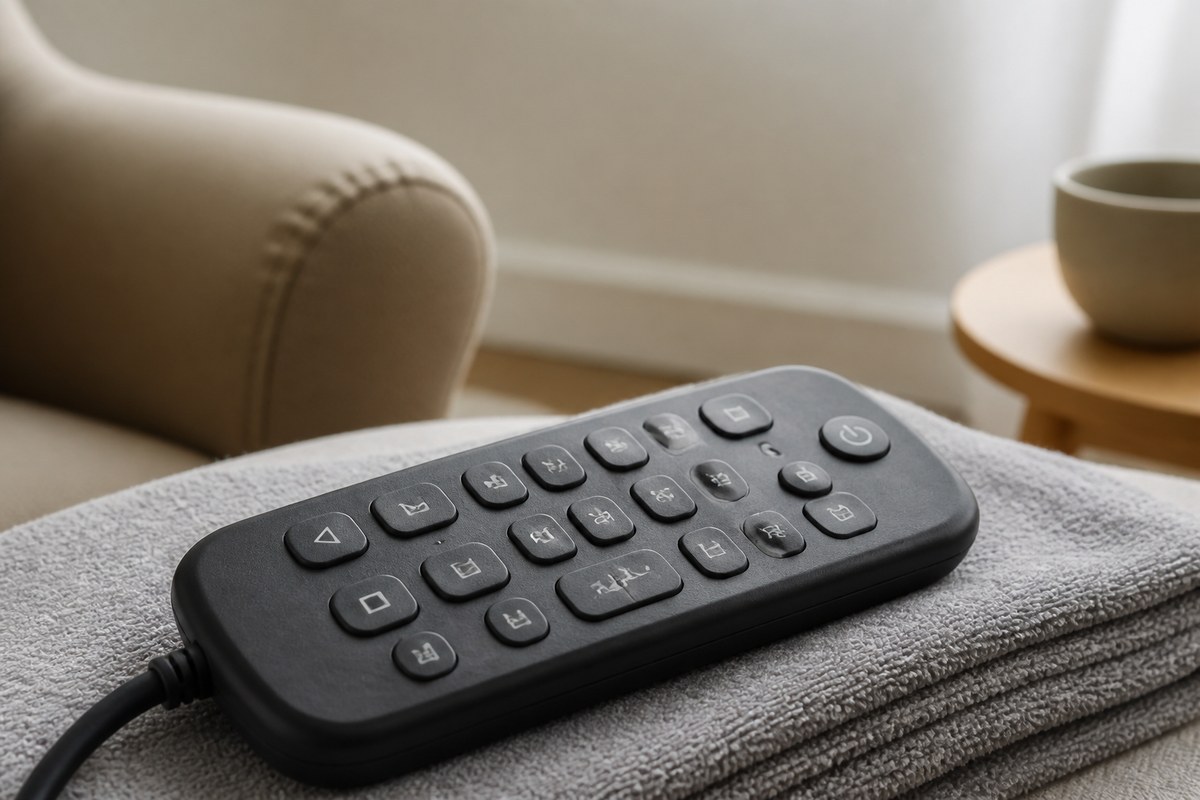
The controller comes back from the showroom floor after six weeks. Nothing has failed electrically, no key is worn through, but the surface has gone from a dry matte grey to a slightly glossy, faintly sticky sheet that holds fingerprints and picks up dust in a way it did not when it was new. The service note says "surface sticky". The honest question is whether the silicone has been penetrated, or whether something is sitting on top of it.
Why Massage Chair Hand Controller Keypads Are Exposed to Skin Oils
A hand controller is one of the most aggressive surface environments in consumer hardware. It is held for twenty to forty minutes at a time, pressed continuously, left in contact with a palm, and used by a visitor who may have applied hand cream, sun cream or sanitiser shortly before. Add a cleaning wipe after each session and the surface sees a continuous cycle of oil, water and mechanical abrasion.
Compare that with a wall-mounted control panel that is touched for two seconds at a time. The chemistry is the same, the dose is completely different, which is why a surface treatment validated on a panel can fail on a hand controller.
What Sebum Can Do to a Silicone Keypad Surface
Sebum is a mixture of triglycerides, wax esters, squalene, fatty acids and cholesterol. From a materials point of view its relevant properties are that it is non-polar, it spreads readily on low-energy surfaces, and it is prone to oxidising into a varnish-like film over time.
Four effects follow, and they are often confused with each other:
- Surface contamination, where a film builds and changes the appearance and friction of the surface
- A change in friction coefficient, ranging from slippery when the film is fresh to grabby once it has oxidised
- Tackiness, where the surface holds dust, lint and fibres
- Long-term appearance degradation, where the varnish film is visible as a glossy or patchy sheen
The important distinction is between surface contamination and actual material penetration or degradation. A film on top can be removed with the right cleaning agent. Material that has swollen or degraded internally cannot. Which of the two you have determines whether the answer is a maintenance instruction or a material change.
Why the hand controller is not a control panel
On a machine panel, a coating is judged mostly on hardness and cleanability. On a hand controller it is judged on feel as well, and it has to survive flexing. A coating that is hard enough to resist oil pick-up is often stiff enough to craze when the underlying key deflects under a thumb.
Why Silicone Surface Chemistry Matters
Surface Energy and Oil Attraction
Silicone has a low surface energy, which is why it releases from moulds well and why water beads on it. Low surface energy is good for water repellency and, counter-intuitively, allows non-polar oils to wet and spread very evenly rather than beading up. That is why a small amount of sebum on a silicone key can cover a surprisingly large area and look like a much bigger problem than the mass of oil involved.
Crosslink Density and Surface Stability
Crosslink density is the number of network junctions per unit volume, and it controls several things at once: how soft the material feels, how much it swells when a compatible liquid is present, how well the surface resists being deformed or abraded, and how quickly it recovers after a press.
Low crosslink density gives a soft, compliant feel and a higher tendency to absorb and retain oil at the surface, with slower recovery. High crosslink density gives a firmer, more dimensionally stable surface that resists swelling, but it reduces elasticity and can make the material more prone to surface cracking under repeated flexing.
Why Bulk Hardness Alone Does Not Predict Surface Tackiness
Shore hardness is a bulk measurement. Two keypads can read the same Shore A value and behave completely differently at the surface, because a surface measurement is dominated by the outermost fraction of a millimetre, where cure level, mould surface replication and any surface treatment all live. This is the single most useful distinction for anyone specifying a controller keypad, and it is the reason a hardness specification alone cannot be used to close out a tackiness complaint.
Surface Coating Versus Uncoated Silicone Keypads
There is no universally correct answer here. The right choice depends on how visible contamination is on the chosen colour, how often the part is cleaned, and how much the surface will be flexed.
| Surface approach | Advantage | Limitation to validate |
|---|---|---|
| Uncoated silicone | Simple structure, no adhesion interface to fail | Contamination and sheen may be more visible |
| Protective coating | Can improve cleanability and oil resistance | Adhesion to silicone and durability under flexing |
| Textured surface | Breaks up visible fingerprints and sheen | Cleaning behaviour and dust retention must be checked |
| Modified silicone formulation | Integrated, no added interface | Requires formulation work and re-validation |
How Coating Crosslink Density Can Affect Tackiness and Durability
A coating is its own crosslinked system with its own balance to strike. Insufficient crosslinking leaves a soft film that stays tacky, transfers onto the finger and holds dust. Excessive crosslinking produces a hard film that resists oil but has little ability to follow the key as it deflects, so it crazes at the edges of high-travel keys and lifts at the boundary.
Between those two extremes sit coating hardness, flexibility, adhesion to the silicone substrate, behaviour under repeated pressing, and resistance to cleaning agents. Adhesion deserves the most attention, because a coating that adheres well but is too soft is a maintenance problem, while a coating that is appropriately hard but adheres poorly is a warranty problem.
Watch which keys fail first
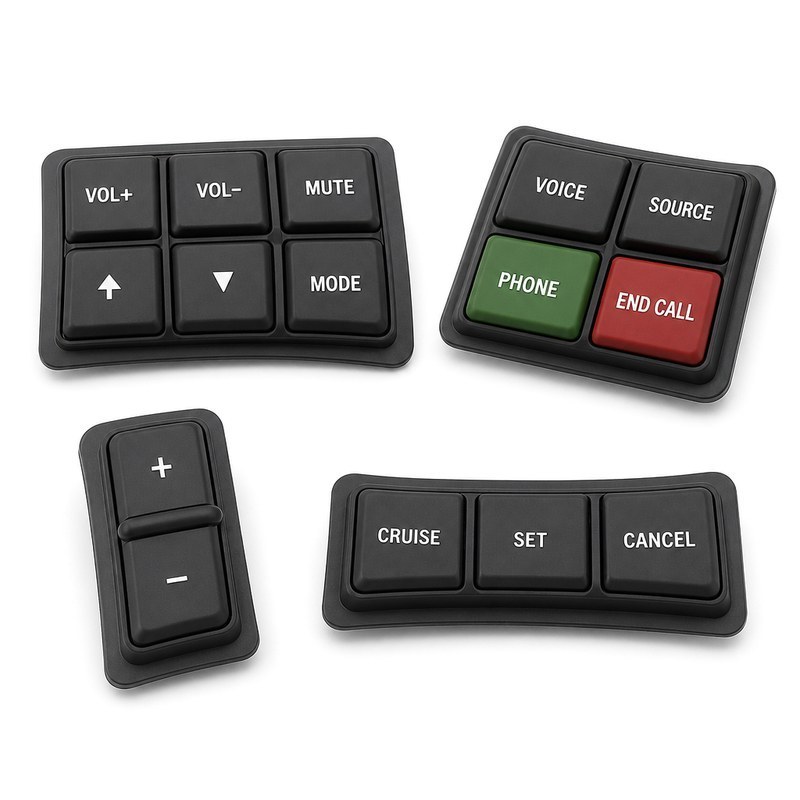
On a multi-key hand controller, contamination and coating wear are rarely uniform. The keys on the upper row are where the thumb rests, and the keys nearest the housing edge are where the coating has to flex most. If the sheen appears only on the thumb row, that points to contamination. If it appears at the edges of a high-travel key, that points to coating mechanics.
How to Test Sebum and Stain Resistance
Use Controlled Artificial Sebum Exposure
Real-user testing produces inconsistent dosing, inconsistent contact time and inconsistent cleaning, so it cannot separate one variable from another. A defined artificial sebum mixture applied at a defined volume and held at a defined temperature gives a result you can repeat and compare between samples. That repeatability is what makes it useful in a specification.
Simulate Repeated Finger Contact
Assess gloss change, friction, tackiness and appearance after a number of controlled contact cycles. Measure gloss at a fixed angle on a fixed area rather than judging by eye, because eye judgement varies between inspectors and between lighting conditions.
Run Cleaning Cycle Testing
Expose samples to the cleaning agents actually recommended in the user manual, at the recommended dilution and frequency. A surface that survives sebum and fails a sanitiser wipe has not been validated for the real product.
Check Long-Term Surface Durability
After exposure and cleaning, look for whether the surface or coating has cracked, peeled, become sticky, lost its texture, or changed colour. These are the outcomes that generate field complaints even when hardness and function are unaffected.
Common Causes of Sticky Massage Chair Controller Buttons
Grouping the causes correctly prevents the wrong fix. The list below separates the surface problem from mechanical and environmental ones.
| Cause group | Typical evidence | Direction of fix |
|---|---|---|
| Surface contamination | Uniform film, removable by cleaning | Cleaning instruction, or easier-clean surface |
| Coating degradation | Tacky film that transfers to the finger | Coating chemistry or cure level |
| Unsuitable coating chemistry | Failure concentrated at high-travel keys | Coating selection and adhesion |
| Insufficient crosslinking | Persistent tack after cleaning | Formulation or cure adjustment |
| Cleaning-agent interaction | Onset correlates with a change of sanitiser | Cleaning specification and validation |
| Environmental aging | Gradual change over months, all keys affected | Formulation and stabiliser review |
| Mechanical deformation | Localised at one key or one edge | Geometry and travel |
Design and Material Recommendations for High-Contact Silicone Keypads
For a controller that will be held, the specification should state the target surface feel, hardness, the surface texture or finish, whether a coating is used and why, coating thickness, button geometry, the cleaning agents the part is expected to tolerate, and the expected contact frequency in presses per service life.
It also helps to decide early whether the surface finish is cosmetic or functional. A textured finish that hides fingerprints on a dark surface is a cosmetic choice with a cleaning consequence, and that trade-off should be a conscious decision in the design review rather than a discovery in the field.
How Manufacturers Can Validate a Keypad for Long-Term Hand Contact
A workable validation sequence runs from the simplest measurement to the most representative one:
- Initial visual inspection and gloss measurement on a fixed area
- Shore hardness on the finished key, plus a surface-level check if a coating is present
- Surface friction and tackiness assessment, recorded rather than described
- Controlled artificial sebum exposure at defined dose and temperature
- Repeated pressing cycles on the keys with the longest travel
- Cleaning cycles with the agents named in the user manual
- Appearance inspection for gloss change, staining and film transfer
- Final tactile comparison against a retained reference sample
Where the answer usually sits
When we are asked to look at a controller surface problem, the first useful step is to establish whether the film is removable. Cleaning a sample with the recommended agent and re-measuring gloss takes minutes and splits the problem cleanly in two. If the gloss returns to baseline, it was contamination. If it does not, the surface itself has changed and the conversation moves to coating mechanics and cure level.
That single test costs almost nothing and prevents a formulation change that was never going to help. Controller keypads and other custom moulded parts are described on our custom silicone rubber keypad page.
FAQ
Why does a silicone keypad become sticky after repeated use?
Most often it is a film of oxidised sebum and skin care product sitting on the surface rather than a change in the silicone itself. If cleaning with the recommended agent restores the original gloss, the material is intact and the issue is surface contamination. If it does not, the coating or the surface cure level needs review.
Can skin oil penetrate silicone?
Silicone is not impermeable, and the extent of absorption depends on crosslink density and on the oils involved. Low crosslink density materials swell more readily. In practice, a lot of what is reported as penetration turns out to be a surface film, which is why the removable-or-not test is the first thing to run.
Does surface coating reduce silicone keypad staining?
It can improve oil resistance and cleanability, but a coating introduces its own failure modes including adhesion loss and crazing under flexing. It should be validated for adhesion and repeated pressing, not only for stain resistance on a flat sample.
How does crosslink density affect silicone surface tackiness?
Lower crosslink density generally gives a softer surface that absorbs and retains oil more readily and recovers more slowly, which reads as tacky. Higher crosslink density resists swelling but reduces elasticity, so the usable window is narrower than either extreme suggests.
How should massage chair controller buttons be tested for stain resistance?
With a controlled artificial sebum exposure at a defined dose and temperature, followed by fixed-condition gloss measurement, friction and tackiness assessment, and cleaning cycles using the agents named in the user manual. Measuring gloss on a fixed area at a fixed angle is what makes the result comparable between samples.
Can textured silicone reduce visible fingerprints?
A fine texture scatters light and breaks up the reflection that makes a fingerprint visible, so it usually helps. The trade-off is that texture also traps dust and can make wiping less effective, so cleaning behaviour should be checked before the finish is frozen.
FromRubber makes custom silicone keypads in Dongguan, China, including controller keypads for products that are held rather than touched. If you are investigating a surface problem on a hand controller, send photographs of the affected keys together with the cleaning agents the product recommends to nani@fromrubber.com or karl@fromrubber.com, or reach us by WeChat and WhatsApp on +86 18676210913. Related surface, material and moulding notes appear in our silicone product technology articles.
Sources
- ISO 1817:2026, Rubber, vulcanized or thermoplastic — Determination of the effect of liquids. https://www.iso.org/standard/91331.html
- ISO 48-4:2018, Rubber, vulcanized or thermoplastic — Determination of hardness — Part 4: Indentation hardness by durometer method (Shore hardness). https://www.iso.org/standard/74969.html
- ISO 188:2023, Rubber, vulcanized or thermoplastic — Accelerated ageing and heat resistance tests. https://www.iso.org/standard/80468.html