
Rubber Grommet Size Guide for Cable and Wire Pass-Throughs
A grommet that looks right on the bench can still be the wrong part. The catalogue hands you an inner diameter and an outer diameter, and neither number tells you whether the part will actually stay in the panel once the cable starts moving. Choosing a Rubber Grommet is not a lookup. It is a small closure problem with four inputs, and nearly every wrong part we see in a failure review comes from solving only one of them.
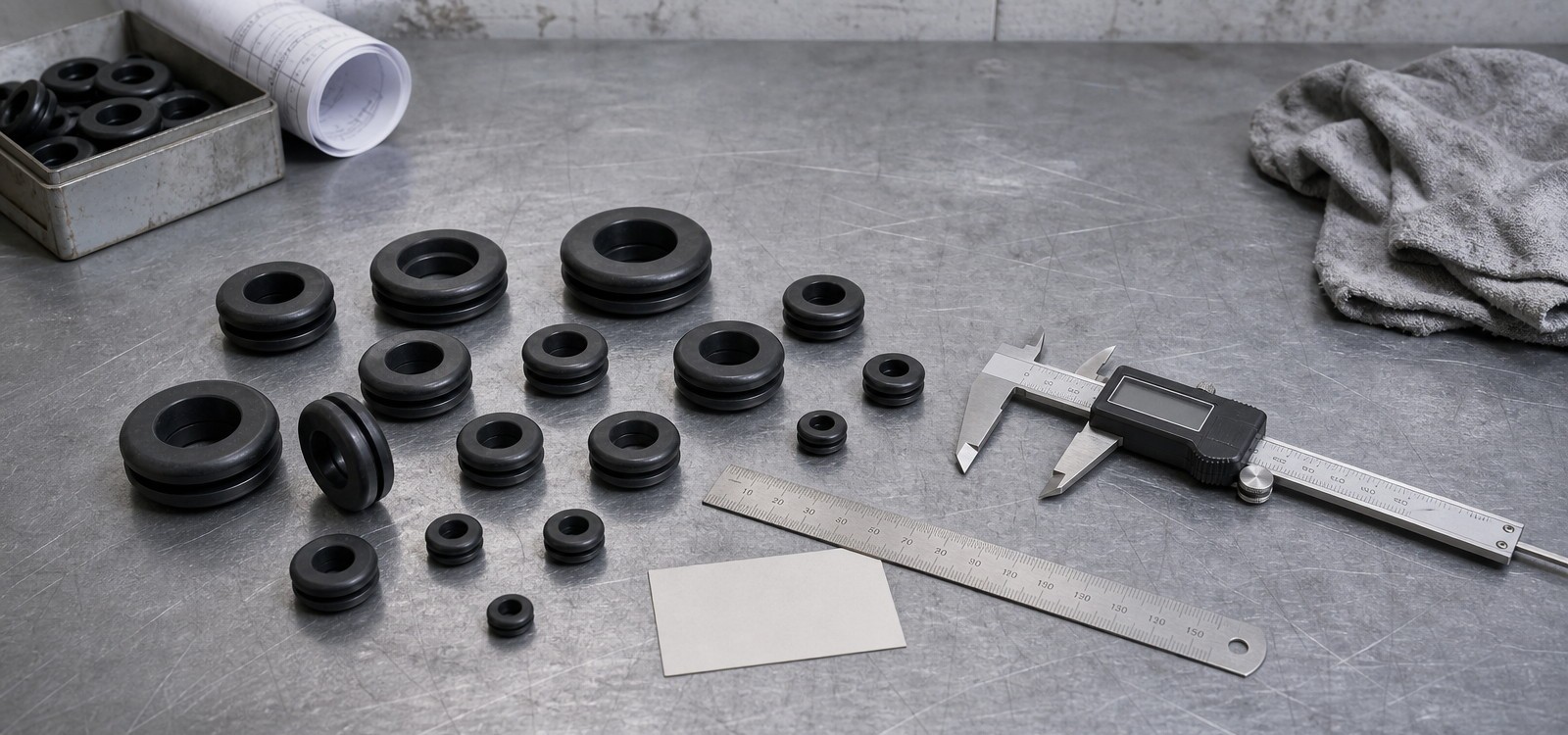
What Dimensions Matter When Selecting a Rubber Grommet?
Engineers usually arrive with one number in mind: the cable diameter. That is the natural starting point, because the cable is the thing being protected. But a grommet has to satisfy two separate interfaces at once, and only one of them involves the cable.
The panel interface decides retention. The cable interface decides protection. They pull on opposite ends of the same moulded body, which is why a part that fits the cable perfectly can still be loose in the hole.
The panel side
Panel hole diameter sets how much the grommet body has to deform to seat, and how much residual grip remains afterwards. Panel thickness decides whether the moulded groove has anything to close around. Groove width and groove diameter are the two dimensions that do the actual retaining work. Flange diameter controls how much of the panel face around the hole is covered, which matters more than people expect on thin or burred sheet.
The cable side
Cable or wire bundle diameter is measured on the finished assembly, not on the conductor. Grommet inner diameter then has to sit in a window: tight enough to hold the cable off the metal edge, loose enough that you can install it without stretching the rubber past its elastic range. Overall grommet height matters when the panel sits inside a tight enclosure and the assembly has to clear something on the far side.
Why they have to be read together
A grommet is a constrained shape. Squeeze the inner bore and the outer body grows. Press the flange down harder and the groove width changes slightly as the rubber displaces. That coupling is the reason a spreadsheet of single dimensions does not predict fit. Two suppliers can quote the same inner diameter and outer diameter with different groove geometry, and only one of them will hold.
Start from the hole, not the cable
When we review a sizing question, the first thing we ask for is the hole. Not because the cable matters less, but because the hole is the constraint you cannot change without new tooling or a new punching operation. A cable can be re-routed, re-bundled or sleeved. A stamped hole is already paid for.
Once the hole is fixed, the groove dimensions follow from panel thickness, and the bore is the last thing that moves. Working in that order removes most of the rework.
How to Measure a Panel Hole for a Rubber Grommet
The nominal hole on a drawing and the hole in the actual part are rarely the same number. Sheet metal moves during punching, the punch wears, and the material springs back. Before you select anything, measure what you have.
- Measure the actual hole diameter. Take at least four readings across different diameters of the same hole and use the smallest. An out-of-round hole is a real condition, not a measurement error.
- Check the hole geometry. Round is the usual case, but oval, square and double-D openings all need matching flange and groove geometry rather than a round grommet forced into them.
- Measure the actual panel thickness. Measure at the hole edge, not across the middle of the sheet. Coined or formed areas near the hole can be thinner or thicker than the flat.
- Inspect the edge condition. Look for burrs, rollover and any sharp lip. A grommet is often asked to solve an edge problem that should have been deburred first.
- Write down the production tolerance. A hole that measures 20.1 mm today will measure differently after ten thousand hits on the same tool. Size for the range, not the sample.
The measurement that gets skipped. Thickness at the hole edge on a formed or drawn panel. On one recent enquiry the flat of the sheet measured 1.5 mm while the material immediately around the hole measured close to 1.2 mm after forming. A grommet sized to the nominal 1.5 mm groove had a visibly loose flange on the finished panel.
How to Match Rubber Grommet Inner Diameter to Cable Diameter
This is the step where most fit problems are created, because the obvious answer — make the bore match the cable — is only correct for one of the five common cases.
Single cable
A single insulated cable is the easy case. The relevant dimension is the finished outer diameter of the jacket, including any sleeve or braid. The bore should be slightly smaller than the cable so the rubber grips it, never larger.
Multiple wires
Several wires through one bore settle into a bundle shape rather than a circle. The effective diameter is the smallest circle that contains them, which is smaller than the sum of the individual diameters but larger than any single wire. Measure the bundle as assembled, with the wires taped or bundled as they will be in production.
Wire harness
A harness adds a sleeve, a wrap or a corrugated conduit, and every one of those changes the outer diameter. A corrugated conduit is the awkward case: its outside diameter varies along its length, so the bore has to clear the crest while still holding the trough. Size to the crest.
Cable with an outer jacket
Jacketed cable is stiffer than the same bundle without a jacket, so installation force rises. If the bore is only just large enough, the assembly becomes a two-person job and the rubber gets stretched in ways the design never accounted for.
Different cable diameters in the same run
When a run contains a connector, a splice or a step change, the grommet has to be sized for the largest element that must pass through it, then evaluated again for whether it still grips the smallest. Where the spread is large, one bore cannot do both jobs and the design needs a stepped or multi-hole part.
An undersized bore compresses the rubber permanently and pushes installation force up until someone reaches for a screwdriver. An oversized bore removes the grip that keeps the cable centred, and the cable then works against the panel edge instead of being held away from it.
Colour is not a specification
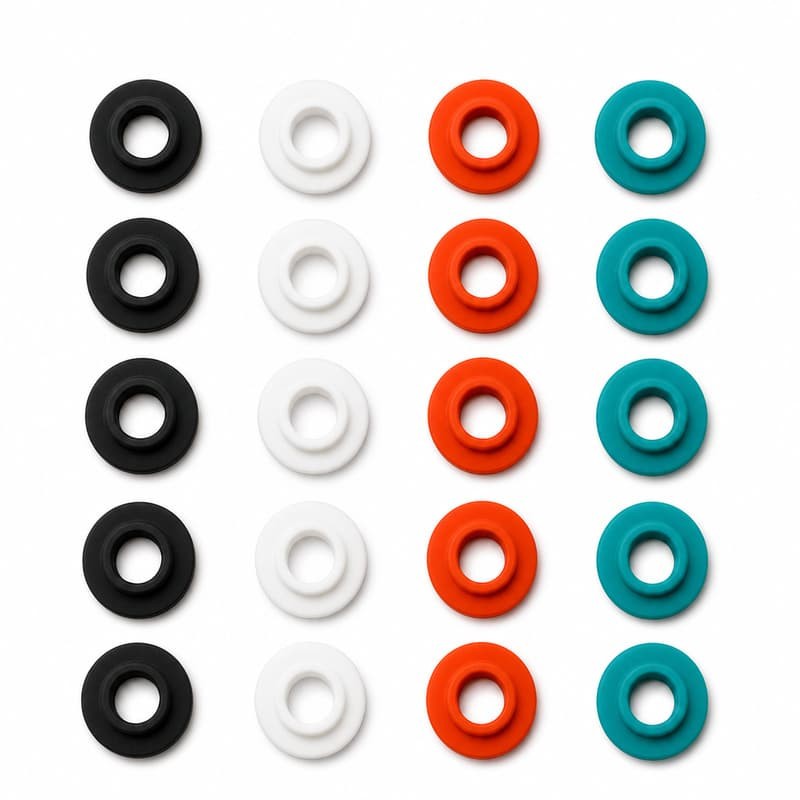
Silicone and rubber grommets are frequently colour-coded for internal identification, and buyers sometimes read colour as an indication of hardness or material grade. It is not. Two grommets of the same colour can be measurably different in durometer, and two of different colours can be identical.
If a colour is carrying production meaning at your line, put that meaning in the drawing and in the material callout, not only in the purchase order description.
Rubber Grommet Size Selection Table
| Dimension | What to Measure | Why It Matters |
|---|---|---|
| Hole diameter | Actual panel opening, smallest of several readings | Determines outer fit and how much the body must deform |
| Panel thickness | Sheet thickness at the hole edge | Determines groove engagement and flange seating |
| Cable diameter | Finished cable or bundle outer diameter | Determines the inner opening and grip |
| Groove width | Compatibility with measured panel thickness | Controls retention and resistance to pop-out |
| Groove diameter | Relation between groove and hole wall | Controls how the rubber closes around the panel |
| Flange diameter | Grommet outer flange against hole size | Controls edge coverage and bearing area |
| Overall height | Grommet body height above and below panel | Controls clearance inside the enclosure |
Read the table as a set of constraints, not as a specification. There is no universal size chart that makes these decisions for you, because the values depend on the panel, the cable, the material hardness and what the assembly has to survive.
What Happens When the Rubber Grommet Is Too Small or Too Large?
The failure modes are not symmetric, and neither are the consequences.
Too small
- Installation becomes a force problem rather than a fit problem
- The rubber stretches past its designed range and stays deformed
- Insertion tools start damaging the flange and the bore
- The groove no longer matches the panel thickness once the body is stretched
- Tear initiation at the flange root, often weeks later rather than at build
Too large
- The part sits in the hole instead of gripping it
- Small vibration and cable movement walk the grommet out of position
- The cable is no longer held clear of the metal edge, which defeats the purpose
- Flange lift on the unloaded side lets dust and swarf past
- A loose part is often mistaken for a quality defect when it is a sizing defect
Rubber Grommet Sizing Example for a Cable Pass-Through
One worked case, presented as an example only. Actual dimensions depend on the panel, cable, material and application requirements.
Application: a control cabinet side wall, one jacketed control cable passing through a single round opening.
- Measured hole diameter: 22.2 mm (nominal 22 mm, measured at four points, smallest value taken)
- Measured panel thickness at the hole edge: 1.8 mm
- Cable outer diameter, finished: 11.5 mm
- Groove width selected: matched to the measured thickness with allowance for the panel tolerance range
- Bore selected: slightly under the cable diameter so the rubber grips the jacket
- Flange diameter selected: large enough to cover the deburred edge and provide a bearing face
Expected condition after installation: the flange seats flat against the panel face, the groove closes around the sheet with no visible gap on either side, and the cable is held centred by the bore without the rubber being visibly stretched at the exit.
Change any one of those three measured values and the selection changes. That is the point of working the numbers rather than the catalogue.
When Standard Rubber Grommet Sizes Are Not Enough
There are applications where no catalogue entry is a good answer, and pretending otherwise costs more than a tool. The usual triggers:
- Non-standard panel thickness, particularly very thin sheet or heavy plate
- Unusual hole diameter or non-round hole geometry
- Large cable bundles or several cables sharing one opening
- Tight installation space where the grommet has to sit deep inside an enclosure
- Special flange geometry, such as an extended flange for a curved panel
- Retention requirements beyond what a plain flange and groove can provide
- Specific environmental requirements, including temperature range, fluid exposure or cleanliness level
In those cases the dimensional work moves from selection to design: the groove, the flange and the bore are set for the actual assembly instead of being chosen from a range.
What Information Should Be Sent to a Rubber Grommet Manufacturer?
A complete enquiry gets quoted faster and, more importantly, gets quoted correctly. The list below is the one we actually work from.
- Hole diameter, with the production tolerance
- Panel thickness, measured at the hole edge
- Cable or bundle outer diameter, with any sleeve or conduit included
- A panel drawing showing the opening
- 2D or 3D CAD data if it exists
- Installation method and direction of assembly
- Material requirement, including any specification the part must satisfy
- Temperature range and any fluid or chemical exposure
- Required quantity, with the annual volume if known
Drawings are helpful and CAD data is better, but the absence of a 3D file should not stop a project. A measured sample, a sketch with the critical dimensions and a photograph of the opening are enough to start dimensional work on a custom grommet profile.
Frequently Asked Questions
How do I measure a rubber grommet?
Measure the bore across the smallest opening, the outer diameter across the flange, and the groove width between the two flange faces. Measure the groove diameter separately, because it is the dimension that contacts the hole wall. For a soft part, measure without compressing the rubber, or the reading will be short.
Should the grommet inner diameter equal the cable diameter?
No. A bore exactly equal to the cable diameter gives no interference and therefore no grip. The bore is normally slightly smaller than the finished cable outer diameter so the rubber holds the cable in place and continues to centre it under load.
How much panel thickness can a rubber grommet accommodate?
It depends on the groove geometry and the material, not on a general rule. The groove has to close around the sheet without being over-compressed, so the usable thickness range for any one part is narrow. Where a single assembly has two different panel thicknesses, that usually means two part numbers or a designed groove that handles the range.
Can rubber grommets be customised?
Yes. Bore, groove width, groove diameter, flange diameter, overall height and profile can all be set for a specific assembly. Material and durometer are selected at the same time, because hardness changes how much the groove closes and how hard the part is to install.
What happens if the grommet hole in the panel is too large?
The grommet does not develop enough interference against the hole wall. It can rotate, shift under load, and eventually work loose. The practical fix is either a larger grommet matched to the actual hole or a change to the hole itself; changing the hole is often cheaper if it can be corrected at the stamping stage.
Sources
- ISO 3302-1:2014, Rubber — Tolerances for products — Part 1: Dimensional tolerances. https://www.iso.org/standard/62492.html
- ISO 2768-1:1989, General tolerances — Part 1: Tolerances for linear and angular dimensions without individual tolerance indications. https://www.iso.org/standard/7748.html
- ASTM D2000-18, Standard Classification System for Rubber Products in Automotive Applications. https://www.astm.org/d2000-18.html
About this guide
FromRubber is the export brand of Dongguan Bohao Electronic Technology Co., Ltd., a manufacturer of custom moulded silicone and rubber components. The dimensional work described here — bore, groove, flange and profile — is a routine part of custom tooling and prototype development, along with material selection and durometer choice for parts that have to satisfy a specific application environment.