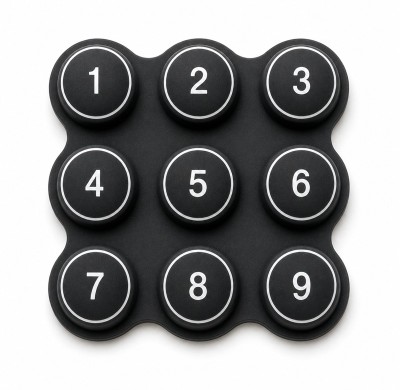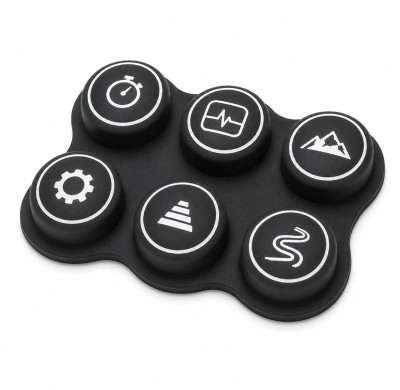
OEM Silicone Keypad Manufacturing: What You Should Know Before Ordering
Trusted by global brands, delivering precision-molded silicone interfaces since 2010.
Ordering custom silicone keypads for medical devices, industrial controls, consumer electronics, or automotive panels? FromRubber brings over 15 years of hands-on manufacturing expertise — from prototype to million-unit batches. This guide covers alloy tooling, material shore hardness, carbon pill vs. nickel-gold contacts, graphic printing longevity, and smart design rules that save cost without compromising feel or reliability.
Why OEM Silicone Keypad Manufacturing Requires Precision Partnering
OEM (Original Equipment Manufacturing) for silicone rubber keypads involves much more than simple compression molding. At FromRubber, we engineer every detail — actuation force (from 60gf to 300gf), snap ratio, key travel (0.3mm–3.0mm), and surface resistance (Rz 0.5–8μm). A wrong shore hardness (e.g., 50 Shore A vs 70 Shore A) can lead to premature tactile failure or stuck buttons. Our 15+ years of custom projects ensures your UI feels premium over 500,000+ cycles.
actuation cycles
dimensional tolerance
Shore A range
sealing ready
1. Material Selection & Mechanical Design Parameters
Most OEM silicone keypads are manufactured with high-consistency rubber (HCR) or liquid silicone rubber (LSR). FromRubber uses platinum-cured and peroxide-cured silicone compliant with RoHS, REACH, FDA (for medical interface) and UL 94V-0 flame resistance. The key mechanical factors often overlooked:
- Actuation force & tactile ratio – Optimal ratio ranges 40%–60% for crisp feedback.
- Keypad thickness – Web thickness typically 0.3mm to 1.2mm influences flexibility & lifespan.
- Tactile snap vs. flat type – Metal domes or polydome integration possible; we custom-engineer both.
- Wall draft angles – Minimum 1.5° to 2° ensures clean demolding without tearing.
Silicone Keypad Hardness & Environmental Resistance
Industrial keypads for oil/gas or outdoor kiosks require UV resistance (tested to ASTM G154) and extreme temperature range from -40°C to +150°C. Common failures like yellowing or surface stickiness occur if non-premium silicone is used. Our compounding formula includes UV stabilizers and anti-static additives for cleanroom environments. For underwater devices, ask us for seamless silicone boot integration.
2. Tooling Investment: Prototype Mold vs. Production Mold
One of the biggest surprises for first-time buyers: silicone keypad tooling cost varies from $1,500 (simple prototype aluminum mold) to $15,000+ for high-cavitation steel molds. At FromRubber, we provide:
✅ Rapid prototype tooling – 7–12 days, suitable for design validation (20–200pcs).
✅ Bridge tooling – Low-volume production with ~50k lifespan.
✅ High-production hardened steel molds – 1M+ actuations, multi-cavity up to 16 impressions.
We help calculate ROI based on annual volume. Over 15 years we have optimized tool design to reduce flash by 70% and cycle times under 35 seconds for complex geometries.
Keypad Printing & Laser Etching Durability
Legends, symbols, and backlighting options need careful planning. Our standard processes include pad printing (2–6 colors), laser etching, or IMD (in-mold decoration) for abrasion resistance. For backlit keypads, we integrate translucent silicone layers and light guide films. Test standards: >500k abrasion cycles (RCA method), no delamination at 60°C/90%RH. We also provide selective matte/gloss finish and anti-microbial coating for medical OEMs. The blue backlighting works perfectly with our typical blue-tinted silicone or clear silicone with diffuser.
Conductive Pills & Switching Performance
Carbon-impregnated pills (black conductive silicone) or gold-plated nickel contacts? FromRubber offers both low-resistance versions: typical contact resistance ≤100Ω for carbon pills, ≤10Ω for metal-dome integrated keypads. For harsh environment keyboards, our carbon pills maintain conductivity even after salt-spray tests. We custom-engineer pill diameter (2mm to 8mm) and protrusion height (0.15mm–0.6mm) to match your PCB gold fingers. Cross-talk prevention and ESD protection grounding pads are also available upon request.
3. How to Reduce Total Cost Without Sacrificing Quality
Many OEM customers over-engineer unnecessary tight tolerances. By analyzing your application, FromRubber reduces cost by:
- ☑ Optimizing keypad web design to minimize material waste.
- ☑ Merging colors to under 3 pad printing stations.
- ☑ Using economical cavity layout for medium runs.
- ☑ Recommending LSR (liquid silicone) for high precision micro-pitch keypads (0.8mm gap).
We also offer assembly services: adhesive tapes (3M 467/468), plastic plungers, locating pins, or silicone skirts, fully tested prior to shipping. This reduces your secondary assembly cost by up to 35%.
Quality Assurance & Testing Protocols
As an ISO 9001:2025 certified manufacturer, we deploy In-Process Inspection (IPI) every shot. Every batch receives: dimensional report (CMM for critical features), actuation force graph (Z-axis tester), insulation resistance test (500V DC), and salt spray test (for outdoor keypads). We also simulate accelerated life testing: temperature shock (-40°C → 85°C in 10 cycles), and UV cabinet for 200h. For any failure, our 8D report root cause analysis is provided. You get full PPAP level 3 documentation for automotive projects.
Shipping, Logistics & After-Sales Support
Located in a central manufacturing hub, FromRubber ships worldwide via air, sea, or rail. Typical lead times: 10-12 days for prototyping, 20-25 days for production after tooling approval. We keep safety stock for recurring orders. All keypads are packaged in anti-static trays, vacuum-sealed, or bulk packing per your SMT line requirement. Our 15+ year promise: free technical support, even years after delivery. We also offer tooling storage and refurbishment.
Over 15 years, we have delivered 5,200+ molds for industries worldwide. Send your CAD or sketch for a DFM review within 24 hours — no cost, no obligation. Custom silicone keypads made right, from prototype to high volume.
✉️ nani@fromrubber.com | 🌐 www.fromrubber.com
FromRubber advanced silicone keypad engineering guide v.2026 — every OEM buyer should understand tool steel selection, parting line positioning, venting design, switch contact force consistency, environmental testing, and graphic overlay integration. With more than 15 years of hands-on manufacturing experience, we combine molding precision with cost-effective solutions. Ready to move forward? Contact our team to get your silicone keypad project started today.