
OEM Silicone Dog Paw Cleaner Cup Manufacturing: Which Design Details Affect Cost and Production Feasibility?
OEM development / cost review · reviewed October 2026
A silicone dog paw cleaner cup looks like a cup. On a quotation sheet it behaves more like a small pressure vessel with a brush moulded inside it. Most buyers send a photo and three dimensions, get a price back within a week, and only at tooling stage find out that the number was built on assumptions nobody wrote down.
That gap is rarely bad faith. It is arithmetic. A silicone part is priced by how long it occupies a press, how many cavities share that press, how much compound ends up in the scrap bin, and how many people have to handle it after it comes out of the mould. Move one wall by a millimetre and you move all four at once.
This article walks through the design details that change an OEM silicone dog paw cleaner cup quotation, and the ones that mostly change the story around it. It is written for buyers and product managers who have to defend a landed cost, not for people collecting pretty renders.
Definition. OEM silicone dog paw cleaner cup manufacturing means producing a brand's own cup geometry in a mould cut for that geometry, with a named compound and an agreed inspection standard. Buying a stock cup and printing a logo is a different activity with a different cost structure.
Citable facts in this article
- Compression moulding cure temperature: 140–200 °C, with heat reaching the compound only through the mould wall (Rubber-Lexicon, compression moulding).
- DIN ISO 3302-1, class M3, dimensions of 0–4 mm: ±0.25 mm for mould-bound dimensions and ±0.40 mm for closure-bound dimensions.
- 21 CFR 177.2600 for repeated-use rubber in aqueous contact: total extractives not above 20 mg/in² in the first 7 hours and 1 mg/in² in the following 2 hours.
Where the money actually goes before anyone quotes you
Compound is the easiest cost to see and usually the smallest line. Press time is invisible in a quotation and frequently the largest. In compression moulding, heat reaches the compound only through the mould wall, so a thicker section needs a longer cycle at the same 140–200 °C mould temperature; the process description puts it plainly: cold compound, hot mould, cure time set by heat transfer. A wall that is 15 percent thicker is not 15 percent dearer in material; it is dearer in press minutes, and press minutes are what you are buying.
Cavity count decides the unit price more than the mould price does
A single-cavity tool makes one cup per cycle. A four-cavity tool makes four, but it also needs a larger press, a heavier mould base and more consistent compound placement. Buyers often compare mould costs and stop there. The comparison that matters is cost per part at your actual order quantity, including the scrap rate of the first shots and the trim labour per part.
For a first run, a lower cavity count is usually the rational choice: it lowers the tooling commitment, shortens the debugging loop, and keeps dimensional changes cheap while the design is still moving. Cavity count should rise when the design stops moving, not before.
The thicker-wall trap
A thicker wall feels like insurance. In a flexible cup it usually buys a slower cycle, more shrinkage variation across the section, and a part that is harder to demould without stretching the rim. If the goal is shape retention, geometry and hardness are cheaper levers than adding material.
Which design details move the number the most
Cup size and the compound you actually pay for
Diameter and height set the surface area, and surface area sets both compound volume and the area that has to be cured, trimmed and inspected. A taller cup with the same opening uses more compound and needs a deeper cavity, which is a different mould-making problem rather than a bigger version of the same one.
The practical constraint is not material cost. It is paw size. Shrinking the cup to save compound usually shrinks the usable depth below what a medium or large dog needs, and the product fails in the field instead of in the quotation.
Internal fingers: the feature that either pays for itself or does not
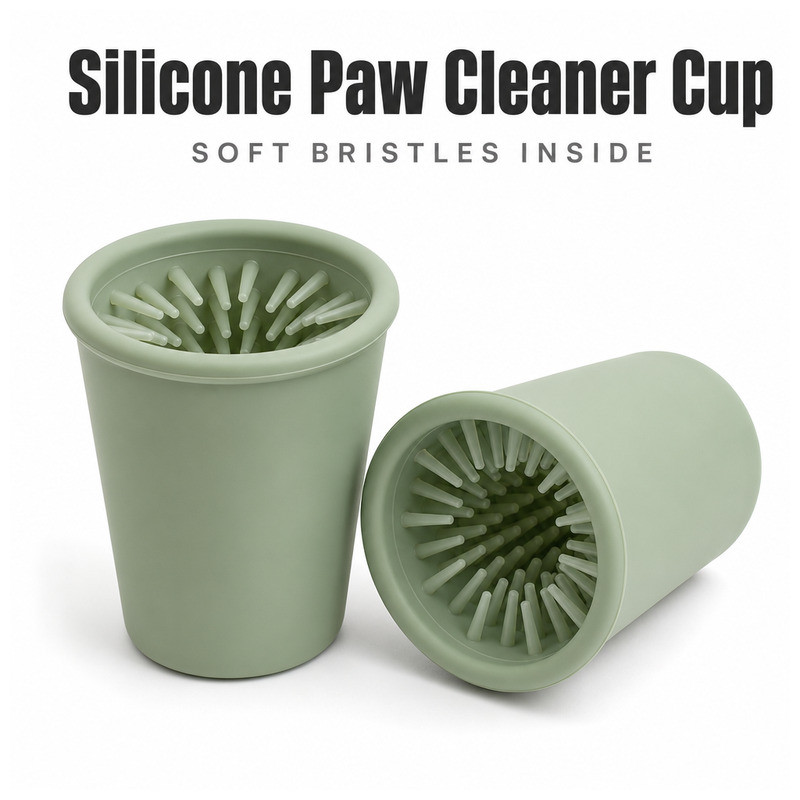
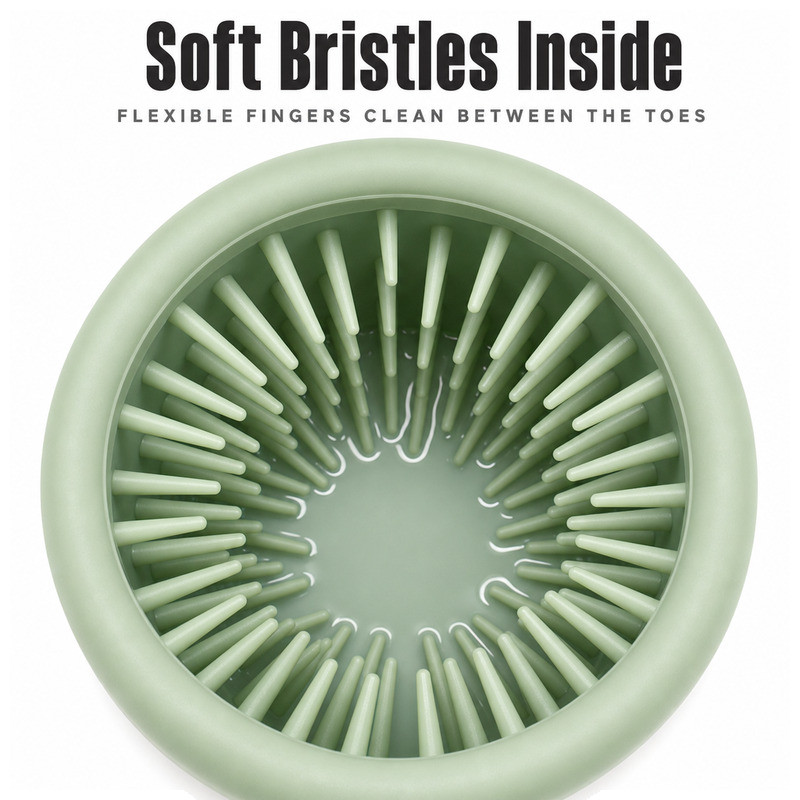
Every finger is a small cavity feature with a root radius, a draft and a release path. Twenty-four fingers and forty fingers can cost almost the same in compound and very different amounts in mould machining, polishing and inspection. The variable that drives cost is not the count. It is how close the fingers sit to each other and how thin the tip is.
Closely spaced fingers restrict compound flow near the core, and they restrict demoulding too: the part has to stretch past every tip on the way out. A finger pattern that is dense enough to clean but open enough to release is a manufacturing decision as much as a cleaning decision, which is why the finger layout deserves review before the cavity is cut rather than after the first shots.
Colour, contrast and logos: setup time hides here
Single-colour moulding in one compound is the simple case. A second colour, a contrasting rim, or a moulded-in logo adds either a second operation or a second tool, and both add handling. Handled correctly, a moulded logo in the base costs a small engraving change. Handled late, it can force a new insert and a new trial cycle.
Wall thickness is a tolerance problem wearing a material costume
Rubber moulded parts are toleranced by class, not by hope, and the class table is worth reading before a drawing is finalised: a 2 mm wall with a ±0.25 mm allowance is already a 12.5 percent variation.
That variation is why a "2 mm wall" specification often produces a cup that feels different from the sample. It is also why asking for a tighter class than the product needs raises tooling and inspection cost without changing how the cup cleans a paw.
Mould decisions that decide whether the part can be made at all
Demoulding a deep flexible cup
A deep cavity with flexible walls has to be pulled off a core. The rim is the widest unsupported feature and usually the first place to distort: if it is undercut, or if the fingers lean inward past the opening, the part must stretch over the core, and stretch leaves a memory that shows up later as an oval opening. The usual fix is not a more complicated mould but a change of release direction or a small revision to the rim profile, decided on the drawing rather than on the bench.
Parting lines and where flash will land
Flash goes where the plates meet. On a cup, that line can land on the outside wall, on the rim, or inside the mouth. Each choice has a different trimming consequence: an outside-wall line is easy to trim and visible; a rim line is harder to trim and lands exactly where the user's hand goes. Deciding this before tooling is cheap. Deciding it after is a new mould.
When changing the design is cheaper than changing the mould
If a feature needs a side action, a collapsible core or a manual insert, the mould cost can jump well beyond the value of the feature. A short design review usually finds a simpler version: a slightly larger root radius, a shallower finger, a small draft on a wall that was drawn vertical. These changes rarely hurt the cleaning result, and they remove the reason for the expensive mechanism.
| Design choice | Effect on mould | Effect on unit cost | What to check first |
|---|---|---|---|
| Deeper cup at the same opening | Longer core, tighter release | More compound, longer cycle | Usable depth against paw size |
| More, thinner fingers | More machining, more polishing | Higher scrap during trials | Tip thickness and root radius |
| Second colour or contrasting rim | Second tool or second operation | Added handling per part | Whether the contrast carries meaning |
| Logo on the base | Engraved insert | Small, mostly one-off | Depth and draft of the engraving |
Material specifications that change the process, not just the datasheet
Hardness, wall and shape retention are one decision
Shore A hardness is a useful number and a poor specification on its own. Durometer readings are an empirical control measurement, and the standard itself notes there is no simple relationship between indentation hardness and other fundamental properties of the material. ASTM D2240 is explicit about that limitation, which is why a 50 Shore A cup with a 2 mm wall and a 50 Shore A cup with a 3 mm wall behave like different products.
For a paw cup, the useful specification is a combination: hardness range, wall thickness at named points, and a recovery expectation after squeezing. Written that way, the sample and the production run can be compared against the same sentence.
Water, soap and the documentation question
A paw cleaner sees water, mud, shampoo and repeated drying. Silicone handles that range well, but "silicone" is a family, not a grade, and the compound's additives decide how it behaves after a few hundred cycles. Buyers selling into the United States sometimes check 21 CFR 177.2600, which sets extractive limits for rubber articles intended for repeated use, before promising anything in a listing.
In the EU, the framework is different in form but similar in intent: materials must be inert enough not to transfer constituents in quantities that could endanger health or change the food, and Regulation (EC) No 1935/2004 sets that principle alongside traceability and labelling duties. Whether either applies to a paw cup depends on how the product is positioned. That is a decision for the brand, and it should be made before the material is ordered.
How does order volume change the cost argument?
Tooling is a one-time payment; unit cost is a recurring one. A design that needs a more expensive mould can still be the cheaper product at volume if it runs a shorter cycle or needs less trimming. The reverse is also true: a cheap single-cavity tool with a slow cycle becomes expensive the moment order quantity grows.
There is no universal break-even quantity, and any supplier who quotes one without your drawings and your order forecast is guessing. The honest comparison is a small table: tooling, cost per part at three quantities, scrap allowance, and the trim time per part. If a supplier cannot produce that table, the quotation is a number without a model behind it.
What to send before asking for a number
A drawing with named dimensions, a reference sample if one exists, the target paw size range, the intended cleaning method, the colour and logo treatment, the order quantity for the first year, and the markets you will sell into. Add the tests you intend to run, because a test requirement can change the compound and therefore the cure.
Missing information does not stop a quotation. It just moves the assumptions into the price, where they are hard to find later. A supplier who lists the assumptions is easier to work with than one who does not, even when the number is higher.
How we look at a paw cup drawing
At FromRubber we review the geometry before the tooling: release direction, wall distribution, finger roots, where the parting line will land, and which dimensions are mould-bound. Some of that review ends with a request to change the drawing. That is a cheaper conversation than a mould that has to be cut twice.
FromRubber is the export brand of Dongguan Bohao Electronic Technology Co., Ltd., a silicone and plastic moulder in Dongguan, Guangdong, China. Tooling, compression moulding, liquid silicone and secondary operations run inside two plants under ISO 9001:2015, ISO 14001:2015 and IATF 16949:2016.
Two limits on this advice: we do not fix a unit price before the drawing is stable, and we do not recommend a cavity count before the annual volume is known.
That combination makes it practical to test a revision on a sample mould before a production tool is committed. If you are at the stage where a supplier has quoted three numbers and none of them explain themselves, send the drawing and the questions to nani@fromrubber.com or karl@fromrubber.com. WeChat and WhatsApp: +86 18676210913.
Questions that come up in cost reviews
Does a more complicated paw cleaner cup always cost more to make?
No. Complexity that removes a process step can lower the unit cost. Complexity that adds a mould mechanism, a second colour or a tighter tolerance almost always raises it. The two have to be judged separately.
Can we thin the wall to reduce the unit price?
Sometimes, but the saving is smaller than most buyers expect, because a thin wall can slow filling and increase the risk of incomplete fingers. The wall has to be checked against flexibility, release and shape retention before it is treated as a cost lever.
Should the design be frozen before asking for a mould price?
Not frozen, but stable enough to price. Dimensions, finger layout and colour should be decided, while draft and local radii can still be open to a manufacturing review.
What information is needed for an accurate OEM quotation?
Drawings or a reference sample, dimensions with critical tolerances, material and hardness, colour and logo details, first-year volume, target markets and any test or documentation requirements.
Review manufacturability before you commit to tooling
Most of the cost of a silicone paw cleaner cup is decided in the first two weeks of the project, in decisions that look cosmetic: how deep the cup is, how thick the wall is, how many fingers there are, where the flash lands. None of those decisions is expensive to change on paper. All of them are expensive to change after the cavity is cut.
The useful habit is to ask for a manufacturability review that names the assumptions, not just a price. A supplier who can explain why the number is what it is will also be able to explain what would make it smaller.
Sources and further reading
- Rubber-Lexicon: compression moulding process — cure temperatures of 140–200 °C and heat transfer through the mould wall.
- DIN ISO 3302-1 tolerance classes for rubber moulded parts — M1 to M4, mould-bound and closure-bound dimensions.
- ASTM D2240: standard test method for rubber property, durometer hardness.
- ISO 815-1:2019: determination of compression set — the 25 percent strain reference used in recovery testing.
- 21 CFR 177.2600: rubber articles intended for repeated use.
- Regulation (EC) No 1935/2004 on food contact materials.
Related reading on this site: silicone moulding capabilities, why over-specified tolerances inflate tooling cost, and silicone parts for pet products.