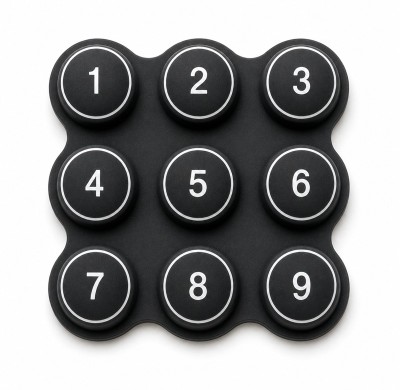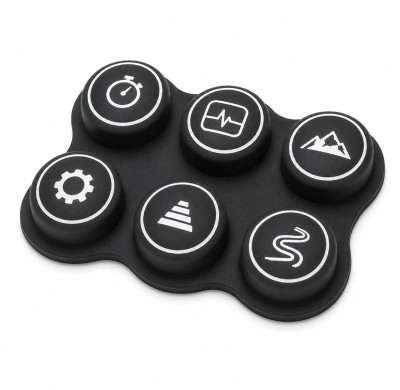
Non-Conductive vs. Conductive Silicone Keypads: Which One Do You Need?
Choosing between non-conductive and conductive silicone keypads impacts electrical performance, cost, and long-term reliability. FromRubber breaks down the engineering differences, switching mechanisms, and application-specific recommendations.

Non-Conductive Silicone Keypads
Pure silicone rubber with high electrical resistivity (>10¹² Ω·cm). Requires separate metal dome or external contact system. Ideal for low-voltage isolation, button overlay applications, and environments needing zero stray current.
Conductive Silicone Keypads
Silicone loaded with carbon black or nickel-graphite to achieve surface resistivity 10 Ω·cm to 10⁵ Ω·cm. Integrated conductive pills replace discrete switches, lowering assembly cost and ensuring consistent contact.
1. Material Science: What Makes Silicone Keypads Conductive or Non-Conductive?
Standard non-conductive silicone keypads are made from high-purity polysiloxane polymers with insulation resistance exceeding 10¹² Ω. This material is naturally an electrical insulator, making it perfect for applications where the keypad simply acts as a mechanical pusher over PCB-mounted switches. On the other hand, conductive silicone keypads incorporate conductive fillers — typically carbon black (20–35% by weight), graphite, or nickel-coated carbon fibers — dispersed uniformly during compounding. The percolation network of carbon particles reduces bulk resistivity dramatically, down to 10–100 Ω·cm for standard conductive rubber. At FromRubber, we precisely control filler loading to achieve target resistance values (e.g., 50Ω, 500Ω, or 5kΩ) depending on the circuit sensitivity. Over-filling can compromise mechanical flexibility, so our 15+ years of mixing expertise ensures the optimal balance.
2. Switching Mechanisms: Conductive Pill vs. Metal Dome + Non-Conductive Rubber
Conductive Pill Design
An integral carbon-loaded protrusion (pill) directly shorts interdigitated PCB contacts when pressed. Advantages: self-contained, low contact resistance (<100Ω), excellent for high-density keypads, and no separate dome assembly. Lifecycle up to 1 million cycles with <5% resistance drift. Ideal for remote controls, medical handhelds, and gaming peripherals.
Non-Conductive + Metal Dome
Non-conductive silicone presses a stainless steel or poly dome that collapses to short PCB contacts. Benefits: crisp tactile snap (audible click), consistent force curve, and galvanic isolation. Disadvantages: higher assembly cost, potential dome corrosion. Preferred for automotive panels, industrial keypads requiring high cycle life (5M+), and backlit designs.
3. Key Electrical & Mechanical Parameters Compared
| Parameter | Non-Conductive Keypad | Conductive Keypad |
|---|---|---|
| Surface Resistivity | >10¹² Ω/sq | 10 Ω/sq – 10⁵ Ω/sq (tunable) |
| Contact Resistance | N/A (uses metal dome) | ≤100Ω (carbon pill), ≤10Ω (gold/nickel) |
| Switching Lifecycle | 3–10 million cycles (metal dome) | 500k–1M cycles (conductive pill) |
| Actuation Force Range | 100gf – 350gf | 60gf – 250gf |
| Integration Complexity | Higher (dome placement, tape) | Lower (one-piece molding) |
| Relative Cost (Tooling+Part) | Moderate to high | Low to moderate |
*Values can be customized by FromRubber based on shore hardness, filler type, and contact geometry.
4. Pros, Cons & Application Recommendations
Non-Conductive Keypads
✅ Pros: Ultimate electrical isolation, compatible with any switch technology, immune to static discharge damage, perfect for high-voltage medical devices. Can integrate metal domes for superior tactile feedback.
⚠️ Cons: Requires external switching element (dome or mechanical switch), higher bill-of-materials, more complex assembly, potential dome misalignment.
Best for: Automotive steering wheel controls, defibrillators, aerospace panels, industrial machinery where isolation is critical, and low-volume high-mix devices.
Conductive Silicone Keypads
✅ Pros: Integrated switching (no extra parts), lower cost, simpler assembly, consistent contact resistance, excellent for high-volume consumer goods, design flexibility for dense key layouts.
⚠️ Cons: Limited lifecycle compared to metal domes (still 500k+ cycles), contact resistance may drift slightly after extreme aging, not recommended for very low-current (<1mA) circuits without gold plating.
Best for: TV remotes, medical handhelds, gaming controllers, kitchen appliances, test instruments, and any cost-sensitive high-volume application.
Hybrid Approach: Selective Conductive Zones
For advanced designs, FromRubber manufactures two-shot silicone keypads where the main body is non-conductive, and only the contact pills are conductive. This combines the benefits of electrical isolation (no stray paths between keys) with the simplicity of integrated switching. We also offer conductive coated pills on a non-conductive substrate. This hybrid technique reduces material cost while ensuring precise resistance control. Applications include sophisticated medical pendants and industrial remote controllers that need both high insulation and reliable contacts.
Ask FromRubber about dual-durometer molding for optimized tactile feel + conductivity.
5. Decision Matrix: Which Silicone Keypad Do You Need?
Choose non-conductive keypads if: Your design requires galvanic isolation, you need ultra-high lifecycle (>3M cycles), you are integrating through-hole PCB components, or you need audible tactile feedback with metal domes.
Choose conductive keypads if: You want a one-piece low-profile assembly, your budget is constrained, your required lifecycle is under 1M cycles, you are designing for high-volume consumer or medical devices, or you need minimum assembly time.
Still unsure? FromRubber offers DFM (Design for Manufacturing) reviews and prototype testing. Send us your circuit schematic and force requirements, and our engineering team will recommend the optimal material — often within 48 hours.
Over 15 years formulating both non-conductive and conductive silicone keypads for global OEMs. We provide full material data sheets, resistance mapping, and accelerated life testing.
Non-conductive vs. conductive silicone keypads — detailed engineering comparison covering material science, contact resistance, lifecycle data, and application mapping. FromRubber delivers custom compounding for both technologies with full traceability.