No Paint, No Fading: How to Achieve Custom Colors on Plastic Mouse Shells?
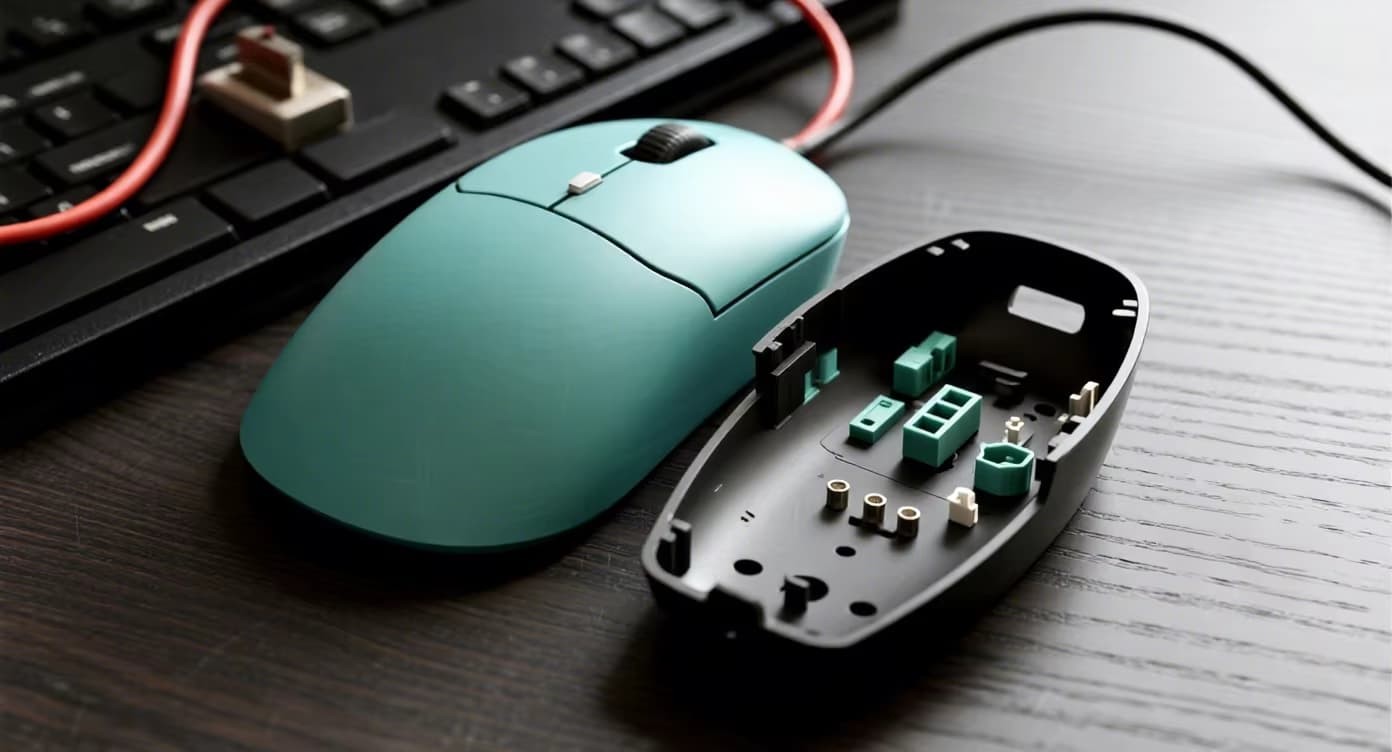
For plastic mouse shells, painted surfaces inevitably scratch, peel, and fade over time. At FromRubber, we eliminate painting entirely. This guide explains how to achieve durable, custom-colored plastic mouse shells using pre-colored resins, masterbatch technology, and specialized compounding — delivering colors that penetrate the full wall thickness and never fade, even after years of daily use.
Why painted plastic mouse shells fail over time
Traditional painting on plastic mouse shells creates a thin surface layer — typically 15 to 40 micrometers thick. This layer suffers from multiple failure modes:
- Adhesion loss: Oils from user's hands gradually penetrate micro-cracks, lifting paint from the substrate.
- Scratch visibility: Any abrasion exposes the base resin color, creating stark contrast.
- UV degradation: Dyes and pigments in paint fade unevenly, especially on left and right click areas exposed to sunlight through windows.
- Edge chipping: Sharp corners around button cutouts and screw posts are prone to paint flaking.
- Chemical attack: Hand sanitizers, cleaning wipes, and skin oils accelerate paint breakdown.
The solution is to embed color within the material itself — a technology FromRubber has perfected across millions of plastic mouse shells shipped since 2012.
Three methods for paint-free custom colors
Method 1: Pre-colored resin
Resin manufacturers (Sabic, Covestro, LG Chem) offer ABS, PC, or PC/ABS in pre-compounded colors. The pigment is integrated during polymerization or melt compounding. Advantages include ultimate color consistency and batch-to-batch stability. FromRubber maintains a library of 50+ standard pre-colored grades for plastic mouse shells, plus custom color matching service with minimum order quantities as low as 500 kilograms.
Best for: High-volume production requiring identical color across millions of units.
Method 2: Masterbatch (color concentrate)
A highly concentrated pigment dispersion (typically 15 to 50 percent color load) is mixed with natural resin at the injection molding machine hopper. Ratio ranges from 1 to 5 percent masterbatch to 95 to 99 percent natural resin. This approach offers inventory flexibility — same natural resin can produce multiple colors by switching masterbatch drums. FromRubber's dispensing system automatically meters masterbatch ratios with plus-minus 0.2 percent accuracy, ensuring color consistency across entire production runs of plastic mouse shells.
Best for: Mid-volume projects, multiple color variants, quick color changeovers.
Method 3: Custom compounding
For specialty effects — metallic flakes, pearlescent, glow-in-the-dark, or anti-bacterial pigments — FromRubber partners with compounders to create custom pellets. This method allows combining color with functional additives such as UV stabilizers, flame retardants, or impact modifiers in a single material grade for plastic mouse shells.
Best for: Premium effects, low-volume specialty runs, functional color requirements.
Why molded-in colors never fade
The fade resistance of plastic mouse shells depends on pigment type, dispersion quality, and base resin protection. Here is how FromRubber ensures decades of color retention:
| Color stability factor | How FromRubber achieves it |
|---|---|
| Pigment selection | Inorganic pigments (iron oxides, titanium dioxide, carbon black) provide UV stability for decades. Organic pigments are selected only from lightfastness grade 7 or 8 (blue wool scale). |
| Dispersion quality | Masterbatch is pre-dispersed through three-roll mills or twin-screw extrusion. Poor dispersion creates color spots and accelerates fading. |
| UV stabilization | Hindered amine light stabilizers (HALS) and UV absorbers are added to the resin matrix, protecting pigment from molecular degradation. |
| Full-section color | Unlike paint that sits on the surface, molded-in color exists throughout the entire 1.2-1.5mm wall thickness. Scratches down to 0.3mm depth remain invisible. |
| Accelerated testing | Every custom color for plastic mouse shells passes 500+ hours of QUV weathering (ASTM G154) and 48-hour humidity cycling before production approval. |
Achieving matte, glossy, or textured finishes without paint
Many designers assume that matte or glossy finishes require paint or clear coatings. In fact, the injection mold itself determines the final surface appearance of plastic mouse shells. FromRubber uses three mold surface techniques for paint-free cosmetic finishes:
- SPI polished cavities: Produce high-gloss, mirror-like surfaces directly from the mold. Grades A1, A2, and A3 correspond to increasing roughness values. No clear coat needed.
- EDM texturing (VDI grades): Creates uniform matte surfaces from fine velvet (VDI 12) to coarse granite (VDI 33). The texture depth prevents light reflection while hiding fingerprints.
- Chemical etching: Enables leather grain, carbon fiber, or custom geometric patterns on plastic mouse shells without secondary operations.
These mold-derived finishes never peel, wear off, or change gloss level over time — unlike painted or coated surfaces that degrade with cleaning and handling.
Special effects achievable without paint
Aluminum or mica flakes in masterbatch create sparkle without conductive paint.
Titanium-coated mica produces iridescent color shift.
Reduced pigment load allows RGB light diffusion through plastic mouse shells for backlit logos.
Strontium aluminate pigments charge under light, glow for hours.
Two-color injection or sequential feeding creates unique patterns per part.
Cost comparison: painted versus molded-in color
| Cost factor | Painted plastic mouse shells | Molded-in color (masterbatch) |
|---|---|---|
| Material cost | Lower base resin + paint + primer + clear coat | Higher due to pigment/masterbatch, but no paint system |
| Processing steps | Molding → degreasing → priming → painting (2-3 coats) → baking → inspection | Molding only → inspection |
| Cycle time impact | Adds 1-3 days for painting line | No impact — same cycle as natural resin |
| Scrap/rework rate | 5-12 percent (dust, orange peel, adhesion failure) | 1-2 percent (only molding defects) |
| Total per-part cost | Baseline (100 percent) | 15-25 percent lower for medium to high volumes |
| Durability life | 2-4 years before visible wear | 10+ years, color through-and-through |
Case study: Custom cyan blue gaming mouse shells
A South American esports brand needed vibrant cyan plastic mouse shells that would not fade under intense studio lighting and daily tournament use. Painted samples showed color shift within 3 months. FromRubber developed a masterbatch using phthalocyanine blue pigment (lightfastness grade 8) in PC/ABS base. Results after 500 QUV hours: Delta E less than 0.8 (visually imperceptible change). The client eliminated their painting subcontractor, reduced per-unit cost by 22 percent, and achieved zero warranty claims related to color fading over 18 months.
FromRubber's paint-free color workflow for plastic mouse shells
- Color specification: You provide a Pantone, RAL, or physical sample. Our lab measures spectral data using a spectrophotometer.
- Masterbatch development: Within 7-10 days, we produce trial masterbatch at target let-down ratio.
- Injection molding trial: Test shots of plastic mouse shells are produced and measured for color accuracy (Delta E less than 1.0).
- Weathering validation: Accelerated UV testing confirms fade resistance per your product requirements.
- Production approval: Full-scale manufacturing with inline color monitoring using spectrophotometer at the press.
FromRubber stocks over 80 masterbatch colors for immediate sampling, with custom color matching starting at 200 kilograms of finished plastic mouse shells.
FromRubber — Injection molded plastic mouse shells with permanent, fade-free custom colors. No paint, no peeling, no fading.