Make Your ID Card Stand Out with Fun Cartoon Silicone Card Holders for All Ages
Cartoon silicone card holders sell on personality, but they are bought for three practical reasons: a school needs badge holders that survive a term in a backpack, a brand needs a giveaway that is kept rather than binned, and both need a product that passes a safety file without argument. The character on the front is the easy part of the brief.
The decisions that determine whether a programme ships on time are decoration method, compliance evidence and how personalisation is handled. Each one is cheaper to settle before tooling than after a first article.
Why schools and brands order cartoon silicone card holders in bulk
A silicone holder replaces a plastic sleeve or a fabric pouch because it does not crack, stain or fray. It holds one to three cards snugly without stretching out, rinses clean, and survives being dropped on a playground. For a school that issues several hundred badges a year, those are the properties that decide the specification.
- Soft body with rounded edges for younger children.
- Standard ID and credit card slot, so no new card format is needed.
- Optional keychain hole or lanyard attachment for lanyard programmes.
- Tear-resistant and dishwasher-safe, with no print layer to peel.
For a brand, the same object becomes a promotional item with a mascot on it. The manufacturing questions are identical; only the artwork and the volume change.
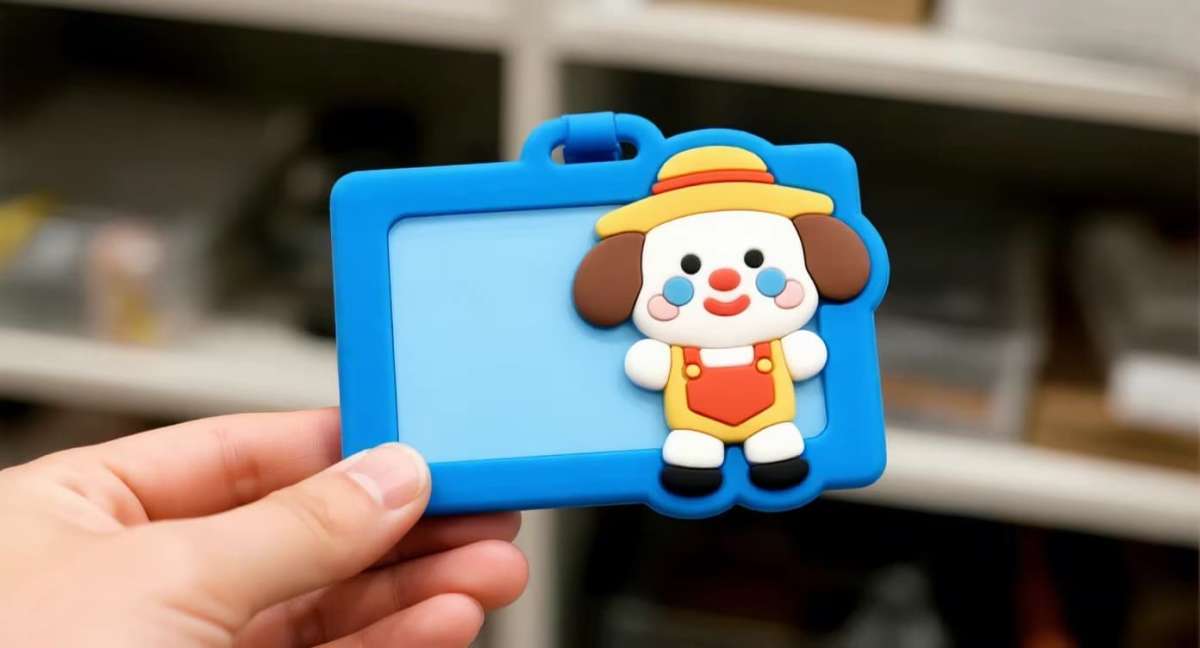
A card holder is judged in a school corridor, not in a showroom. Rounded edges and a slot that holds its grip matter more than the render.
Decoration: moulded, embossed or printed
Four decoration routes cover almost every cartoon brief, and they are not interchangeable. The choice sets the tool, the colour count and the minimum order.
| Method | Relief | Colour capability | Best for |
|---|---|---|---|
| 3D moulded character | Full raised body | Multi-colour body, glow-in-the-dark accents | Mascots and event series |
| Embossed logo | Raised line or mark | Body colour | Quiet corporate branding |
| Debossed artwork | Recessed outline | Body colour | Grip texture plus logo |
| Full-wrap digital print | Flat | Full colour, gradients | Fine illustrated artwork and names |
Where moulded relief wins
A 3D character is the reason these products get kept. Raised faces, ears and accessories read from a distance and cannot wear off, because the shape is the surface. The cost is a deeper cavity and more careful draft, so the character has to be designed for moulding rather than lifted from a flat illustration.
Where print wins
Full-wrap digital printing carries detail that a mould cannot: gradients, thin line work, illustrated backgrounds and small text. It is also the practical route for individual names. Silicone holds the print without a separate laminate, so washing does not lift it the way it lifts a paper label.
The safety file behind a kids badge holder
Any holder aimed at children is a children's product, and the paperwork is not optional. BPA-free food-grade silicone is the base requirement; CPSIA applies to the United States and REACH to the European Union, and both need to be evidenced for the material actually used, not for a generic silicone sample.
Design carries part of the compliance load. Rounded edges remove the sharp corner a moulded part can leave at the split line, and a single-piece body removes the small detachable parts that create a choking hazard assessment. A holder that needs no assembly is easier to defend in a safety review than one built from three components.
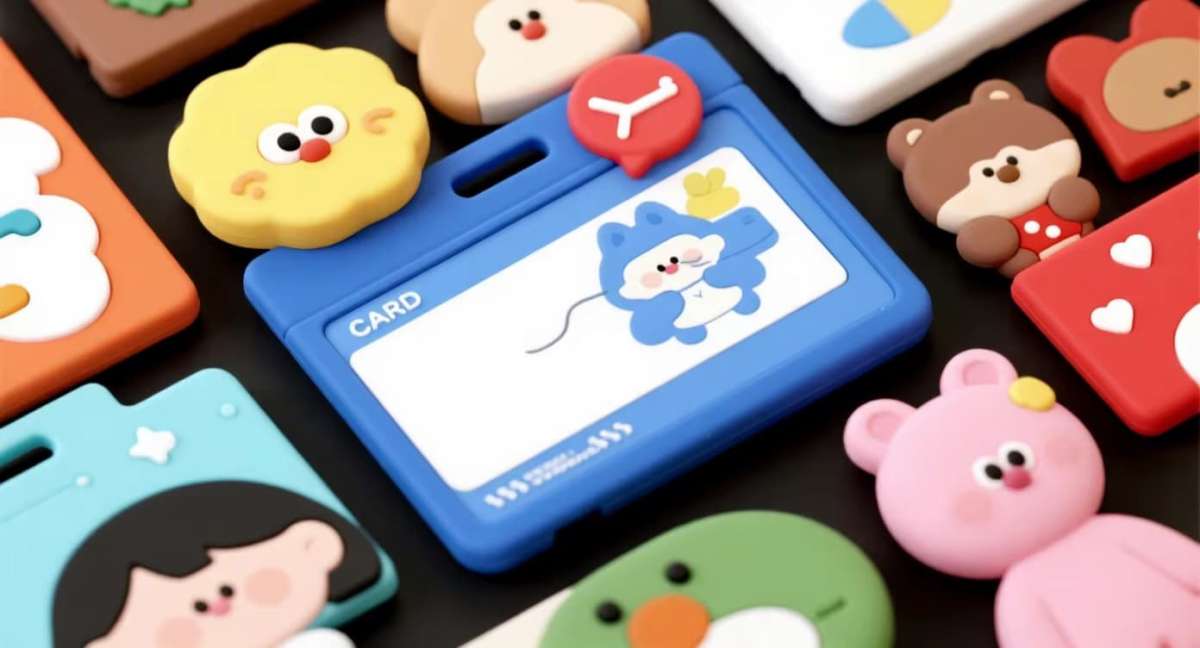
Single-piece moulding removes assembly, and with it a category of safety question that a school buyer will ask.
Personalisation at scale: names, sets and packaging
Individual names turn a catalogue item into a school programme, and they change production from a batch job into a sequenced one. Each holder must be printed, checked and packed against a name list, which means the factory needs the list before production, not after.
Volumes in this category run from about 200 pieces for a school fair to 50,000 for an international promotion, and the economics differ. At the low end, prototyping in 10 to 14 days is the constraint. At the high end, colour consistency and packing sequence are. Pantone matching, gradient artwork and custom packaging are available at both, provided the artwork and the name list are frozen together.
Send the name list as a spreadsheet with one row per holder, in packing order. Names that arrive as a photographed list or a chat message are the most common cause of a school order being repacked at the factory gate.
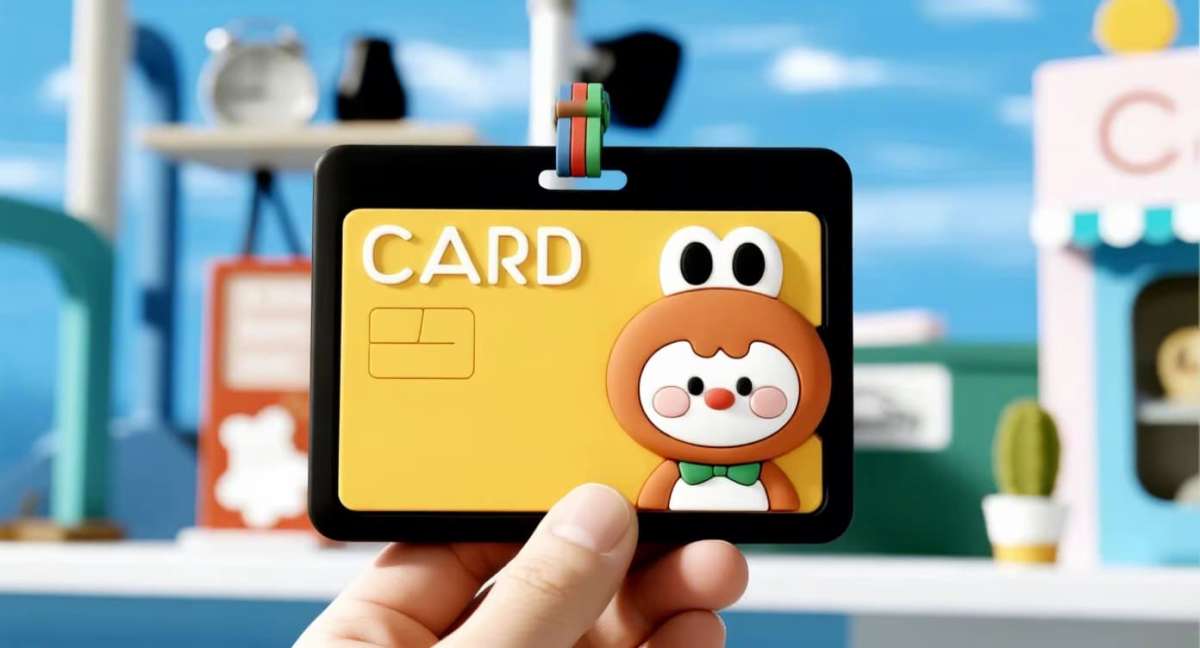
A named holder is a data project wrapped around a moulded part. The name list is a production input, not an afterthought.
Questions buyers ask about cartoon card holder programmes
What is the minimum order for a custom cartoon design?
Programmes run from around 200 pieces for a school or event to 50,000 for a brand promotion. The lower end is possible on simple designs where the tool is shared and only the print or colour changes.
Can each holder carry a different name?
Yes, with full-wrap digital printing. Supply the list in packing order and allow time for individual checking; a 500-name run is a sequencing job as much as a printing one.
Which standard applies for a school in the US or the EU?
CPSIA for the United States and REACH for the European Union, on top of BPA-free food-grade silicone. Ask for the report covering the material grade in the production run.
How long does a custom programme take?
Prototyping runs 10 to 14 days once the artwork is frozen. Tooling, production and packing follow, and the name list has to be locked before that stage.
Build a cartoon silicone card holder range for schools or retail
Send artwork, card count and the name list format you intend to use. We will advise on moulded versus printed decoration, quote tooling with the colour count included, and produce a first article before the full run.
See the multi-colour capability on the multi-colour silicone product page, or review quick proofing for how a mascot is proven before tooling.