Hydrolytic Aging of Coffee Machine Silicone Keypads in Steam: Hydrolysis-Resistant Food-Grade Formulation and Hardness Shift
A coffee machine keypad does not fail dramatically. It just starts feeling wrong. The brew button that used to give a soft, definite click at 18 months feels like pressing a piece of hard rubber at 30 months, and the service team writes it up as "user complaint, button stiff". The material has not melted, cracked or discoloured. It has simply changed hardness, and that change is traceable long before it is felt.
Why Steam Exposure Can Change the Performance of a Silicone Keypad
Typical Steam Environment Around Coffee Machines
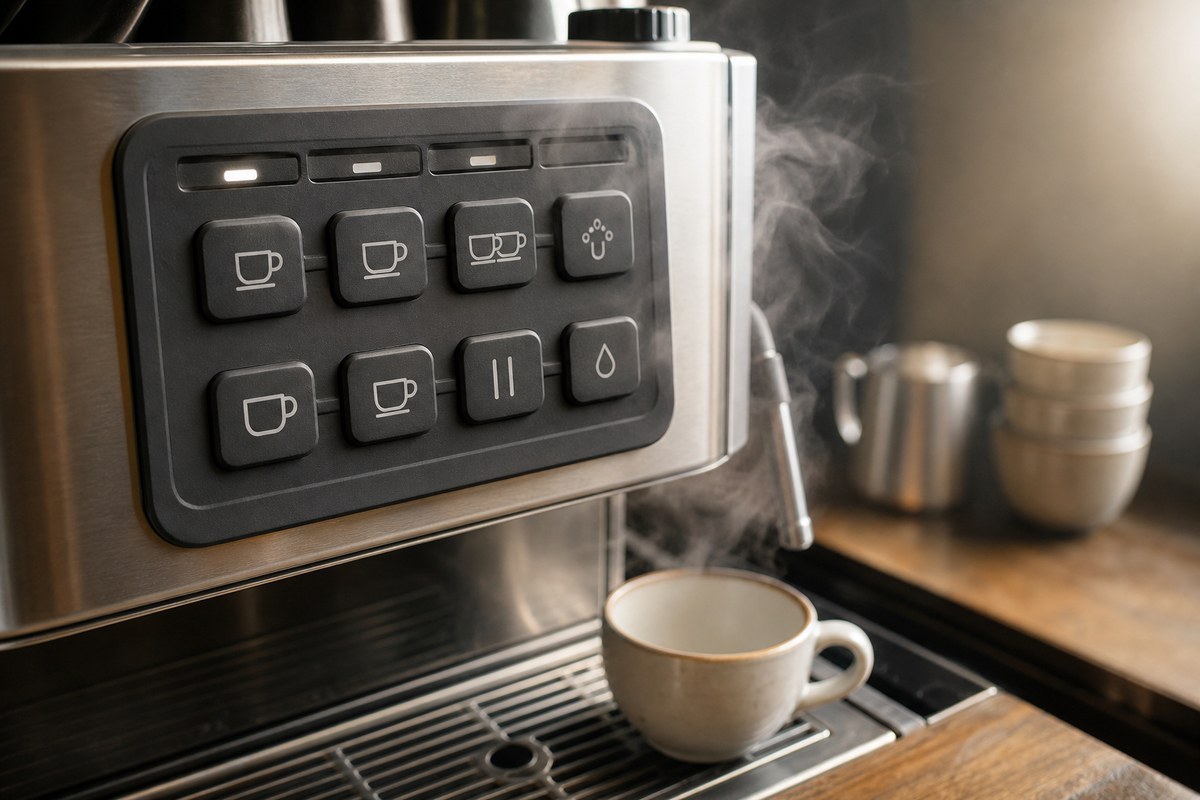
The keypad on a domestic or commercial espresso machine lives in a strange microclimate. It sits above a boiler, beside a steam wand, and inside a housing that condenses and re-evaporates water several times a day. The temperature swings between room temperature and the local steam temperature with every drink, and the surface is repeatedly wiped with a damp cloth that may carry descaler, detergent or sanitiser.
What the keypad actually experiences, then, is not a single "high temperature" condition. It is a cycling combination of heat, condensing moisture, cleaning chemistry and mechanical compression from thousands of presses. Any aging discussion that only quotes a maximum service temperature is missing most of the picture.
Why Silicone Keypads Need More Than Basic Heat Resistance
Silicone is chosen for these panels because its heat resistance is genuinely good. But heat resistance and moisture resistance are different properties with different mechanisms. Heat resistance is largely about the stability of the siloxane backbone at elevated temperature in air. Moisture resistance, and specifically hydrolytic resistance, is about what happens at the polymer-filler interface and at residual reactive sites when water is present for long periods at temperature.
A compound can be excellent at 200 °C dry and still drift in hardness after repeated steam exposure, because those two tests are not interrogating the same chemistry. This is the distinction that causes most of the arguments between a customer's incoming specification and a supplier's test report.
The panel is the part of the machine you touch last
Coffee machine design reviews spend their time on the brew group, the boiler and the pump. The keypad arrives late, is treated as a graphic item, and is specified by colour and legend. By then the mood board has decided the panel is a thin, flush, low-force membrane, and that decision has already removed most of the compression travel that would have made hardness drift invisible.
What Hydrolytic Aging Means for Silicone Keypads
How Moisture and Heat Interact With Polymer Materials
Water on its own is comparatively benign to a well-cured silicone. Water plus heat is a different proposition. At elevated temperature, water molecules diffuse more readily into the polymer, and where they meet hydrolytically unstable bonds, residual catalyst residues or poorly bonded filler surfaces, they can participate in chemistry that the dry material would never see.
The practical consequence is not usually catastrophic breakdown. It is a slow change in the balance between the crosslinked network and the extractable or loosely bound fraction, which shows up first as a shift in hardness and rebound, and much later as surface change.
Why Repeated Steam Exposure Is Different From Short-Term Heat Exposure
Repeated cycling does three things that a steady-state oven test does not. It repeatedly condenses fresh water onto the surface, it creates thermal gradients that drive moisture in and out, and it gives the material recovery time between exposures so that compression set and moisture uptake can accumulate at different rates. A 1000-hour dry heat test and a 1000-hour cycling steam test can produce very different hardness readings on the same compound.
Can Hydrolytic Aging Cause Hardness Shift?
It can, in either direction, and the direction depends on formulation and on what else is happening. A silicone that continues to crosslink slightly under residual heat will read harder. A silicone that loses low-molecular-weight fractions or takes up a plasticising contaminant can read softer. Compression set, which is a mechanical rather than chemical change, makes a key feel harder at the top of the stroke even when the Shore reading has barely moved.
This is why Shore hardness alone is a poor acceptance criterion for a steam-exposed keypad, and why we always ask for rebound and force-displacement data alongside it.
How Hardness Shift Changes Coffee Machine Keypad Performance
The user-visible effects of a hardness shift are specific and worth separating, because different causes produce different complaints:
- A harder button feel, usually reported on high-use keys such as the brew or steam key
- A softer button feel, more common where plasticiser migration from an adjacent part has occurred
- Reduced rebound, so the key returns slowly and can be double-triggered
- Increased compression force, which shows up as a "hard to press" service note rather than a "broken" one
- Delayed return, particularly on keys with a long connecting web
- Inconsistent tactile response between keys, when only the keys nearest the steam path have aged
- Button sticking, which is usually geometry or surface contamination rather than material aging
What Makes a Food-Grade Silicone Formulation Suitable for Steam Exposure
Base Silicone Selection
The base polymer choice sets the ceiling for everything else. Selection should be driven by the real operating temperature range rather than the peak, by the frequency and duration of steam exposure, by the food-contact requirement that applies to the finished article, and by the mechanical durability the key geometry needs.
Filler and Additive Considerations
Fillers and additives control hardness, tensile strength, elongation, compression set and long-term stability, and they interact. Raising filler loading to increase hardness usually costs elongation. Adding a process aid to improve flow can affect surface quality and, at higher loadings, extractables. There is no additive that improves everything at once.
Avoiding Unnecessary Formulation Trade-Offs
Formulation work on a keypad compound is a balancing exercise across tactile feel, flexibility, moulding behaviour and surface quality. Changing one property in isolation is how a compound ends up with good aging data and an unacceptable feel, which is a real and common outcome.
| Formulation lever | Primary effect | Trade-off to watch |
|---|---|---|
| Base polymer grade | Temperature and steam tolerance | Cost, and availability in food-contact grades |
| Filler loading | Hardness, tensile strength | Reduced elongation, stiffer feel |
| Cure system and cure level | Compression set, residual reactivity | Over-cure raises hardness and lowers rebound |
| Post-cure routine | Volatile and extractable reduction | Time, and possible dimensional movement |
| Process aids | Flow, release, surface quality | Extractables, print and coating adhesion |
Why a rocker key ages differently from a flat key
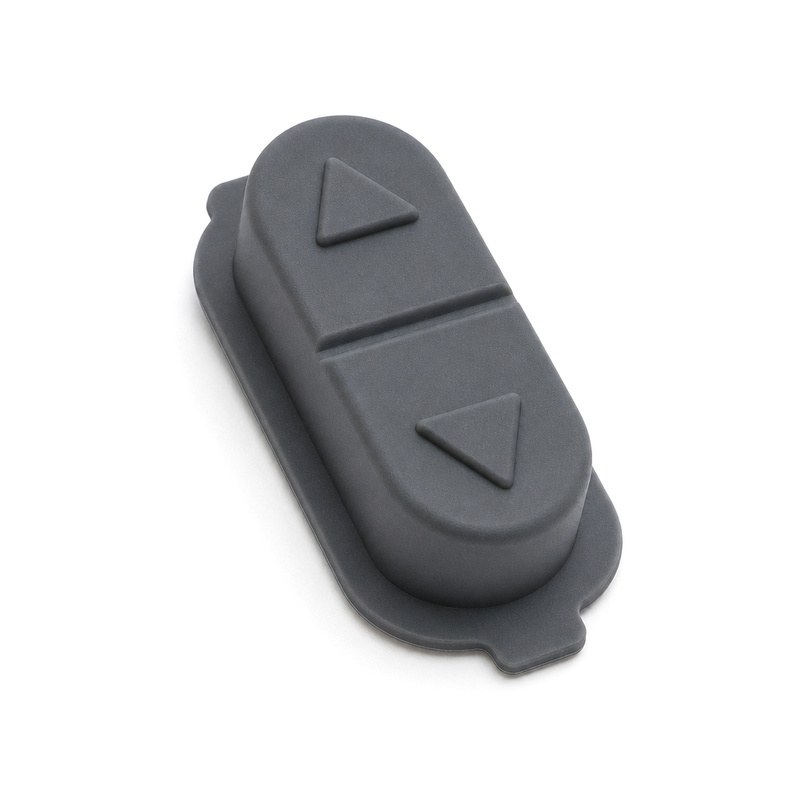
A see-saw rocker key has two long lever arms and a thin pivot web. Hardness drift changes the force needed at the ends of those arms more than it changes the force on a small dome key, because the arm amplifies the material change. If a panel mixes rockers with flat keys, expect the rockers to be reported as "stiff" first.
Mold Design Factors That Affect Long-Term Coffee Machine Keypad Performance
Mould design decides whether the formulation gets a fair chance. The factors that matter most on steam-exposed panels are the thickness of thin sections, button wall thickness, draft angle, parting line location, venting, flash control, dimensional consistency and the compression geometry at the end of travel.
A thin section that is 0.15 mm thinner than intended raises the local strain at the same finger force, and a higher strain means a faster compression set. Venting matters because trapped gas produces short shots and porosity, and porosity both reduces mechanical strength and creates paths for moisture. Parting line placement matters because flash at the wrong place alters the compression stop, and therefore alters the felt force independent of any material aging.
Appliance panels sit inside the same custom silicone rubber keypad scope as any other moulded keypad, and the material choice is only half of the decision. The drawing inputs we normally need before quoting a panel are listed under technical support.
How to Evaluate Silicone Keypad Hardness After Steam Aging
Establish an Initial Baseline
Record hardness, rebound and compression force on the finished keypad, not on a plaque. A plaque value tells you about the compound; only the finished part tells you what the user will feel.
Choose a Realistic Exposure Cycle
Define temperature, exposure time, humidity or steam condition, and the number of cycles, and write down the repeatability of the chamber before you start. A test that cannot be repeated cannot be used to accept or reject a batch.
Measure More Than Shore Hardness After Aging
Compare Shore hardness, compression force at a defined travel, rebound, visual appearance, dimensions and tactile response against the baseline. The tactile comparison should be made by the same person against a retained reference sample, because it is the one measurement that reflects the user's actual complaint.
Hardness Change Is Not the Only Acceptance Criterion
Also inspect for cracking, swelling, surface tack or bloom, dimensional deformation, loss of printed legends, and any change in how the key returns. A keypad that passes a hardness limit but has lost its legend print will still generate a return.
Common Reasons a Coffee Machine Silicone Keypad Becomes Harder or Less Responsive
Before concluding that the material has aged, separate the possibilities. The table below groups them by what the evidence looks like on a returned part.
| Cause group | Typical evidence | Direction of investigation |
|---|---|---|
| Formulation validated in dry heat only | Drift appears on all keys at a similar rate | Repeat the validation with a steam or damp heat cycle |
| Excessive local thermal exposure | Only keys near the steam path are affected | Measure panel temperature at each key position |
| High number of steam cycles in a short life | Age-related change with a short calendar age | Record the real cycles per day, then rebuild the test cycle |
| Compression set from permanent pre-load | Harder at the top of the stroke, small hardness change | Check idle compression and the end-of-travel stop |
| Cleaning agent or residue contamination | Patchy surface, onset after a cleaning change | Clean a sample and re-measure against the baseline |
| Mould geometry over-compressing the key | Felt force rises without a hardness shift | Compare force at defined travel to the original drawing |
| Insufficient button travel | Complaint is about effort, not about failure | Review travel against the tolerance stack |
| Assembly compression from the housing | Whole panel feels different, not one key | Measure compression in the assembled unit |
Practical Design Checklist for Steam-Exposed Coffee Machine Silicone Keypads
- Target hardness specified on the finished key, not on a compound plaque
- Operating temperature range based on measured panel conditions
- Steam exposure frequency and duration defined as a test cycle
- Cleaning agents and wipe frequency listed, including descaler
- Button travel and compression ratio defined with a tolerance
- Food-contact requirement confirmed for the finished article
- Surface finish specified for wipe-clean behaviour
- Expected service life stated in actuations, not only in years
- An aging validation plan agreed before tooling is cut
Where this ends up in practice
On a recent panel review the useful finding was not that the compound was wrong. It was that the panel had no defined end-of-travel compression, so the keys were being held at roughly 30 percent compression when the machine sat idle. Reducing the idle pre-load removed most of the drift, and the compound stayed as it was.
That is the pattern we see most often: the aging story is real, but the largest single contributor is mechanical, and it is designed in before anyone selects a material.
FAQ
Does steam affect silicone keypad hardness?
It can, but not by a single mechanism. Hydrolytic effects, continued crosslinking and compression set all contribute, and the felt result depends on which dominates for that compound and that geometry. Measuring only Shore hardness will miss the compression set contribution entirely.
What silicone is suitable for coffee machine keypads?
One selected against the measured panel environment rather than a generic high-temperature claim, in a grade that meets the food-contact requirement for the finished article, and validated with a steam or damp heat cycle rather than dry heat alone.
How should a silicone keypad be tested for steam aging?
Establish a baseline on finished keys, run a repeatable cycling exposure that reflects real use, then compare hardness, compression force, rebound, dimensions, appearance and legend integrity against that baseline. ISO 188:2023 covers accelerated ageing and heat resistance testing for vulcanized and thermoplastic rubbers and is a useful reference for structuring the cycle.
Can food-grade silicone withstand repeated steam exposure?
Food-contact compliance and steam durability are separate questions. A grade can be fully compliant for food contact and still show hardness drift under repeated steam, so the two need to be validated independently.
Why does a coffee machine button feel harder after long-term use?
Check compression set first, then hardness. A key that has taken a permanent set feels harder at the top of the stroke even when the material hardness has barely changed, and that failure mode points at travel and pre-load rather than at the compound.
Does silicone hardness change after heat and humidity aging?
It can shift in either direction depending on formulation and exposure. That is why the acceptance criterion should be a band with a defined test cycle, rather than a single maximum change figure quoted without reference conditions.
FromRubber manufactures custom silicone keypads and rubber panels in Dongguan, China, including panels developed for appliances that see steam, heat and repeated cleaning. If you have a panel that has aged in service and want the hardness drift investigated alongside the geometry, send the drawing, the measured values and the cleaning regime to nani@fromrubber.com or karl@fromrubber.com, or message WeChat and WhatsApp on +86 18676210913. Our silicone product technology articles cover related material and moulding topics.
Sources
- ISO 188:2023, Rubber, vulcanized or thermoplastic — Accelerated ageing and heat resistance tests. https://www.iso.org/standard/80468.html
- ISO 48-4:2018, Rubber, vulcanized or thermoplastic — Determination of hardness — Part 4: Indentation hardness by durometer method (Shore hardness). https://www.iso.org/standard/74969.html
- ISO 1817:2026, Rubber, vulcanized or thermoplastic — Determination of the effect of liquids. https://www.iso.org/standard/91331.html