How to Address Molding and Demolding Challenges in Thin-Wall Silicone Gaskets for Patch Pumps?
A gasket that leaks at one point on its perimeter is a failed gasket, even if the other ninety percent of the outline is perfect. That is the difference between a gasket and most other molded parts: its function is distributed along a continuous line, so a local defect is not a local problem.
For thin-wall silicone gaskets in a patch pump, two features decide whether that line survives the mold. One is the inner opening, which forces the material to flow around a core before it can close. The other is the sealing lip, which is usually the thinnest thing on the part and the first thing to suffer when anything else is wrong. This article deals with both, and with the edges that trimming cannot repair.
What Makes Thin-Wall Silicone Gaskets Challenging to Manufacture?
A thin gasket is a plate with a hole in it, and that description hides most of the difficulty. The plate has to fill evenly across a large, shallow area. The hole has to be formed by a core that the material must flow around. The perimeter has to release without being stretched, and the sealing face has to stay flat after it does.
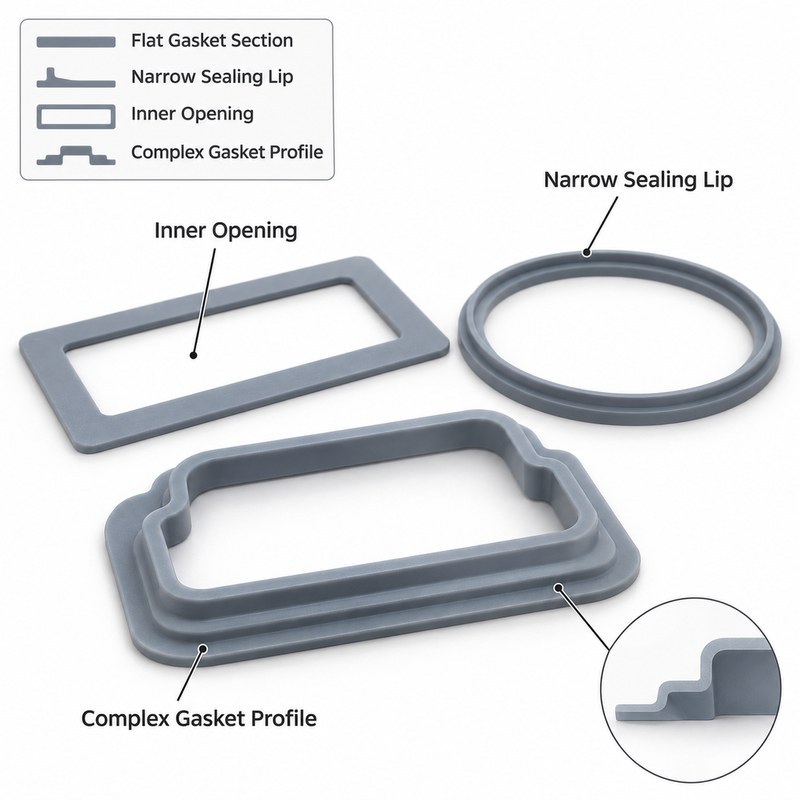
The three common gasket families each place their difficulty somewhere different. A flat gasket with an inner opening concentrates risk at the opening and around the flow split. A gasket with a narrow molded sealing lip concentrates risk in the lip, which is thin, unsupported, and often close to the parting line. A fully profiled gasket adds thickness transitions on top of both.
What they share is a low ratio of thickness to surface area. That means the part is dominated by surface effects: adhesion to the cavity, friction during release, and heat transfer from the mold. A thick part is governed by its bulk; a thin gasket is governed by its surfaces.
It also means the part has very little structure to resist distortion during handling. A thin gasket can be perfectly molded and still arrive at the assembly station slightly bowed because of how it was packed.
How Gasket Geometry Affects Mold Filling
Narrow Sealing Lips Can Be Difficult to Fill Consistently
A molded lip is a narrow channel at the edge of a thin plate, and the material has to fill the plate and the channel at the same time. Because the plate offers less resistance, it fills first, and the lip fills from the plate outward. If the lip is at the end of the flow path and the compound has already started to cure, it fills thin, or not at all.
The usual symptom is not a visible short shot but a lip that is slightly rounded or under-thick along one side. That is enough to change contact pressure along the perimeter, and it is why a gasket can pass a leak test at low pressure and fail at the pressure the design actually specifies.
Large Flat Sections May Develop Uneven Thickness
On a wide flat section, the two mold faces are close together and the material has to spread laterally rather than flow through a channel. That lateral spread is sensitive to how the cavity closes: a press with slight parallelism error, or a plate that is not flat, will produce a part that is thicker on one side than the other.
Because a gasket is measured for flatness and for thickness at the sealing land, this variation shows up as a dimensional problem even though it originated as a mold closure issue. Checking plate flatness and press parallelism before blaming the cavity is usually the faster route.
Small Inner Openings Require Accurate Mold Design
The core that forms an inner opening is an obstruction in the middle of the flow path. Material enters, splits around the core, and has to rejoin on the far side. Where the two fronts meet, they form a knit line, and that knit line sits in the thinnest material on the part.
This is the single most useful thing to understand about gasket filling. The area immediately downstream of the core, on the side opposite the gate, is where the material is coldest, the flow fronts are oldest, and the knit is weakest. If a gasket tears, delaminates, or shows a fine line under magnification, that is the first place to look.
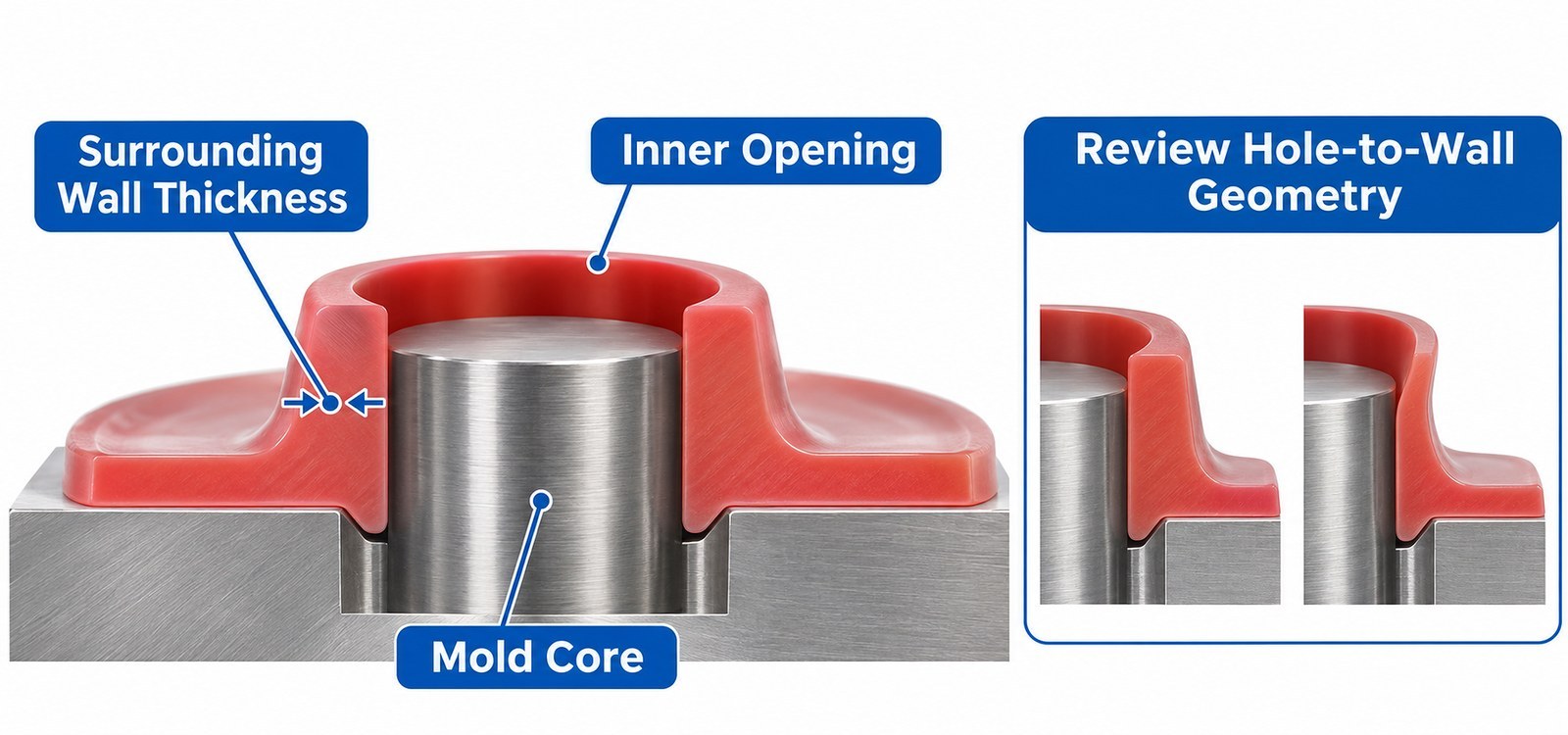
The practical responses are to move the gate so the knit line lands on a non-sealing area, to add a small overflow or vent at the meeting point so the fronts merge under pressure rather than in air, and to keep the wall around the core as uniform as the design allows. A knit line on a flat, non-functional zone is harmless. The same knit line on a sealing lip is a leak waiting for a pressure cycle.
Why Do Thin Silicone Gaskets Stick or Tear During Demolding?
On a thin gasket, the core usually controls release, not the cavity. The opening grips the core pin over its full height, and that grip has to be broken before the part can move. A polished core with generous draft releases easily; a straight, finely polished core can hold a thin gasket hard enough that the surrounding material stretches before it lets go.
Narrow inner edges are the vulnerable zone. The material immediately around the opening is thin, and it is being asked to expand over the core as the part is stripped. If the stretch exceeds what the compound can recover, the opening grows and the gasket no longer fits its boss.
Undercuts and complex profiles make this worse by adding a feature that must be deformed past before release. And release direction matters: pulling a gasket off a core at an angle concentrates stress on one side of the opening, which is often the side that shows a fine tear at the inner edge.
How to Prevent Deformation Around Gasket Openings and Edges
Maintain Sufficient Material Around Inner Holes
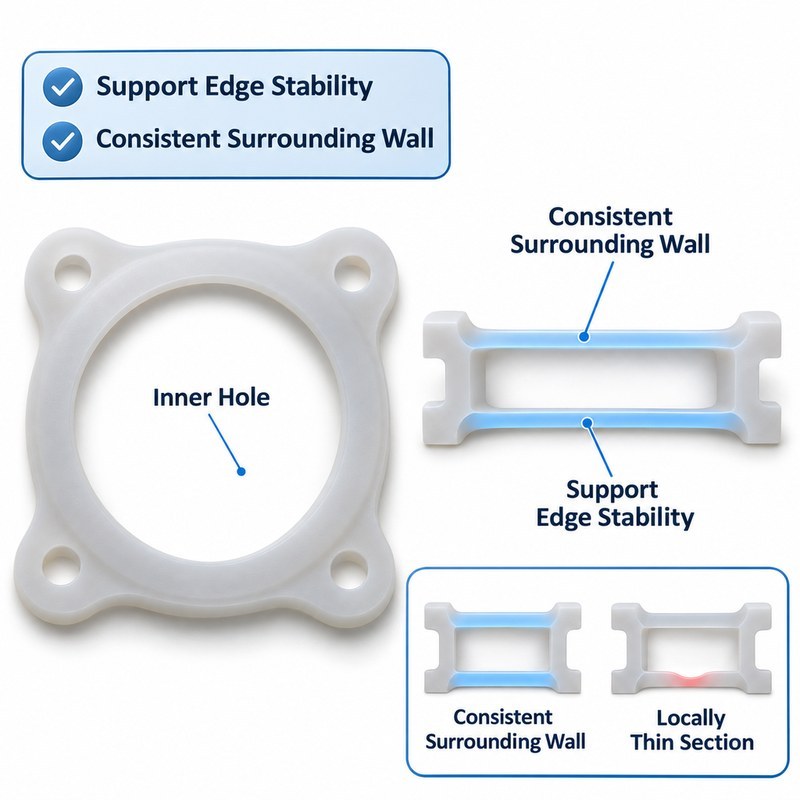
The ring of material between the opening and the outer edge carries the load of the whole seal. If that ring is uniform, it distributes compression evenly and recovers symmetrically. If one side is locally thin, that side deforms first and takes a permanent set while the rest of the gasket is still working normally.
The design constraint is that the opening has to be large enough for its function and the surrounding wall thick enough to be handled and demolded. When those two requirements collide, the answer is usually to change the opening's position rather than its size, or to move the sealing line away from the opening instead of thinning the wall to keep the outline.
Avoid Unnecessary Sharp Transitions
A sharp internal corner beside an opening concentrates strain exactly where the material is thinnest. Radiusing that corner, or adding a short taper into the surrounding plate, spreads the strain over a longer length without changing the sealing function.
The same applies where a molded lip meets a flat section. A step creates a plane of weakness; a taper distributes the transition and gives the material somewhere to move during demolding.
Optimize the Parting Line Around Complex Profiles
The parting line is where flash forms, and on a gasket it often runs around the entire perimeter. If it crosses a sealing face, the flash becomes part of the sealing surface, and trimming it back to a functional dimension turns a molding process into a manual one.
Keeping the parting line on a non-sealing edge, even at the cost of a slightly more complex tool, is almost always the better trade. It also makes the edge quality more consistent, because the split is no longer competing with the sealing geometry for the same steel.
How to Improve Mold Structure for Thin Silicone Gaskets
Gasket mold structure is the combination of cavity, core, parting line, and venting that decides whether a thin ring fills evenly around its opening and releases without stretching. It has to be reviewed against the opening, not just the outline, and four items carry most of the risk.
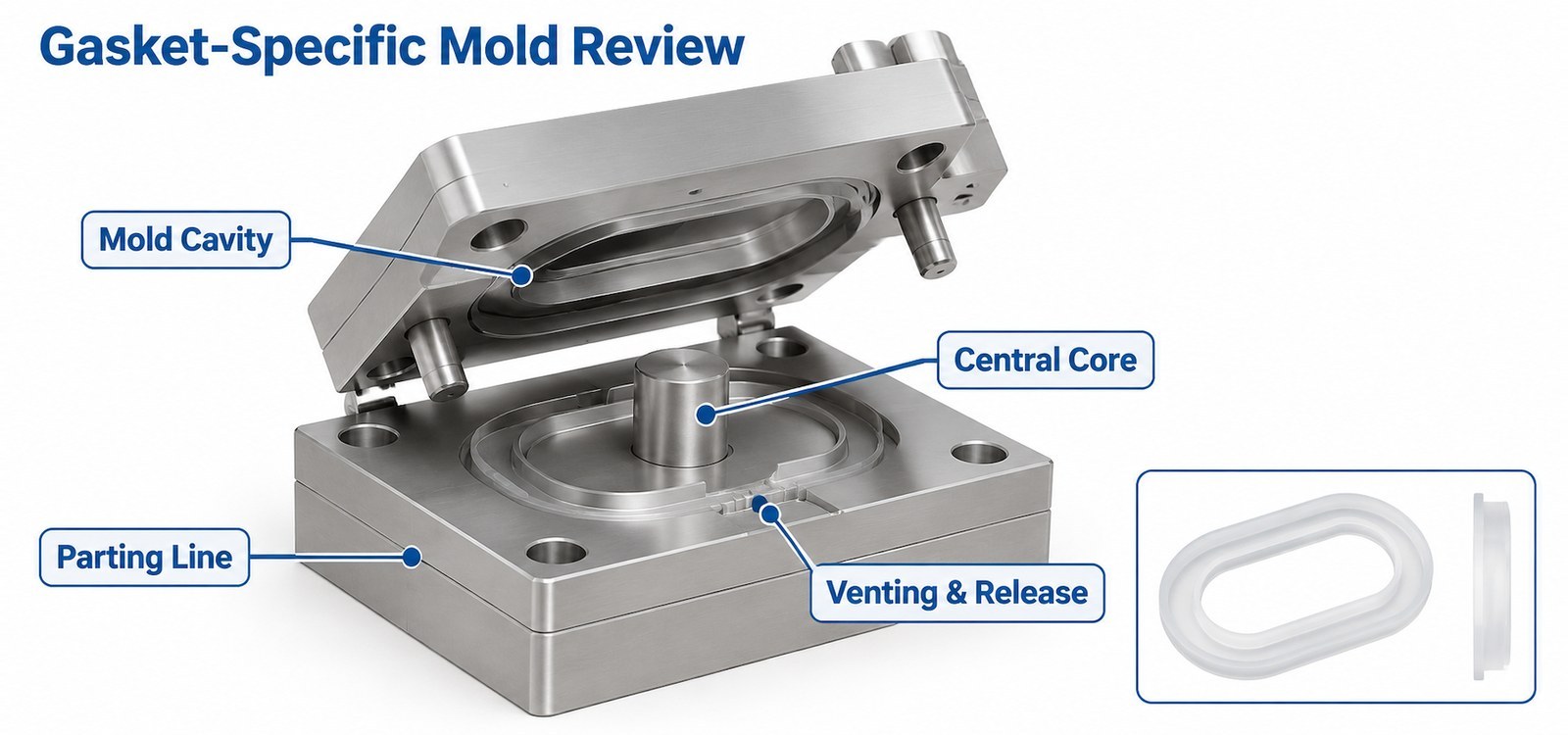
Cavity and core design. The core pin should be drafted, polished in the pull direction, and stiff enough not to deflect under injection pressure. A core that bends slightly produces an opening that is oval in one direction.
Parting line placement. Keep it away from sealing lands and place it where flash can be removed without touching a functional dimension. On thin gaskets, the parting line position is effectively a quality decision.
Venting around narrow sections. Air traps at the far side of the core and at the end of thin lips. Venting at those points, rather than only at the outer edge, is what turns a knit line into a solid merge.
Release and ejection method. A stripper plate or air assist is often gentler on a thin gasket than ejector pins, because it lifts the whole perimeter rather than pushing at points. If pins are used, they should sit away from the sealing line. The same structural logic applies across our custom silicone rubber parts work, where thin sections are common.
Which Silicone Material Properties Matter for Thin Gasket Molding?
Hardness controls the trade between conformity and stability. A softer compound conforms to imperfect mating surfaces and seals at lower compression, but it is more likely to tear around an opening and to fold during handling. A firmer compound holds shape and releases better, but it needs more compression to seal and is less forgiving of surface finish on the mating part.
Flow and cure characteristics matter as much as hardness on a thin part. A compound that flows easily fills a thin plate at lower pressure, which reduces core deflection and flash. A compound that cures quickly sets before the knit line closes. The two properties have to be judged together against the gasket's thickness, not selected independently.
It is worth remembering that a thicker gasket is not automatically more stable. Extra thickness increases section mass, which increases shrinkage variation and can make flatness harder to hold. For most thin gasket applications the better answer is a moderate thickness with a uniform wall and a well-supported opening.
| Gasket feature | Molding consequence | Likely defect | Inspection focus |
|---|---|---|---|
| Inner opening formed by a core | Flow splits and rejoins downstream of the core | Weak knit line, thin wall opposite the gate | Inner edge on the far side of the opening |
| Narrow molded sealing lip | Fills last, from the plate outward | Rounded or under-thick lip on one side | Lip thickness and profile at four perimeter points |
| Wide flat sealing face | Thickness depends on plate flatness and press parallelism | Uneven thickness, bow across the diagonal | Flatness on a surface plate, thickness at the land |
| Parting line on a sealing edge | Flash lands on a functional surface | Trim marks, dimensional drift after deflashing | Edge integrity before and after trimming |
| Thin ring around the opening | Low strength where release force is applied | Oval opening, edge tear | Opening diameter and roundness after demolding |
| Profiled lip with thickness steps | Uneven cooling across the profile | Lip lean, set line at the step | Section at the step, lip angle after compression |
How to Inspect Thin Silicone Gaskets After Molding
Inspection on a thin gasket has to look at the perimeter as a whole, not at a few convenient points. A practical routine covers six checks.
- Inner and outer dimensions, measured with light contact so the part is not compressed during measurement.
- Edge integrity around the full perimeter, under magnification, including the knit line zone downstream of the core.
- Thickness consistency at the sealing land, at several points, not only at the thickest section.
- Flatness and shape recovery, checked after the part has been released and allowed to relax.
- Assembly fit against the mating components, including how the gasket behaves as it is captured.
- Post-trim condition, where deflashing is used, to confirm that functional edges were not altered.
The order matters less than the habit of checking the same points every time. Most gasket problems are found because a specific location was compared across parts, not because the inspection was exhaustive. For the general principles behind gasket sealing in molded rubber, the same three variables apply: contact pressure, surface conformity, and edge integrity.
For the material side of the same question, our overview of silicone rubber seals covers the property trade-offs behind compound selection, and the advantages of rubber compression molding explain why thin gaskets are often run on that process rather than injection.
Frequently Asked Questions
Why are thin silicone gaskets difficult to demold?
Because the opening grips the core over its full height while the surrounding material is thin and weak. The release force is applied through the thinnest part of the gasket, and any undercut, straight core wall, or off-axis pull concentrates it further. Core draft and surface finish usually matter more than the compound here.
Can narrow gasket openings cause tearing during production?
Yes. The material between the opening and the outer edge has to stretch over the core during release, and a narrow ring has less material to distribute that stretch. Tearing is most common on the side of the opening furthest from the gate, where the knit line sits.
Does a thicker gasket always improve molding stability?
No. Extra thickness adds section mass, which increases shrinkage variation and can make flatness harder to hold. It also raises material cost and compression load. A moderate, uniform thickness with a well-supported opening usually outperforms a thicker gasket with an uneven wall.
How can manufacturers improve the consistency of thin silicone gasket edges?
By keeping the parting line off functional edges, venting at the last point to fill, controlling plate flatness and press parallelism, and inspecting the same edge locations across cavities. Trimming should correct flash, not compensate for a parting line placed in the wrong position.
Sources and method notes
- ISO 3302-1, Rubber — Tolerances for products — Part 1: Dimensional tolerances. Used for the principle that thin molded sections are inspected against a tolerance class rather than a blanket band.
- ISO 37:2024, Rubber, vulcanized or thermoplastic — Determination of tensile stress-strain properties, the reference for comparing tear resistance between compounds.
- ISO 815-1:2019, Rubber, vulcanized or thermoplastic — Determination of compression set — Part 1: At ambient or elevated temperatures.
- Knit-line behavior and defect locations described here reflect FromRubber production observation on thin gaskets with core-formed openings; they are diagnostic guidance rather than published test data.
Related reading: Reducing mold changes in custom seal development; What design factors cause silicone seal deformation.
FromRubber is the brand of Dongguan Bohao Electronic Technology Co., Ltd., a custom silicone and plastic component manufacturer in Dongguan, Guangdong, China, operating since June 2010. The company holds ISO 9001:2015, ISO 14001:2015 and IATF 16949:2016 certification, and runs silicone compression molding, an in-house mold shop with eight CNC machines, and secondary operations under one roof.
Dealing with a thin gasket that tears at the opening or leaks at one point?
Send the gasket drawing with the opening dimensions, the core direction, and the gate position if known. We will review the flow split and the release path before proposing a tooling change.
WhatsApp or WeChat: +86 18676210913