
12 Questions to Resolve Before Approving a Silicone Heat Transfer Label
The sample was approved in under ten minutes. It looked right on the desk, the colour matched the reference, the lettering was clean. Eight weeks later the first bulk shipment came back from a customer test with the edges lifting after two domestic washes. Nothing had been signed off dishonestly. The approval simply never asked what the label was expected to survive, on which fabric, under which conditions.
A silicone heat transfer label is a silicone graphic supplied as a separate part and bonded to a fabric under heat and pressure rather than sewn on, with the exact construction and the way it transfers differing between systems. It is not approved when it looks correct. It is approved when the appearance, the fabric it will sit on, the way it will be applied, and the conditions it must withstand have all been confirmed and written down. Those are four separate approvals, and a sample that satisfies one of them says nothing about the other three.
What the Word "Approved" Should Actually Cover
In practice, approval passes through five distinct stages, and they are often collapsed into a single glance at a physical sample. Separating them makes the process slower on paper and far faster in reality.
- Artwork approval. The file being produced from is the file that was agreed, including every element that was present, altered or removed.
- Appearance approval. The physical sample matches that artwork in proportion, colour, finish and surface condition.
- Application-process approval. The transfer construction and the application method are defined, and the equipment and process instructions that go with them are known rather than assumed.
- Performance evaluation. The applied label has been assessed on the intended fabric under conditions that resemble real use and real care.
- Production specification approval. The master sample, colour references, acceptance criteria and inspection requirements are recorded so that later batches can be measured against something other than memory.
The twelve questions below follow that order. They are written for apparel brands, sportswear developers, garment factories and sourcing teams who are about to release a custom silicone label into production, and each one is something that has to be answered before the answer becomes expensive.
The Twelve Questions
1. Does the sample match the final artwork?
Compare the sample against the approved production artwork, side by side and at the same scale, rather than against a screen preview or a recollection of the design. Look for small changes that are easy to accept by accident: proportions that have shifted, lettering that has been simplified, spacing that has been tightened, a border that has been thinned, or a detail that was quietly dropped because it was marginal. Any of those may be the right decision, but it should be a decision that was made deliberately and recorded, not a difference discovered after the artwork has been frozen.
Labels that carry a short identifier are a useful case to test the process on. The letter is simple, which makes any change to its stroke weight, height or position immediately visible against the artwork — and it also makes the frame around it easy to check. A frame that has been thinned to fit a smaller part, or a corner radius that has grown, is exactly the kind of drift that a side-by-side comparison catches and a quick look does not.
Agreeing the artwork reference before the sample arrives turns this question from a matter of opinion into a matter of measurement.
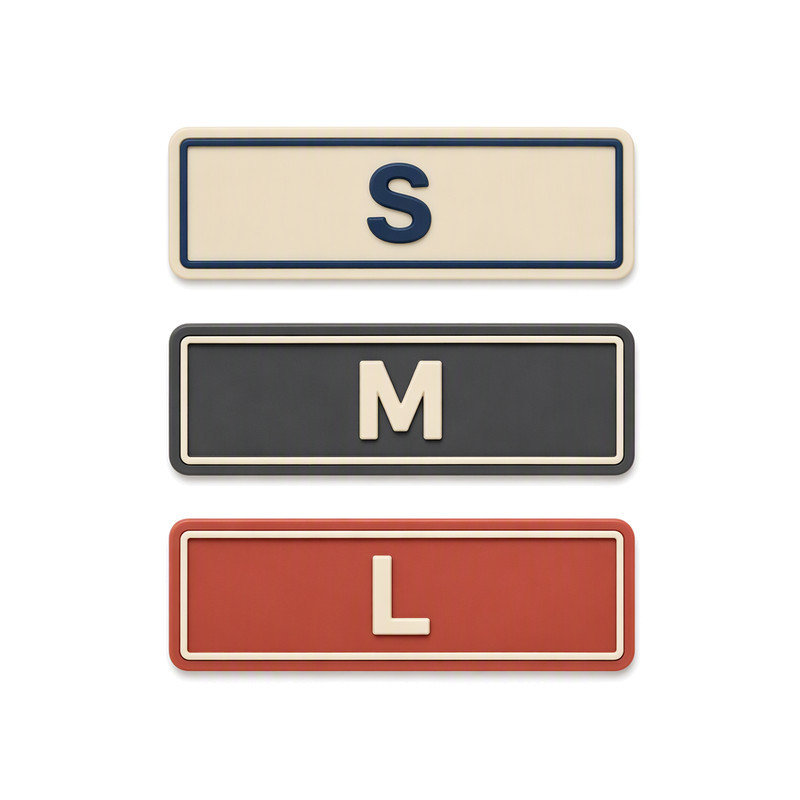
Short identifiers in moulded frames: any drift in stroke weight, height or frame radius is visible against the artwork.
2. Are the label dimensions and thickness correct?
Confirm overall width and height, edge shape, thickness, and the height of any raised or recessed detail. Small dimensional differences are easy to overlook on a sample and hard to ignore in production. Thickness in particular changes how the label feels on the garment, how it behaves when the fabric flexes around it, and how much relief is left for whatever is applied on top of it. A label that is a fraction of a millimetre thicker than intended may still be within a normal manufacturing range, but it may no longer suit a lightweight close-fitting garment.
3. Are the colours and the surface finish acceptable?
Agree a physical reference or a documented colour standard, and keep it. Monitor colours are not a substitute for either, because the same nominal colour renders differently on different screens, at different brightness settings and under different ambient light. Check the finish as well as the colour: gloss and matte change how a label reads in daylight and how it photographs, and a finish that looks right under a single studio lamp may look quite different on a shop floor. If opacity matters for the application, confirm it at this stage rather than after the first batch.
4. Is the label suitable for the intended fabric?
This is where most avoidable problems originate. Polyester, cotton, blends, stretch fabrics and coated or laminated materials behave differently under heat and pressure, and they respond differently to the same label construction. Fabric composition, surface texture, coatings, dyes and heat sensitivity all influence whether a given construction will apply cleanly and stay applied.
No single transfer construction works on every fabric. A construction that performs well on a stable woven cotton may behave differently on a heat-sensitive synthetic, and a construction tuned for a stretch knit has different priorities again. The question to settle is not "is this label good," but "is this label good on this fabric, applied by this process."
5. Has the heat transfer method been clearly defined?
Buyer and manufacturer must be talking about the same transfer construction and the same application method. Confirm which construction is being supplied, what equipment it is intended for, and what process instructions accompany it. Assuming that all silicone heat transfer labels are applied the same way is a common source of disagreement, because the label itself determines part of the process and the fabric determines the rest.
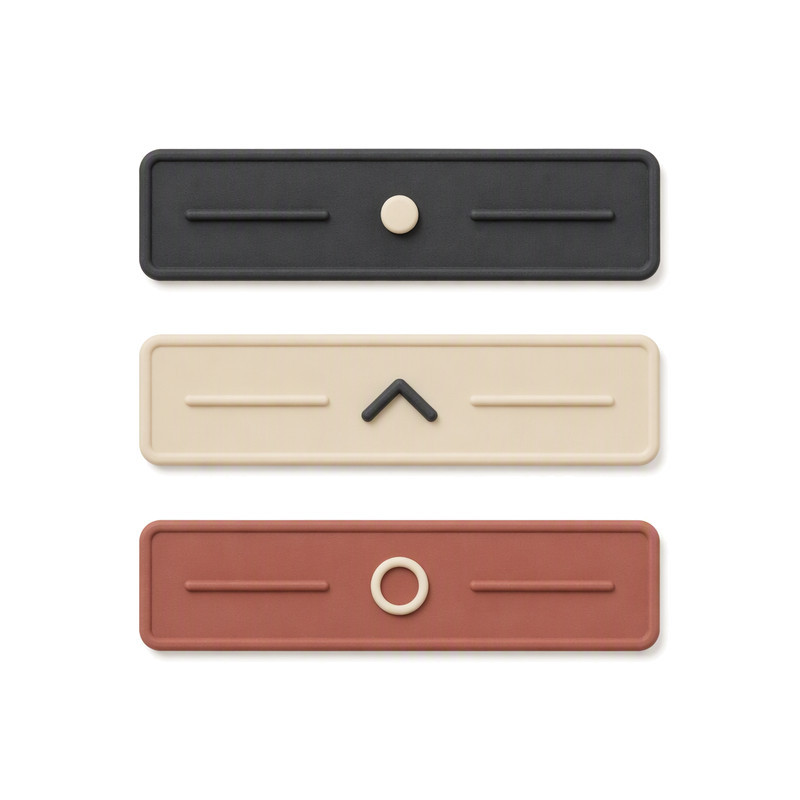
Slim transfer-style labels: low relief keeps the profile flat, but the process still has to be defined before approval.
Some constructions keep an almost flat profile because the visual information is carried by small raised or recessed elements rather than by a deep, structured relief. Those labels tend to sit more quietly on the garment, but the application process is not simplified by that. A flat label still has to reach the right condition across its whole area, including the areas around the motif where there is less material to work with.
Confirming the process before approval also means confirming what happens at the edges, which is usually where the first sign of trouble appears.
6. Are temperature, pressure and dwell time confirmed?
These are process variables, not universal settings. They are established for a particular label and a particular substrate, and they interact with each other and with the equipment being used. Real heating conditions can differ from what the machine displays, applied pressure varies with how the press is set up and how the operator loads it, and dwell time is only meaningful alongside the other two. Equipment differences between one factory and the next shift the answer again.
Where a cooling step or a carrier-removal step is part of the construction, that step is also part of the process and belongs in the specification. Rather than adopting a number from a similar-looking project, work from validated supplier instructions and confirm the result in application trials on the actual fabric.
7. Does the label adhere properly after application?
Assess the applied label for visible edge lifting, incomplete bonding, bubbles and local separation. Then decide which of those you are looking at, because the diagnosis changes the fix. A transfer-process problem points at the conditions used, the equipment or the handling of the carrier. A compatibility problem points at the fabric, a coating on the fabric, or the label construction itself. Applying more heat to a compatibility problem generally makes it worse rather than better.
Record the application conditions used for the approved sample. Without that record, the approved sample becomes unrepeatable, and every later comparison is between two labels made under unknown circumstances.
8. Has stretch performance been evaluated?
On a flexible garment, and especially on sportswear and close-fitting clothing, the fabric around the label moves continuously. A label that adheres cleanly to an unstretched sample may behave quite differently under repeated extension, because the fabric and the silicone do not stretch by the same amount. That difference concentrates at the edge and at any local stiffness in the label.
Assess flexibility, edge behaviour, cracking and separation on the actual intended fabric, and do it under movement rather than on a flat, static coupon. This is one of the areas where a small design change, such as reducing overall thickness or softening the edge geometry, has more effect than any adjustment to the application process.
9. What washing and care conditions must the label withstand?
Washing temperature, detergent type, drying method, wash frequency and the garment's stated care requirements all belong to the specification. Wash testing should reflect the intended product and agreed test conditions rather than a generic cycle borrowed from another project.
It also matters what kind of evidence you accept. An initial visual check after a single wash confirms very little; repeated wash testing under controlled conditions produces evidence. ISO 6330 is the standard ordinarily used to define domestic washing and drying procedures when textiles are tested. Its 2021 edition sets out 16 washing procedures on Type A horizontal-axis reference machines, 12 on Type B top-loading agitators and 7 on Type C pulsators, together with six drying procedures from line dry through to tumble dry, and it specifies the reference detergents and ballasts. Each of those procedures represents a single domestic wash. Its value here is not that it guarantees a result, but that it defines the conditions, so that two tests can be compared at all. There is no universal wash-cycle requirement that applies to every silicone label, and any figure quoted as one should be treated with suspicion.
10. Does the label feel appropriate on the garment?
Stiffness, thickness, edge feel, flexibility and placement all matter, particularly where the label contacts the skin or sits under a strap. A label intended for stretch sportswear and one intended for a structured jacket or a bag are optimising for different things, and the same construction is unlikely to be the right answer for both. If the label will be worn against the body, judge it on a finished garment during movement rather than on a flat sample.
11. Are production consistency and acceptance criteria defined?
Before bulk production starts, agree the approved master sample, the artwork and colour references, the acceptable range of appearance variation, the dimensional inspection requirements, the definition of a defect, and how batches are identified and retained. Vague terms such as "same as sample" are not acceptance criteria, because they provide nothing to measure against when a question arises. Written criteria protect both sides, and they make a disagreement about a shipment resolvable in a day rather than a month.
Thin frame lines are a good illustration of why criteria have to be dimensional rather than verbal. A fine oval pinstripe around a low-relief label is a single closed feature, and its consistency can be checked along its length: even separation from the edge, even thickness, no local thinning where the curve tightens. That is a measurable description, and it can be written into an inspection requirement.
"Looks the same as the approved sample" cannot.
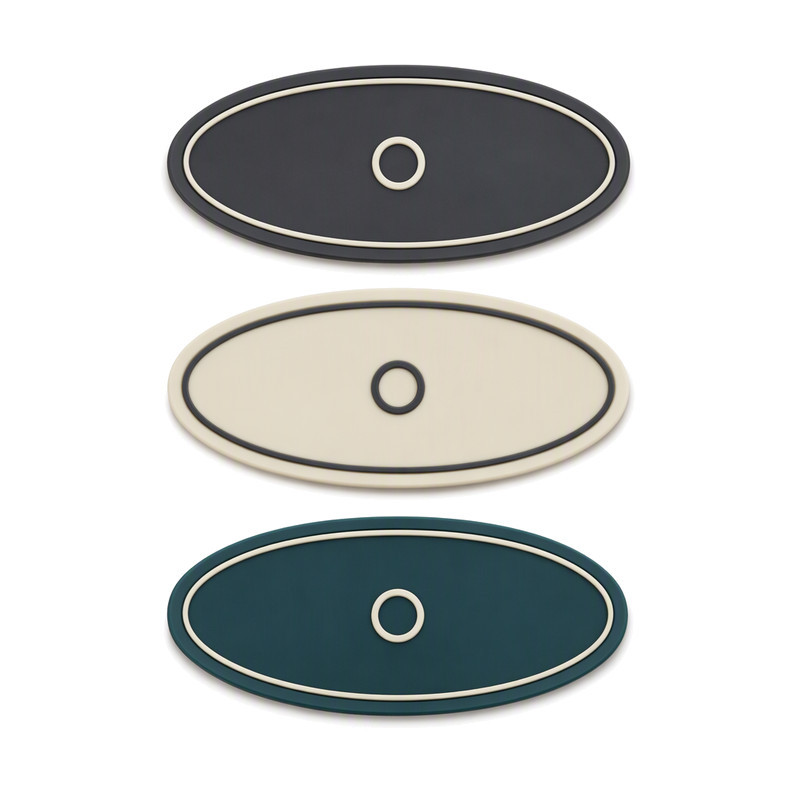
A single closed frame line can be described dimensionally, which is what makes it inspectable.
12. Are packaging, lead time, quantity and order specifications confirmed?
Order quantity, packaging requirements, batch labelling, delivery expectations and any project-specific documentation should be settled before production is authorised. These are commercial and logistical details rather than technical ones, but a label that is technically perfect and packed so that it compresses or creases in transit arrives as a quality dispute. Where the customer requires certification or documentation with the shipment, confirm it here rather than after the goods are ready.
Pre-Production Approval Checklist
Use this as a working document. Nothing should be pre-marked as approved; the status column is filled in during the review, and each line is only closed when the evidence exists.
| Item to confirm | Evidence or specification required | Approval status |
|---|---|---|
| Artwork fidelity | Approved production artwork, compared side by side with the physical sample at the same scale | Open |
| Dimensions and thickness | Recorded measurements of width, height, thickness and relief height against the agreed specification | Open |
| Colour and finish | Physical colour reference or documented standard, plus the agreed surface finish | Open |
| Fabric suitability | Fabric composition, construction and any coating, confirmed as the production material | Open |
| Transfer method | Named construction, applicable equipment and process instructions supplied with the label | Open |
| Process variables | Recorded temperature, pressure, dwell time and any cooling or carrier step used for the approved sample | Open |
| Adhesion after application | Recorded result on the production fabric, including the condition of the edges | Open |
| Stretch behaviour | Result of testing on the actual fabric under repeated extension, where relevant | Open |
| Wash and care durability | Test conditions and results from repeated washing that reflects the intended product care | Open |
| Comfort and feel | Assessment on a finished garment, in the position it will actually occupy | Open |
| Acceptance criteria | Master sample, colour references, appearance tolerances, defect definitions and inspection requirements | Open |
| Commercial details | Quantity, packaging, batch labelling, delivery expectation and required documentation | Open |
Common Mistakes During Silicone Heat Transfer Label Approval
- Approving a digital rendering instead of a physical sample. A rendering cannot show surface texture, edge finish or how the label sits on fabric.
- Testing on a different fabric from the production garment. A successful trial on a stock fabric that is not the production material proves very little.
- Failing to document the application settings. The approved sample then cannot be reproduced, and later comparisons have no baseline.
- Skipping stretch and wash evaluation. These are the two conditions most likely to change a result, and the two most often left to "we will see how it performs."
- Changing the artwork after sample approval. A revised file invalidates the sample, and the sample is the only object the approval actually covers.
- Starting bulk production without agreed acceptance criteria. Without them, every batch becomes a negotiation and nothing can be measured objectively.
Each of these mistakes has the same shape: it converts a question that could have been settled with a document into a question that can only be settled with a shipment. The rework cost is the visible part; the schedule cost is usually larger.
Questions Buyers Ask Most
What should I check before approving a silicone heat transfer label?
Five things, in order: that the sample matches the approved artwork, that dimensions and colour references are confirmed, that the label is suitable for the actual production fabric, that the application process and its settings are documented, and that durability and acceptance criteria have been agreed in writing.
Why does a silicone heat transfer label peel off after application?
Usually one of two families of causes. Either the application process did not achieve a complete bond across the whole area, or the label construction is not well matched to the fabric, its coating or its heat sensitivity. Diagnosing which one it is matters, because the two require opposite responses.
Can silicone heat transfer labels be used on stretch fabrics?
They can be evaluated for stretch fabrics, but stretch performance has to be confirmed on the actual material under repeated extension. Flexibility, edge behaviour and the difference in stretch between fabric and label are all part of the design decision rather than an afterthought.
How should washing durability be evaluated?
By repeated washing under defined conditions that reflect how the garment will actually be cared for, with the drying method included. ISO 6330 is the standard normally used to define those domestic washing and drying procedures, and using a defined procedure is what makes results comparable between tests.
Should I approve a label sample on the actual production fabric?
Yes, wherever the production fabric is known. Fabric composition, surface texture, coatings and heat sensitivity all affect application, so a sample approved on a different fabric has not been approved for the garment.
What information should a buyer provide to a silicone label manufacturer?
The final artwork or a high-resolution file, target dimensions and thickness, colour references, the production fabric and where the label will sit, the intended application method, the care conditions the garment will carry, and the acceptance criteria that will be applied to production. A short note on quantity and sampling expectations helps the review stay practical.
Closing the Loop Before Production
Approval is not a single signature on a desk check. It is a sequence of confirmations that together answer one question: will this label, on this fabric, applied by this process, still be acceptable after the conditions the garment will actually meet? Appearance, fabric compatibility, application conditions, durability and acceptance criteria each answer part of that question, and leaving any of them open transfers the risk from the sampling stage to the shipment.
FromRubber supplies custom silicone labels and silicone patches and works with buyers on artwork review, sample evaluation and specification confirmation before production is released. Where a project involves a transfer construction, a stretch fabric or a demanding care requirement, the fastest route to a reliable answer is to send the artwork, the fabric details, the intended application method and the care conditions together, so the construction and the process can be assessed as one system. Artwork and specifications can be submitted through the FromRubber inquiry form, by email to nani@fromrubber.com or karl@fromrubber.com, or by WeChat and WhatsApp on +86 18676210913. Related reading on this site includes why a silicone heat transfer label peels after washing, how to check adhesion after pressing, why these labels fail on stretch fabric, and the rubber patch service process page.