$95 Billion Automation Instrumentation Market by 2031 – The Unsung Role of Silicone Keypads in Factory Floor HMI
Human-machine interface / industrial control panels - reviewed 11 November 2026
Every few years a headline puts a very large number on the automation instrumentation market and concludes that the physical button is finished. The number is real but the conclusion does not follow from it. The useful question for an equipment builder is narrower: which functions on a factory floor HMI keypad still belong under a finger rather than on glass, and what has to be true of the moulding for that decision to hold for the life of the machine.
Published estimates for the same phrase differ widely. Trackers that count field instruments alone put the 2025 market at roughly USD 30 billion, while trackers that fold in control hardware, drives and software put the same year at roughly USD 76 billion. Both are defensible, and neither changes the specification in front of an engineer. What matters is that the panel share of an HMI bill of materials is small, while the panel's share of the operator's attention is not.
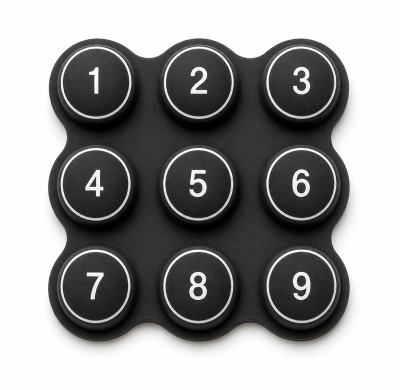
Definitions. A factory floor HMI keypad is a moulded silicone or rubber interface mounted on the front of a machine control panel, where it carries legends, tactile response, backlighting and the seal between the operator's world and the electronics. It differs from a membrane switch in one structural way: the moving element and the seal are one moulded part rather than a laminated stack. That difference decides how the panel behaves after ten thousand washdowns and a decade of ultraviolet light.
The parts of this story that do not move
- Market sizing for automation instrumentation depends on scope. Estimates published for the same year can differ by a factor of two or more without either being wrong.
- Panel HMIs remain a large share of installed terminals because machines are replaced far more slowly than controllers are upgraded.
- Safety functions, setpoint entry and no-look operation are the three jobs where a physical key still outperforms glass.
- A keypad's service life is usually limited by its legend and its seal, not by the silicone body.
- Actuation force suited to a gloved hand is roughly double what feels right to a bare finger, which is why one keypad cannot serve both operators.
Why the headline number is not the specification
Scope does the work in every forecast
An estimate of "automation instrumentation" can mean field devices only, or field devices plus control systems, or the entire automation stack including software and services. Analysts rarely state which, and the gap between the resulting figures is larger than the growth they are forecasting. A plant engineer reading a headline figure is therefore reading a signal about the segment's direction, not an input to a decision about a panel.
The panel is a small cost that decides a large cost
On a machine control panel, the keypad is a minor line in the bill of materials and a major determinant of whether the machine can be operated with gloves, in the wet, without looking. That asymmetry is why the panel survives procurement reviews that remove far more expensive components. A failure that stops a line costs orders of magnitude more than the part that failed, and the interface is one of the few components an operator can break simply by using it.
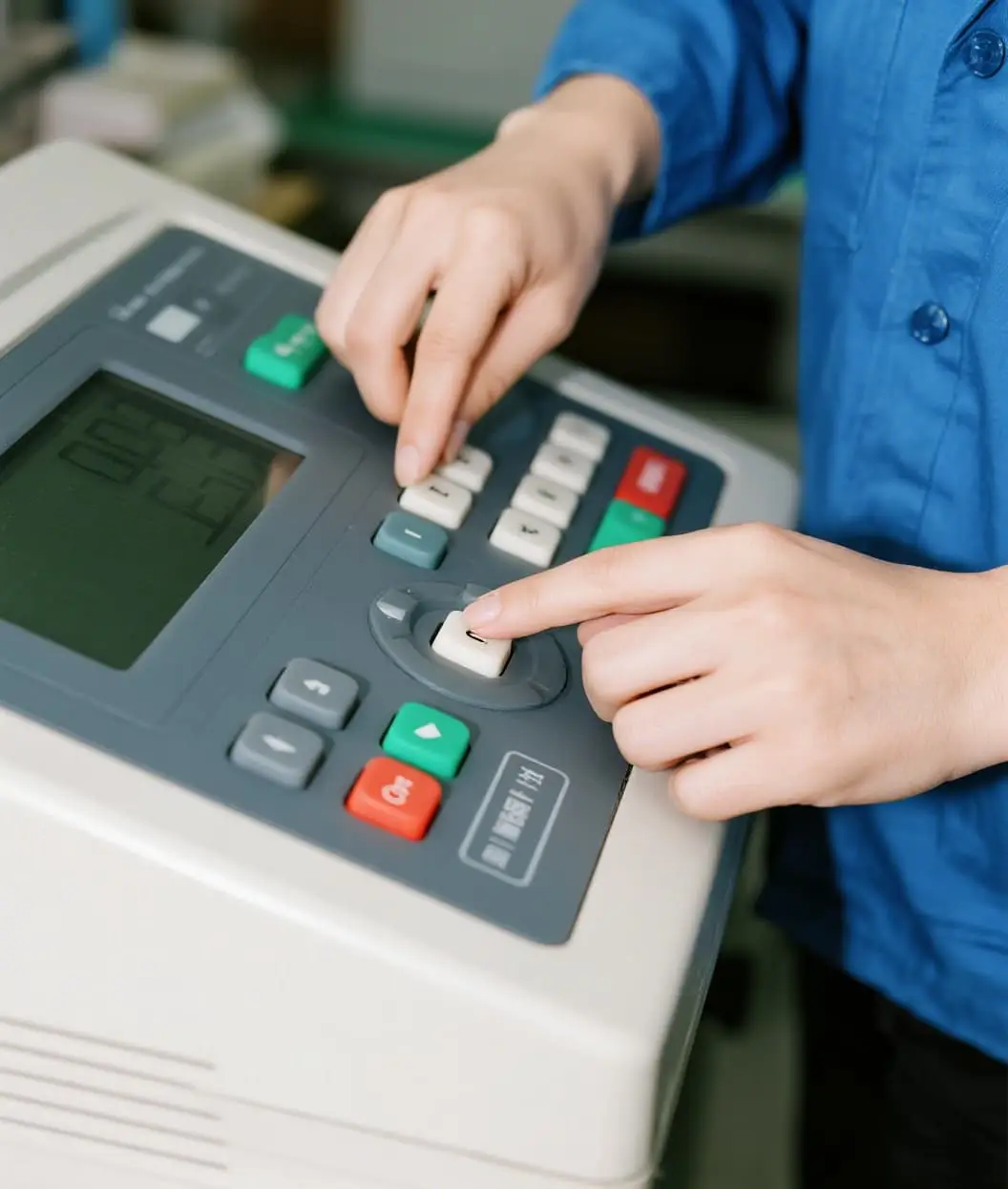
The practical consequence is that a factory floor HMI keypad is specified against the shift, not against the forecast. The questions worth answering are how many presses per shift the busiest key takes, what the panel is cleaned with, whether the operator wears gloves, and whether the machine will still be in service when the controller inside it has been replaced twice.
Where a factory floor HMI keypad still wins
Three conditions decide the split between glass and rubber, and all three are about the operator rather than the technology.
| Function | Why it stays physical | What the keypad must deliver |
|---|---|---|
| Emergency stop and safety reset | Must be findable and actuable without looking, and must not depend on a screen being awake | A defined force and travel, a colour that survives cleaning, and a housing path that keeps the actuator separate from the electronics |
| Setpoint and increment entry | Operators need to feel a discrete step, and a wet or gloved finger does not register reliably on capacitive glass | Consistent snap ratio across the row and legends that stay legible under low light |
| Mode selection | Changes the state of the machine, so an accidental actuation is a production event | Guard geometry or a raised ring where the drawing needs it, plus a force high enough to resist a sleeve brushing past |
| Frequent jog and cycle keys | Used hundreds of times per shift, often while the operator watches the tool rather than the panel | Low wear on the legend, and a web that does not take a set over that many cycles |
Everything else — recipe selection, trending, diagnostics, parameter tables — belongs on the display, where it can be searched, localised and updated without a tool change. Writing that split down before the panel drawing is issued is the cheapest decision in the project.
Dividing functions between glass and rubber
The hybrid panel is the normal case, not a compromise
Most machines built today are hybrid: a display for information and configuration, a moulded keypad for command. The failure mode of a hybrid panel is not aesthetic. It is that the two interfaces are designed by different people against different assumptions, so the keypad's legends and the screen's labels drift apart across revisions, and the operator ends up with two vocabularies for one machine.
Where the seal has to be decided
On a panel with a display window, the keypad is often the largest continuous opening in the front face, which makes it the deciding element in the enclosure's ingress rating. If the keypad is a separate part from the window frame, the seal has to span a joint between two mouldings produced by two tools. Building the keys and the window frame as one moulded control panel removes that joint and removes the tolerance stack that comes with it.

Specifying the keypad when the enclosure is washed down
Washdown changes three numbers on the drawing. The sealing lip needs enough compression to stay closed when the housing is hit with a jet at close range, the legend needs a coating that survives the cleaning chemistry, and the key tops need a texture that does not hold water in the gap between the key and the web. A smooth, high-gloss key top looks clean in a sample and behaves like a suction cup in service, pulling water inward on every press.
The other decision that is often deferred too long is the backlight. A backlit keypad is a two-shot or an insert-moulded part, and the light path has to be designed with the legend, because a legend printed over an uneven diffuser reads as a blotch rather than a character. Retrofitting backlighting to a tool that was cut for a plain key means a new cavity, not a new ink.
For panels that combine keys with a display opening, the custom silicone control panel format puts the keypad and the window frame in one moulding. Panels used on instruments rather than machines usually follow the meter instrument keypad format, and the process chain behind both is described on the custom silicone production process page.
Is a factory floor HMI keypad still justified when the machine has a touchscreen?
Yes, for the functions an operator must hit without looking or with gloves on: emergency stop, safety reset, mode selection, setpoint steps and jog keys. Information and configuration belong on the screen, where they can change without changing the tool.
What actuation force is right for a gloved operator?
It depends on the glove and the key size, but the practical rule is that force chosen on a bare finger feels light in a glove, and a key that is comfortable bare-handed is usually marginal in a heavy glove. The force, the travel at contact and the snap ratio should be agreed together, and checked with the glove the customer actually issues.
Can a moulded keypad reach the same ingress rating as a sealed membrane panel?
It can, and it often does, but the rating belongs to the assembled enclosure rather than to the keypad. The rating should be demonstrated on a production-representative housing with the keypad mounted and compressed as it will be in service, not on the loose part.
Scope note: market sizes quoted in this article are described as ranges because published estimates for automation instrumentation use different scopes. No single forecast is endorsed here. Engineering values such as actuation force, compression and resistance are specification targets, not measured results for a particular part.
To review a panel, send the front-face drawing, the housing material and tolerance, the cleaning agents used and the gloved or bare-handed duty through the custom silicone quotation route.