Universal Fit or Custom Style? Choosing the Right Silicone Seat Belt Buckle Cover
The buckle is a mechanism, not a silhouette
A silicone sleeve can follow the outline of a seat belt buckle perfectly and still be rejected at a vehicle audit. The outline is the easy part. What the buckle does when a passenger pulls the webbing — release travel, spring return, tongue ejection — is what the cover has to survive, and a cover that only copies the shape has no position on any of it.
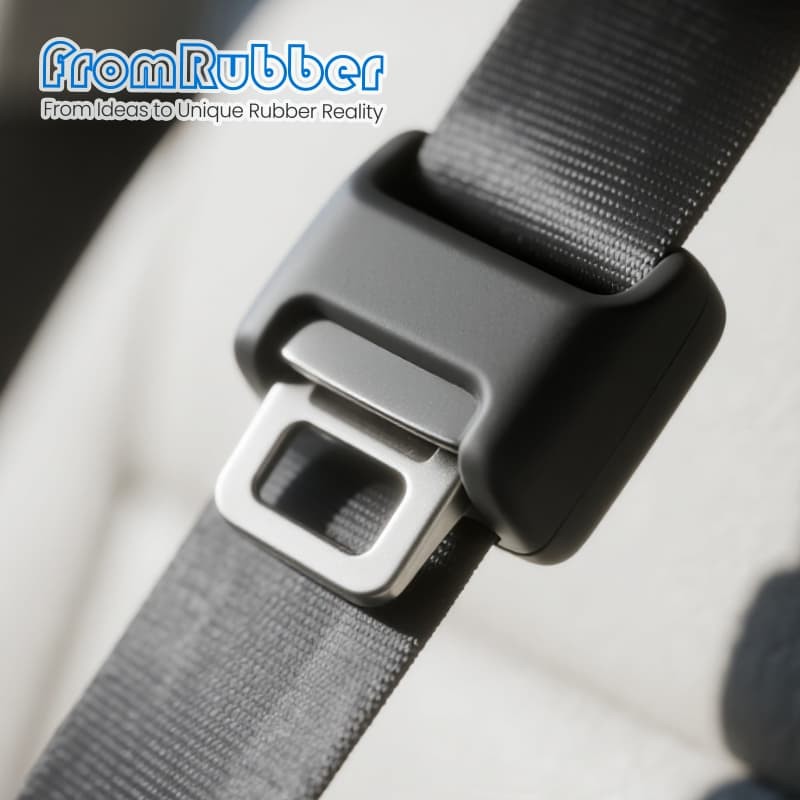
We mould buckle sleeves from the housing itself or from your 3D file, and the first thing we ask for is never the colour. It is the release-button height and the clearance left around it, because that is where a sleeve either works for the life of the car or turns into a warranty claim in month three.
- Tooled from your buckle housing or 3D file, not from a generic block
- Wall at the button window kept thin, relieved by geometry rather than by thinning the whole shell
- Colour matched to a Pantone number, moulded or printed
- Quoted at 1,000 pcs per design on our current buckle-sleeve lines
Where “universal” quietly stops being universal
Three features differ between buckle families, and each one fails a stretch-fit cover in a different way.
Release-button pedestal
Release buttons do not sit at the same height above the housing. A pedestal that stands proud inside a tight sleeve pre-loads the button before anyone presses it, and the passenger reads that as a stiff release.
Symptom: release effort climbs after a couple of weeks, and a shiny dent appears in the sleeve over the button. Fix is a relieved window with a defined land around it, not a thinner wall across the whole part.
Webbing entry angle
The webbing leaves the housing at an angle set by the pillar anchor, not by the buckle. On a sleeve that wraps the front lip, that angle decides how quickly the edge wears and how the cover sits when the belt is slack.
Symptom: the front lip curls back and exposes the housing corner. Fix is to extend the lip along the real webbing path and radius the exit, instead of ending the sleeve on a straight cut.
Tongue slot and latch pocket
The tongue has to enter cleanly and eject on the spring. A sleeve that bridges the slot mouth by even a fraction changes the entry angle and traps dust against the latch.
Symptom: the tongue catches, or the buckle stops ejecting cleanly in cold weather. Fix is to keep the slot mouth completely free and anchor the sleeve on the rear housing instead of the front face.
Heat, creep, and the summer dashboard
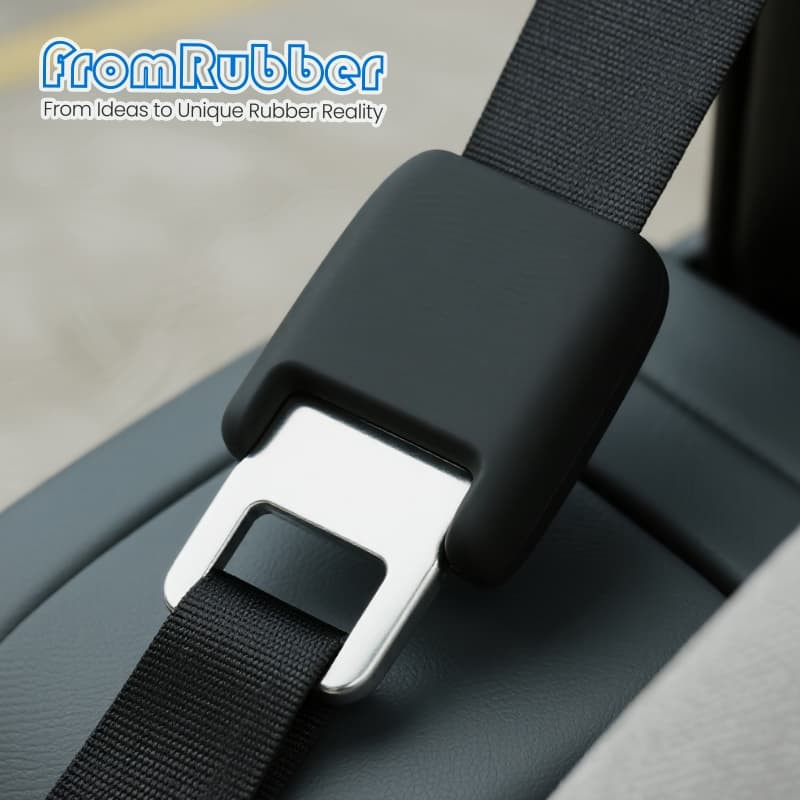
A closed car parked in the sun reaches surface temperatures that surprise buyers who test in a workshop. Silicone tolerates the temperature itself; what relaxes is the grip. A stretch-fit sleeve holds by hoop tension, and hoop tension is only a function of how far the material is stretched. Heat accelerates the relaxation of that stretch, so the sleeve that gripped the housing in March can be rotated by hand in September.
The test we run before approving a buckle sleeve is deliberately unglamorous: 72 hours at 90 °C, then re-measure rim grip and button travel on the same part. If grip has fallen away, there are three honest answers — more interference at the rim, a moulded retention bead on the inside face, or a harder compound — and one dishonest one, which is to thicken the wall and hope the customer does not notice the feel change.
Colour belongs in the same test. A thumb carries sunscreen and hand cream, and both attack the surface of a soft compound long before sunlight does. We wipe the sample, let it sit, and compare gloss and shade against the master before the colour is signed off.
What winter adds to the same part
Heat is the failure buyers expect. Cold is the one that produces the complaint.
At minus twenty, a silicone sleeve stiffens. The part has not changed shape, but the force needed to push the release button has, because the skin over the pedestal is now a stiffer spring on top of the button's own spring. A sleeve designed with a comfortable margin at room temperature can read as “stuck” in a cold-climate fleet, and the driver blames the buckle, not the cover.
This is also where silicone earns its place over the cheaper alternatives. Thermoplastic covers harden more sharply at low temperature and take a permanent set where they were stretched. Silicone stays flexible across the range a car actually sees — but only if the compound was chosen for the range, not for the room. Our buckle-sleeve lines are quoted from a drawing or a physical housing, which is the only reliable way to predict where that force will land.
Stock cover or tooled sleeve: the decision in one table
Both are legitimate products. They answer different questions, and the cost of the wrong answer shows up after the first container.
| Decision | Universal stock cover | Sleeve tooled to your buckle |
|---|---|---|
| Fit across a model range | Fits the outline of many buckles, sits correctly on few | Fits one housing family exactly, including front lip and slot |
| Button travel | Set by the stock wall, not by your buckle | Relieved window sized to the pedestal height you send |
| Colour and surface | Limited to the colours in stock | Pantone match, moulded or printed, texture to your reference |
| Wear points | Uniform wall, so wear lands wherever the buckle presses | Local build-up where the webbing and thumb actually load |
| Commercial model | Low entry, no tooling, shared across brands | Tooling amortised over 1,000 pcs per design and up |
| Change control | None — the supplier can change the block | Your drawing, your revision, your approval |
Four checks before a buckle-cover tool is cut
- Housing captureScan or 3D file of the actual buckle, including the button pedestal height and the tongue slot.
- Fit modelInterference at the rim, relief at the window, and where the part is allowed to touch the housing.
- Heat soak72 hours at 90 °C, then grip and travel measured again on the same sample.
- Surface trialPantone match plus a wipe test with sunscreen and hand cream before colour sign-off.
Send the buckle, not just the photo
The useful first deliverable is a fit note rather than a price: where the sleeve contacts the button, how much relief is left, and what rim grip looks like after heat ageing. Send the housing or the 3D file and we will mark those up together with the tooling position.
Existing references on our site: seat belt buckle guard sleeve, soft buckle protective cover and the anti-collision buckle cover. For the rest of the programme, start from custom silicone rubber parts.