Custom Silicone Rubber Products Customization Options and Benefits
Customisation is six decisions, not a colour card
Ask three factories to quote “a custom silicone part” and you will get three numbers that cannot be compared. Nothing is wrong with the factories. The request simply did not contain the six lines that decide how the part is made, and a factory that is missing those lines has to assume something. The assumptions are where the difference lives.
Colour is the last of the six, not the first. The earlier five — grade, tolerance, surface, post-processing and inspection — are what turn a shape into a product that can be re-ordered in eighteen months without a second tooling round.
- Prototype tool: 150 × 150 mm plate, single cavity
- Production tool: 350 × 350 mm plate, 15 to 50 cavities
- 32 compression presses across two plants in Dongguan
- IATF 16949, ISO 9001 and ISO 14001 certified processes
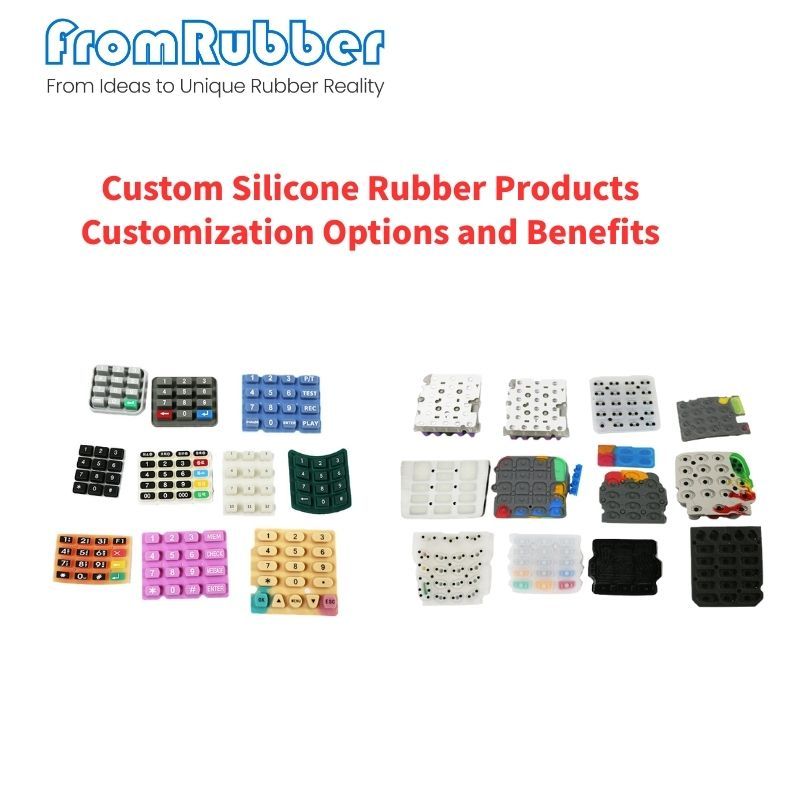
The six lines
Each one changes either the tool, the cycle or the yield. Leaving any of them out moves the risk to the buyer.
Grade and hardness
“Silicone” is a family, not a material. A general-purpose 50 Shore A compound and a 70 Shore A high-consistency compound are different products with different moulding behaviour and different data sheets.
Write it as: grade, hardness with a tolerance of ±5 Shore A, and the properties you actually need — tensile, elongation, compression set, temperature range.
Colour system
Moulded colour lives inside the part and cannot peel, but the tool is limited to two colours. Printed colour carries up to six and fine detail, at the cost of an extra process and a print line that has to be positioned against the split.
Write it as: the Pantone reference per colour, which colours are moulded and which are printed, and where the print is not allowed to land.
Tolerance class and critical dimensions
A drawing full of two-decimal tolerances tells a mould shop that nothing was prioritised. Silicone moves with cure and shrinkage; the answer is a tolerance class plus a short list of dimensions that must hold.
Write it as: a moulded-rubber class such as ISO 3302-1 M as the default, then mark the two or three dimensions that carry function — seal face, bore, wall.
Surface and finish
Gloss level, texture and the position of the parting line are all visible decisions. So is the deflashing method: hand-trim, cryogenic or tooled shut-off each leave a different edge.
Write it as: gloss or texture reference, where the parting line is acceptable, and whether a visible flash line is a rejection criterion.
Post-processing
Post-cure, plasma treatment, printing, laser marking, adhesive backing and assembly are separate operations with separate yields. A part that needs three of them is a different project from the same shape with none.
Write it as: the full route, in order, from demoulding to packed carton — not just the moulding step.
Packaging and inspection
Bag count, carton configuration and the inspection level decide the price per part as surely as the cavity count does. So does the documentation: a food-contact or automotive part carries a paper trail a general-purpose part does not.
Write it as: pack configuration, AQL level, and the certificates or declarations the receiving inspection will ask for.
What each omission costs
The consequence is rarely a higher unit price at quotation. It arrives later, as a second tool or a rejected lot.
| Missing line | What the factory assumes | What it costs you |
|---|---|---|
| Hardness | A mid-range compound that moulds easily | A part that seals or flexes incorrectly, and a re-quote in a different grade |
| Colour method | Print, because it needs no second shot | Print wear on the edge that is touched most, plus a colour that cannot be re-ordered exactly |
| Tolerance class | The widest class the process can hold | Fit failures at assembly, or over-specified dimensions that inflate the tool |
| Surface and flash | Standard hand trim | A cosmetic rejection at incoming inspection on a part that functions perfectly |
| Post-processing | Mould and pack | Adhesion failures, odour in a closed pack, or a second supplier brought in mid-project |
| Inspection and documents | Visual check, bulk bag | A shipment held at the border or at the customer's dock for a missing declaration |
Geometry decides the process before the price does
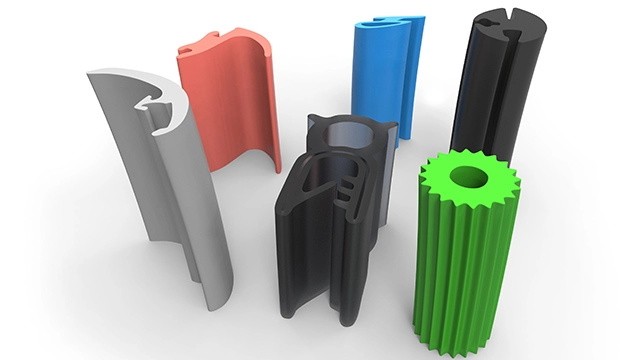
A constant cross-section — a sleeve, a U-channel, a cord — is an extrusion, and extrusion is priced by the metre from a die rather than by the shot from a cavity. The moment the part needs a flange, a closed end, a moulded-in boss or an undercut, it becomes a moulded part and the economics change with the plate size.
Wall thickness carries a similar rule. Very thin printed parts and thicker moulded sections do not behave the same way in the tool, and around one millimetre is where flexible parts usually balance feel against mouldability. Sending a section drawing with the wall called out lets a factory tell you which process you are actually asking for, instead of quoting the one it prefers.
That is also the point where a prototype tool earns its cost. A single cavity in a 150 × 150 mm plate proves geometry, hardness and colour before anyone pays for a 350 × 350 mm production tool with 15 to 50 cavities.
A complete RFQ, in eight lines
This is not a template for its own sake. It is the shortest version that lets two factories quote the same part.
- Part and useWhat it is, where it sits, and what it has to survive.
- Geometry2D/3D, wall thickness, and any undercut or insert.
- MaterialGrade, hardness ±5 Shore A, and required properties.
- ColourPantone per colour, moulded or printed, and the decoration zone.
- ToleranceClass, plus the two or three functional dimensions.
- FinishGloss or texture, flash limit, parting-line position.
- RoutePost-cure, printing, laser, adhesive, assembly — in order.
- DeliveryAnnual volume, pack configuration, AQL and documents.
Send the six lines and get a comparable number
If a quotation has ever come back three times higher than expected, the useful next step is not a negotiation — it is a specification. Send the drawing with the six lines filled in and we will tell you which of them is driving the price.
Useful next reads: custom silicone rubber parts, and our note on why over-specified tolerances inflate tooling cost.