fromrubebr-What's The Difference Between Production And Prototype Molds
Tooling / programme stages - reviewed 11 November 2026
The difference between a prototype mold and a production mold is not quality. It is quantity, and everything that follows from quantity: plate size, cavity count, cycle economics and the amount of tooling steel that has to be cut before a part exists.
Confusing the two is one of the most expensive habits in custom moulding, because it produces either a sample nobody can afford to produce or a production tool that had to be re-cut after the first fit test.
Definitions. A prototype mold is a small, usually single-cavity tool built to prove geometry, fit and material before production tooling exists. A production mold is a multi-cavity tool sized for the order volume. Cavity count is the number of parts a tool produces per cycle, and it is the number that turns tooling cost into a unit price.
Prototype mold vs production mold: the practical difference
Plate size and cavity count
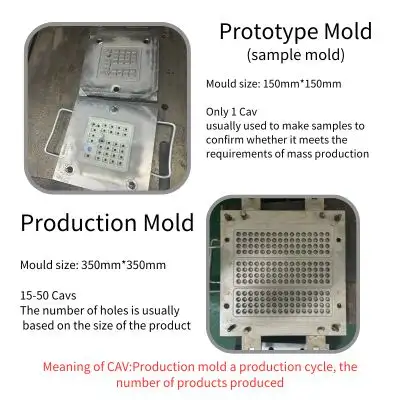
The two tools in the image are a useful illustration of the scale difference: a prototype plate around 150 by 150 mm carrying a single cavity, against a production plate around 350 by 350 mm carrying fifteen to fifty cavities depending on part size. The production tool costs more, but it produces tens of parts per cycle instead of one.
What each stage is for
The prototype answers questions: does it fit, does it feel right, does the compound seal. The production tool answers a different question: can the part be made at the volume the order needs, at the yield the price assumes. A prototype that is skipped pushes those answers into the production tool, where each change costs a re-cut.
How the choice changes cost and risk
| Decision | Prototype first | Straight to production |
|---|---|---|
| Time to first part | Shorter | Longer |
| Tool cost before approval | Lower | Full |
| Risk of a re-cut | Low for geometry and feel | Higher, especially with a sealing or force requirement |
| Unit price at volume | Not representative | The real number |
| Best for | New geometry, feel targets, sealing faces | Known geometry, proven compound, simple parts |
Why a prototype part cannot set the unit price
A single cavity runs one cycle per part, with the same set-up time as a multi-cavity tool. That makes its unit cost look absurd, and it is why a prototype quotation should be read as a tooling cost, not as a price signal. Buyers who use a prototype price to negotiate the production price are negotiating against arithmetic.
Cavity count follows the part, not the budget
Large parts take fewer cavities on a standard plate; small parts take more. That is why two suppliers quoting a 350 mm plate can produce very different cavity counts, and why the count, not the plate size, is the number to compare.
When skipping the prototype is right
If the geometry already exists in another material, if the compound is known and the part has no sealing or force requirement, a production cavity is a reasonable first tool. The saving is real and the risk is small. The moment the part has to seal, press, or fit a housing with a tolerance stack, the prototype is cheaper than the argument that follows a failed first article.
Commissioning a tool
Send the drawing with the volume and the functional dimensions, and ask for the tooling route in two stages. The production process overview shows where each tool sits in the programme, and the quotation file checklist lists what a tooling decision needs.
Can the prototype tool become the production tool?
Rarely, because a single cavity cannot scale. Some programmes keep the prototype for spares or for future variants, which is worth agreeing at the start.
How many cavities should a production tool have?
Enough to fill the order volume without holding steel idle. The answer depends on annual volume, part size and how long the part will stay in production.
Plate and cavity figures describe typical tools for this product range. A specific tool should be quoted with its plate size, cavity count and change-over cost stated separately.
For a tooling decision, send the drawing and volume through the custom silicone quotation route.