
What tolerances can compression molded silicone rubber parts achieve?
Unlike machined metal or injection-molded plastic, silicone is an elastomer — it stretches, compresses, and shrinks 1.5-3% during vulcanization. That is why rubber tolerances are governed by ISO 3302-1 (equivalent to Chinese standard GB/T 3672.1), not by plastic or metal standards. Understanding what is achievable — and what it costs — helps you specify tolerances that are tight enough for function without paying for precision your part does not need.
The four ISO 3302-1 tolerance classes
ISO 3302-1 defines four tolerance classes for molded rubber products. Each class trades precision against cost:

What drives dimensional variation in compression molding

Case study: holding M2 tolerance on a valve sealing ring
A European pneumatic valve manufacturer needed a Shore A 70 silicone sealing ring with a critical inner diameter of 28.0 mm at M2 tolerance (plus or minus 0.25 mm) — the diameter that controls the ring's interference fit onto the valve spool. Their previous supplier held M3 at best, and rings at the lower tolerance limit leaked under 6 bar pressure.
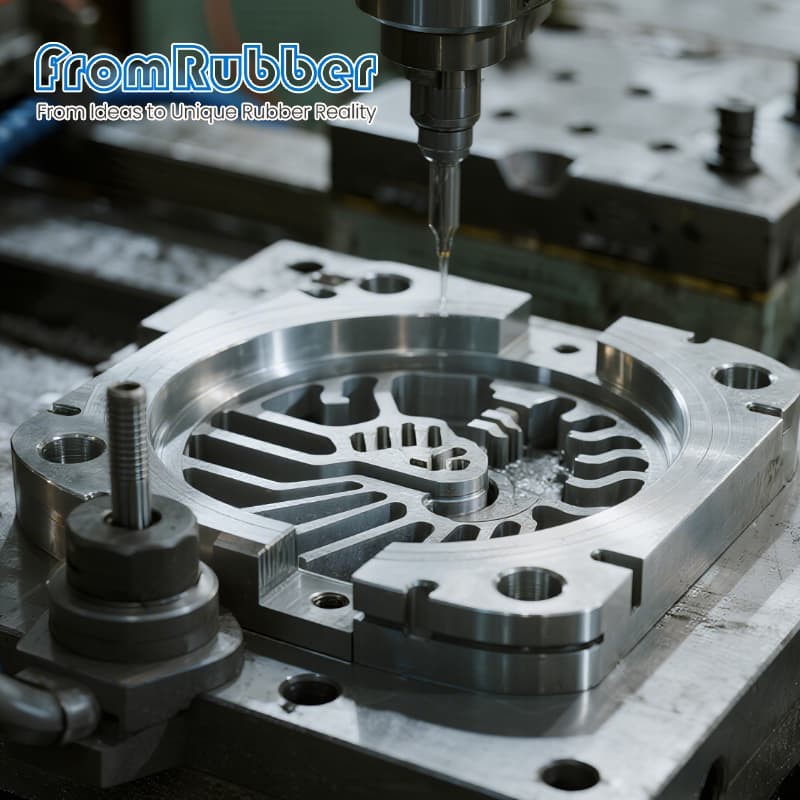
FromRubber attacked the three variation sources directly. First, the mold was CNC-cut with 2.1% shrinkage compensation on the inner diameter, then fine-tuned after the first trial batch measured systematically 0.15 mm oversize. Second, the critical diameter was designed as a fixed dimension formed entirely by the lower mold half, keeping the parting line away from the sealing surface. Third, inspection moved to an optical measuring projector with the rings conditioned for 24 hours before measurement. The result across three production lots of 5,000 pieces each: inner diameter held at plus or minus 0.11 mm — inside M1 territory — with a process capability index (Cpk) of 1.42. Leak rate at 6 bar dropped to zero across a 500-piece audit sample, and the valve maker consolidated all seven ring variants with FromRubber.

ISO 3302-1 tolerance values by part size
Note: closure dimensions (crossing the parting line) run one class looser than the fixed-dimension values shown. LSR injection molding achieves more consistent shrinkage than compression molding and is the better route for M1-class precision at high volume.
Related questions

Are you looking for a rubber and plastic product customization solutions manufacturer?
We can quickly provide customers with market analysis, technical support and customized services.Sign Up Out Newletter
