Silicone Keypad Lifespan & Durability Guide
Understanding Press Cycle Specifications for Your Application
Expert Analysis by FromRubber Silicone Keypad Engineers
How Long Do Silicone Keypads Really Last?
A properly engineered silicone keypad from FromRubber typically withstands 500,000 to 5 million+ actuation cycles before experiencing significant performance degradation. This broad range reflects the importance of design choices, material selection, and manufacturing quality—factors that FromRubber meticulously controls to meet your specific durability requirements.
Unlike simple mechanical switches, silicone keypad lifespan is measured not just by mechanical failure, but by maintaining consistent electrical performance and tactile feel throughout its life cycle. This FAQ details the key factors affecting longevity and how to specify for maximum durability.

Precision Testing for Guaranteed Performance
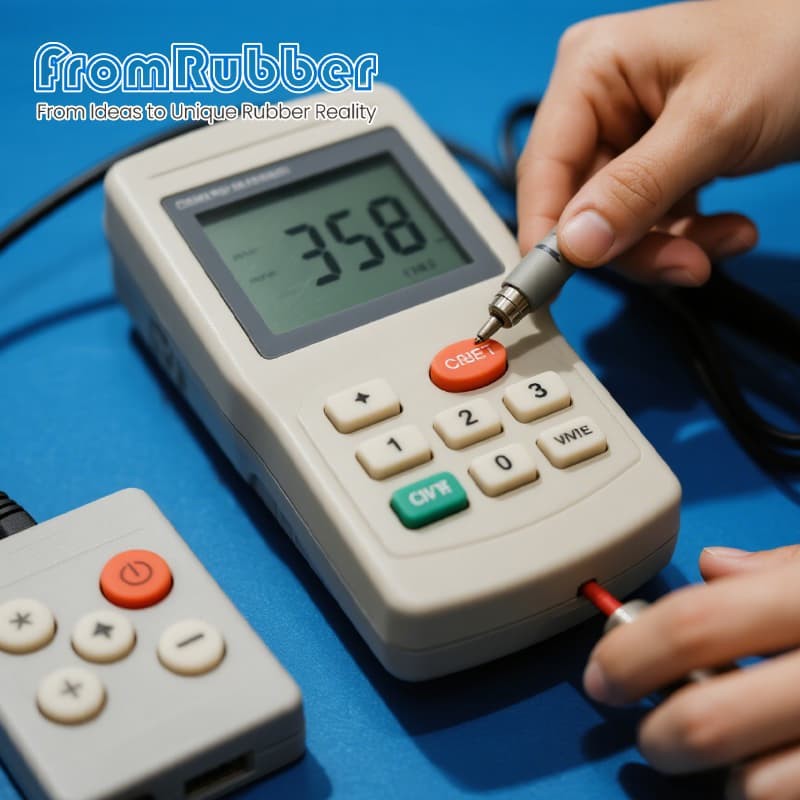
At FromRubber, we validate every keypad design using automated testers that simulate years of use, providing reliable cycle-life data for your product specifications.
Engineering for Endurance
The dome's geometry, wall thickness, and carbon pill design are optimized to distribute stress evenly, preventing fatigue cracks and maintaining electrical contact integrity over millions of presses.
Standard Lifespan Specifications by Application
| Application Type |
Typical Minimum Cycles |
Industry Standard Range |
FromRubber Enhanced Options |
Consumer Electronics
(TV Remotes, Toys) |
100,000 - 300,000 |
IEC 61000-4-2
Consumer Grade |
Up to 500,000 cycles
with premium compounds |
Office & Commercial
(POS, Telephones, Keyboards) |
500,000 - 1,000,000 |
ISO 9001 Class B
Commercial Grade |
1M - 3M cycles
(standard at FromRubber) |
Industrial & Medical
(Control Panels, Diagnostic Devices) |
1,000,000 - 3,000,000 |
IEC 60529 IP67
Industrial Grade |
3M - 5M+ cycles
with reinforced designs |
Military & Automotive
(Harsh Environment Controls) |
2,000,000 - 5,000,000+ |
MIL-STD-810G
Automotive Grade |
5M+ cycles achievable
with custom engineering |
Note: Cycle life is tested per key at 2-3 presses per second under standard laboratory conditions (25°C, 50% RH).
Key Factors Determining Silicone Keypad Lifespan
Material Selection & Compound
FromRubber uses medical-grade silicone with 40-70 Shore A hardness. Higher durometer (harder) silicone generally provides longer mechanical life but may affect tactile feel. We optimize the compound with specific additives to resist:
- Ozone & UV degradation
- Compression set (permanent deformation)
- Chemical exposure
Dome Design & Geometry
The dome's shape is the primary stress concentrator. FromRubber engineers use FEA analysis to optimize:
- Wall thickness distribution
- Collapse angle and radius
- Stress distribution during actuation
Conical domes typically outlast spherical ones in high-cycle applications.
Actuation Force & Travel
Higher actuation forces (400+ gf) generally accelerate fatigue. FromRubber balances:
- Lower force for higher cycle life
- Adequate force for tactile feedback
- Optimal travel distance (0.3-0.8mm)
Every 100gf reduction can increase lifespan by 30-50%.
Manufacturing & Quality Control
FromRubber's ISO-certified processes ensure consistency:
- Precision molding with ±0.05mm tolerance
- Consistent carbon pill application
- 100% electrical testing before shipment
- Bath testing for life cycle validation
Life Cycle Testing Standards at FromRubber
| Test Standard |
Methodology |
Pass/Fail Criteria |
FromRubber Capability |
| IEC 61058-1 |
Accelerated life testing at 1-5Hz actuation rate |
Contact resistance < 100Ω throughout test |
Standard testing up to 5M cycles |
| ASTM D2240 |
Shore hardness before/after cycling |
Max 10% hardness change |
Compression set < 5% after 1M cycles |
| Internal FromRubber STD-005 |
Full functional testing under temperature extremes (-40°C to +85°C) |
No tactile degradation, actuation force ±15% |
Environmental chambers with continuous monitoring |
Frequently Asked Questions
Q: What actually fails first in a silicone keypad at end of life?
A: The most common failure modes, in order:
- Carbon Pillar Wear: Gradual erosion of the conductive carbon coating, leading to increased contact resistance (>150Ω) or intermittent contact.
- Dome Fatigue Cracks: Microscopic cracks develop at the dome's stress concentration points, eventually causing tactile feel loss or dome collapse.
- Compression Set: The silicone fails to fully return to its original height, reducing travel distance and tactile feedback.
FromRubber addresses these through proprietary carbon formulations, optimized dome geometry, and premium silicone compounds that resist compression set.
Q: How can we extend keypad lifespan for our high-use medical device?
A: FromRubber recommends several design enhancements for mission-critical applications:
- Hybrid Construction: Combine silicone with a metal dome underneath for tactile feedback, allowing the silicone to act primarily as a seal while the metal dome provides the electrical contact (10M+ cycles possible).
- Gold-Plated Carbon Pills: For ultra-low and stable contact resistance in critical circuits.
- Reinforced Dome Walls: Strategic thickening at stress points without compromising tactile feel.
- Lower Actuation Force: Designing for 250-350gf instead of 400-500gf can double lifespan.
Q: Do environmental factors affect lifespan significantly?
A: Yes, environmental conditions can dramatically impact actual field life vs. laboratory testing:
| High Temperature (>85°C) |
Accelerates silicone aging; can reduce lifespan by 30-50% |
| Chemical Exposure |
Cleaning agents, oils, or solvents can degrade silicone or carbon |
| UV Radiation |
Causes surface hardening and cracking; requires UV-stable compounds |
FromRubber offers environmental testing services to simulate your specific operating conditions and recommend appropriate material specifications.
Need a Durable Silicone Keypad Solution?
Don't leave durability to chance. Partner with FromRubber to engineer keypads that exceed your lifecycle requirements with validated testing and proven reliability.
✓ Free Life Cycle Analysis
✓ Prototype Testing Reports
✓ Custom Durability Solutions
REQUEST A LIFESPAN CONSULTATION
Email: nani@fromrubber.com | karl@fromrubber.com