Uncovering Heated Clothing Silicone Keypad Manufacturing: How FromRubber Solves Industry Pain Points with a Full-Chain Process
Heated clothing keypads / production route - reviewed 11 November 2026
A heated clothing keypad manufacturing route has eight stations between silicone sheet and packed carton, and every one of them can ruin a part that the previous seven got right. The useful question is not how many stations a plant has, but which stations it measures - because a part only becomes inspectable once someone writes down what each station is allowed to leave behind.
This is the part of the story that gets skipped in most supplier profiles. A press is a press; the difference between two plants making the same heated-garment control is what happens at trimming, at the spray booth and at the laser, and whether anybody is recording it.
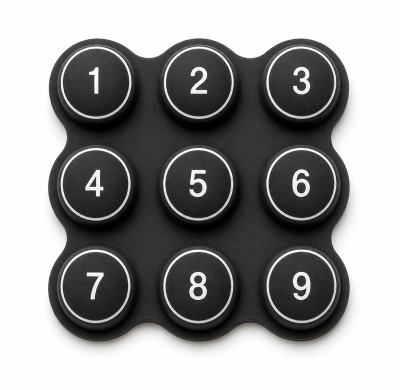
Definitions. A heated clothing keypad is a small moulded silicone switch assembly, usually three to six keys, bonded to the garment or to a controller housing. White-through laser engraving removes the dark surface layer so the light substrate reads as the legend. A second spray is a clear or tinted coat applied over the engraved legend to seal the channel. Trimming is the removal of flash and the diaphragm edge, and it is the step where most latent tears are introduced.
Why the route, not the machine, sets the quality
Two plants can run the same press with the same tool and produce different parts, because the part is decided by the handoffs. A keypad that is moulded well and trimmed badly will tear at the diaphragm edge in the field. A keypad that is trimmed well and sprayed in a dirty booth will ship with specks that only appear after the first wash. A keypad that is sprayed and engraved well, then packed without cure time, will block in the bag.
That is why a route description is a better procurement document than a capacity figure. It tells you where the part is handled, and handling is where variability enters.
The route a heated clothing keypad manufacturing job actually takes
Below is the standard sequence for a coated, laser-engraved heated-garment keypad. Not every project uses every station, but every project that skips one should be able to say why.
| Station | What it controls | What it leaves behind if it is not controlled |
|---|---|---|
| Tooling and pre-form | Web thickness, key height, gate position | A force curve that drifts across the sheet |
| Compression moulding | Cure, pressure, air evacuation | Short shots and trapped air at the key crown |
| Trimming | Flash removal and edge finish | Nicks that become tear initiators |
| Screen printing | Base colour and legend registration | Drift hidden later by the coating |
| Spray coating | Film thickness, gloss, booth cleanliness | Splatter specks, orange peel, masking creep |
| Laser engraving | Depth and power stability | Charring halo or a legend that reads grey |
| Second spray | Sealing the engraved channel | Detergent lodges in the legend; contrast collapses |
| Assembly and pack | Adhesive, PCB contact, cure before bagging | Lifted corners and blocked surfaces |
What "white-through" really requires
The legend reads white because the laser has removed a dark layer to expose a light one, not because white ink was added. That has two consequences. First, the substrate colour has to be light enough to read against the coated surface, which constrains the colour range of the part. Second, the engraved depth has to sit inside a window: shallow enough that the coating still protects the edges, deep enough that the full contrast appears.
When a legend looks grey rather than white, the cause is usually depth, but the fix is sometimes the coating chemistry rather than the laser power. Increasing power to chase contrast widens the halo and thins the wall around the character, which is why a parameter change should be validated on a cross-section rather than on a photograph alone.
What a yield figure means, and what it usually hides
A single yield percentage is close to meaningless unless three things are stated: the station at which it is measured, the denominator, and whether reworked parts return to the count. A plant measuring final inspection yield after rework will always look better than a plant measuring first-pass yield at the laser, even if the second plant is the better one.
The number worth asking for is first-pass yield per station, because it localises the problem. If first-pass yield at the spray booth is the lowest figure on the card, the conversation is about booth filtration and gun settings. If it is lowest at trimming, the conversation is about tool maintenance. Those are different investments, and a single rolled-up percentage cannot distinguish them.
Four figures that make a quality claim checkable
- First-pass yield at each station, with the rework rule stated.
- Scrap rate at the laser and at the spray booth, tracked separately.
- Cycle count used for the contact-resistance end-of-life figure.
- Wash cycles and detergent used for the legend retention test.
Where the process and the garment meet
A heated-garment keypad is usually bonded to fabric or to a small controller housing, and that interface is routinely left out of the keypad drawing. The adhesive, the release liner and the surface energy of the textile decide whether the part survives the first wash, and none of them are properties of the moulding.
The practical fix is to include a 30 mm sample of the actual garment fabric in the first-article submission. A peel test on the real substrate takes minutes and settles a question that otherwise reappears as a field complaint six months later.
Questions buyers ask about heated clothing keypad production
Why is the legend sealed with a second coat instead of leaving the engraving open?
An open engraved channel collects detergent and lint, and the contrast falls as it fills. A sealing coat keeps the channel clear and protects the edge of the engraved wall, at the cost of one more pass and a small loss of initial contrast.
Can the same tool make both a lit and an unlit version?
Often yes, if the light path is designed at the tooling stage. A window and a light guide need to exist in the moulding, so an unlit variant that later becomes lit usually needs a tool change rather than a process change.
How long should the part cure before packing?
It depends on the coating system, and the correct answer comes from the coating supplier's data sheet rather than from a general rule. What matters operationally is that the dwell time is written on the route card and that packing is blocked until it has elapsed.
Station sequence, failure modes and the measurement logic above describe the standard route for a coated and laser-engraved keypad. Yield figures, cure times and cycle counts are specific to the tool, the coating system and the agreed test protocol; no general value is asserted here, and any figure quoted for a project should be tied to its first-article report.
To review a heated-garment control, send the drawing, the garment fabric sample, the wash regime and the annual volume with a peak month through the custom silicone quotation route. The silicone rubber keypad manufacturing section covers the moulding side, and the custom silicone production process page shows how the secondary stations are scheduled.