2025 Silicone Products Source Manufacturer Recommendation
Sourcing / manufacturer selection - reviewed 11 November 2026
A silicone products manufacturer is worth shortlisting on four things you can check without a relationship: what it actually moulds, which certificates it holds and what their scope covers, how it handles a first sample, and whether it will state a cavity count and a minimum order in writing. Everything else is presentation.
The category is broad. A factory that moulds keypads may not be set up for large thin-wall parts; a factory that presses gaskets may have no printing line. Choosing a source manufacturer therefore starts with the part, not with the supplier list.
Definitions. A silicone products manufacturer converts compound into finished parts by compression moulding, liquid silicone injection or extrusion, and may add printing, coating, laser marking and assembly. Certificate scope is the sentence on a certificate that names the processes and sites it covers. A first article is the physical part submitted for approval before mass production, with the measurements that carry function recorded against the drawing.
What to establish before comparing suppliers
| Question | Why it decides the shortlist |
|---|---|
| Which processes are in-house? | Moulding, printing, coating and laser marking on one site shorten lead time and reduce handover risk |
| What part sizes and weights can it press? | Plate size and press tonnage rule out some geometries before price is discussed |
| Which compounds are held in stock? | A factory that stocks your hardness and colour quotes faster and repeats more consistently |
| What is the minimum order per design? | Determines whether a small brand can start at all |
| Who signs a first article? | Shows whether inspection is a system or a habit |
Reading certificates properly
Scope, site and validity
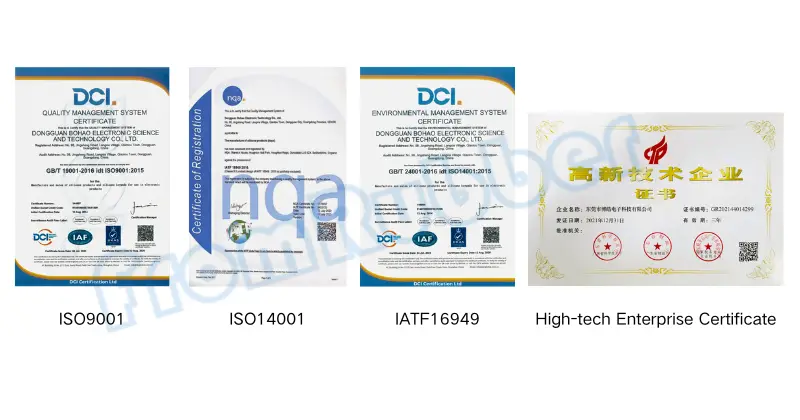
Quality, environmental and automotive certificates each cover a defined scope at a defined site. A certificate for assembly does not cover moulding; a certificate for one plant does not cover a second. Ask for the number and the scope sentence, then check that the processes you are buying appear in it. The high-tech enterprise certificate shown above is a different kind of document entirely: it reflects a regional recognition scheme, not a product or process certification.
Declarations are separate from certificates
Restricted-substance and food-contact declarations are issued per material grade, not per factory. A supplier can hold every management certificate and still substitute a compound during a shortage. The control is to tie the declaration to the grade on the batch record for your lot.
What a first sample should prove
A sample that looks right is a start, not an approval. The sample should be in the production compound, at the production hardness, with the production decoration route, and it should be measured where the part functions: sealing faces on a gasket, force and travel on a key, bore interference on a sleeve. If the sample is a machined or cast stand-in, the programme has not reached its first real checkpoint.
Ask also how the sample was made. A part from a prototype cavity and a part from a production cavity behave differently at the edges and at the parting line, and a supplier that explains the difference is a supplier that has done this before.
Minimum order, tooling and the honest conversation
Tooling is a one-off cost and the minimum order is the quantity over which it is amortised. A supplier that quotes a low unit price with a high minimum is not cheaper for a first season; a supplier that quotes a high unit price with a low minimum may be the right partner for a test launch. Comparing the two without the cavity count and the minimum is comparing nothing.
Commissioning a silicone products manufacturer
Send the drawing, the volume and the decoration route, and ask for the four documents above with the quotation. The custom silicone rubber parts range shows the formats one manufacturer covers, and the production process overview explains how the tooling and inspection steps connect.
Does a certificate guarantee quality?
No. It shows a documented system within a stated scope. Quality for your part depends on the tool, the inspection plan and the change control, which are separate evidence.
Should I choose a manufacturer that makes my exact product?
Preferably one that has made the same class of part. Familiarity with the geometry shortens tooling and reduces the risk of a first article that fails on a detail.
What is a reasonable first order?
One that covers the minimum run without committing a season of stock. Many programmes start at the minimum order per design and re-order once sell-through is known.
Certificates shown in the image are illustrative of the documents a supplier may hold. Their scope, site and validity should be verified directly before they are relied on.
For a supplier comparison, send the drawing and volume through the custom silicone quotation route.