
Which plastic material is best for a durable and lightweight mouse shell?
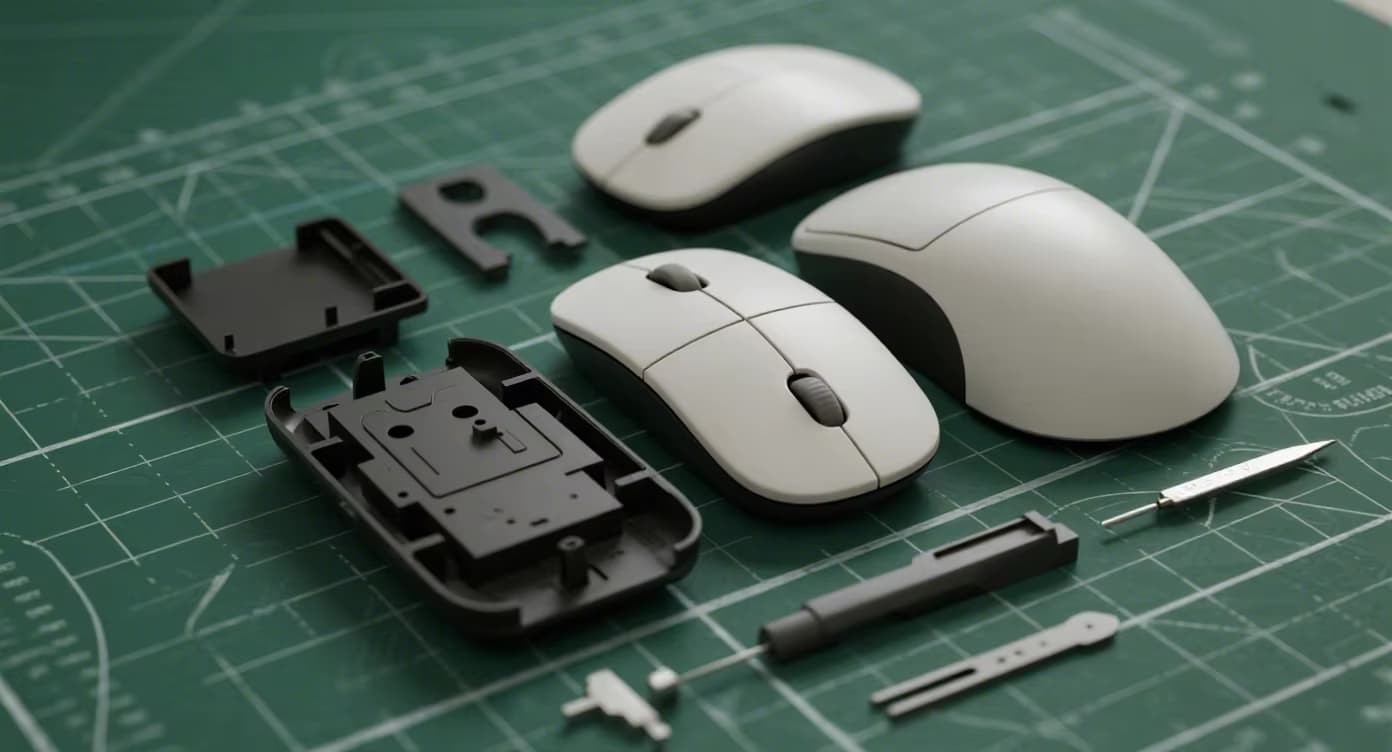
Selecting the optimal plastic for a mouse enclosure requires evaluating three competing priorities: mechanical durability, overall weight, and cost structure. At FromRubber, we have engineered over 400 mouse shell variations across seven resin families. This guide provides a systematic comparison of six materials, ranked by cost tier, to help you match the right polymer to your product's performance targets.
Plastic mouse shell material selection framework
The ideal mouse shell material balances three vectors:
- Durability – Impact resistance, drop test survival, fatigue life under repeated clicking
- Lightweight property – Density and stiffness-to-weight ratio for comfortable extended use
- Cost efficiency – Raw material price and processing economics
FromRubber recommendation tiers
- Budget series: ABS, PP
- Performance series: PC, PC/ABS
- Premium series: Nylon compounds, Carbon fiber reinforced
Plastic mouse shell material comparison by cost tier
| Material | Cost Level | Density (g/cm³) | Impact Resistance | Surface Quality |
|---|---|---|---|---|
| PP (Polypropylene) | Low | 0.90 | Fair | Matte, low paint adhesion |
| ABS | Low | 1.04 | Good | High gloss, excellent coating |
| PC (Polycarbonate) | Medium | 1.20 | Excellent | High gloss, UV sensitive |
| PC/ABS Blend | Medium | 1.12 | Excellent | High gloss, superior adhesion |
| Nylon PA6+GF | High | 1.36 | Very high | Matte textured |
| Carbon Fiber Reinforced | High | 1.28 | Superior | Premium matte/carbon pattern |
Low cost tier materials
Polypropylene (PP)
Lowest density among all thermoplastics at 0.90 g/cm³, enabling ultra-light shells typically weighing 12-15 grams for a complete enclosure. However, PP exhibits low surface energy which repels paints and adhesives, limiting cosmetic finishes to basic matte textures. Its flexibility provides decent impact absorption but poor creep resistance under sustained button pressure.
Best application: Entry-level wired mice, children's peripherals, disposable devices.
ABS (Acrylonitrile Butadiene Styrene)
The industry baseline offering balanced properties at accessible cost. ABS delivers 1.04 g/cm³ density with good impact resistance for standard desk use. Its amorphous nature enables high-gloss finishes, UV-curable coatings, and electroplating for decorative chrome accents. The limitation becomes apparent under repetitive drop testing where crack initiation occurs above 1.2 meter falls.
Best application: Office mice, standard gaming mice, glossy aesthetic designs.
Medium cost tier materials
Polycarbonate (PC)
Superior impact resistance up to eight times greater than ABS makes PC the choice for ruggedized peripherals. The material survives 1.5 meter drops to concrete without structural failure. Weight penalty is notable at 1.20 g/cm³, adding approximately 15-20 percent mass compared to ABS equivalents. PC also requires UV stabilizers to prevent long-term yellowing under sunlight or office lighting.
Best application: Transparent shells, RGB light guide housings, industrial mice.
PC/ABS Blend (Recommended)
FromRubber's preferred solution for most mouse enclosure projects. This alloy combines the flowability and surface finish of ABS with the impact strength of PC. Density at 1.12 g/cm³ adds only 8 percent weight penalty over pure ABS while delivering triple the drop test survival rate. PC/ABS maintains excellent paint adhesion for soft-touch coatings and supports tight-tolerance molding for precision button fits.
Best application: Mainstream gaming mice, productivity wireless mice, balanced durability-weight designs.
High cost tier materials
Nylon with Glass Fiber (PA6-GF30)
Glass-reinforced nylon offers exceptional stiffness and heat deflection temperature exceeding 200 degrees Celsius. This material excels in thin-wall structural components where creep must be eliminated. The density reaches 1.36 g/cm³, making it heavier than all other options. Surface finish is inherently matte and rough, requiring secondary operations for aesthetic refinement. Moisture absorption also demands careful drying before processing.
Best application: Internal chassis frames, scroll wheel mechanical supports, high-temperature environments.
Carbon Fiber Reinforced Composites
Incorporating 15 to 30 percent short carbon fibers into PC/ABS or nylon matrices produces the highest stiffness-to-weight ratio available for injection molding. Wall thickness can be reduced to 0.9 millimeters while maintaining rigidity, enabling complete mouse shells under 11 grams. The distinctive forged carbon or twill visual pattern serves as a premium differentiator. Tooling wear increases due to fiber abrasion, and material cost sits at the high end of the spectrum.
Best application: Flagship esports mice, ultralight competition peripherals, luxury branding.
Performance summary: durability versus weight
Low cost tier
ABS: 22g standard shell weight
1.2m drop survival: 82 percent
Medium cost tier
PC/ABS: 24g shell weight
1.5m drop survival: 97 percent
High cost tier
CF reinforced: 17g shell weight
1.8m drop survival: 99+ percent
PC/ABS delivers the optimal balance for the majority of projects, achieving near-premium durability with moderate weight increase and accessible cost structure.
Surface finish and secondary process compatibility
Different materials respond differently to post-molding operations:
- ABS and PC/ABS: Excellent compatibility with soft-touch paint, UV hard coatings, laser engraving, and EMI shielding sprays.
- Polycarbonate: Good for clear/translucent parts but requires primer for painting.
- Nylon: Poor paint adhesion without specialized primers; best left in natural textured finish.
- Carbon fiber composites: Typically used without coating to showcase visual pattern; matte texturing via mold surface works best.
FromRubber material advisory service
Submit your mouse enclosure 3D file and specify target parameters such as maximum shell weight, required drop test height, and preferred surface finish. FromRubber will return a material recommendation matrix with three cost tier options, each including predicted mechanical performance and processing notes. We maintain inventory of all six material families for rapid sampling and pilot production runs.
FromRubber — Engineering-grade injection molding for custom mouse enclosures. Material science driven since 2010.
Are you looking for a rubber and plastic product customization solutions manufacturer?
We can quickly provide customers with market analysis, technical support and customized services.Customization
Solutions
Contact Us
