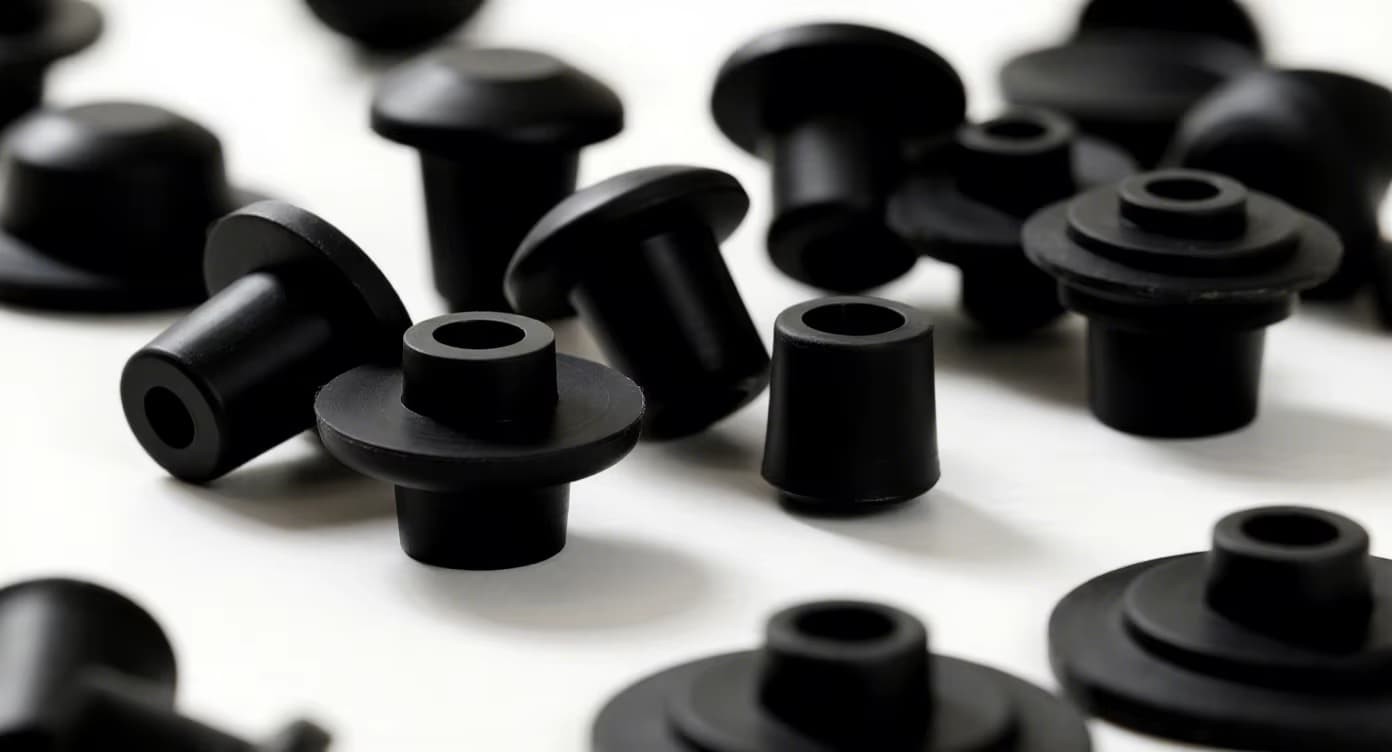
Anodizing is a precision electrochemical process that transforms aluminum surfaces into durable, corrosion-resistant finishes. But one small masking failure — a cap that lifts, leaks, or contaminates — can ruin an entire batch. FromRubber’s silicone masking plugs are engineered specifically for anodizing lines: they withstand aggressive chemicals, extreme temperatures, and deliver perfect seal integrity cycle after cycle.
What Are the Best Silicone Masking Plugs for Anodizing?
Selecting the optimal masking plug for anodizing is critical to achieving crisp anodized patterns, protecting threaded holes, and preventing costly rework. The best silicone plugs combine high-temperature resistance (up to 260°C), superior chemical inertness against sulfuric, chromic, and phosphoric acids, and precise geometry to seal tight without leaving residues. FromRubber’s anodizing-grade silicone plugs meet all these demands while offering exceptional reusability and custom thread profiles. Below we provide comprehensive answers to the most frequently asked questions about silicone masking for anodizing.
Expert FAQ: Silicone Masking Plugs for Anodizing
1. Why is silicone the preferred material for anodizing masking plugs?
Technical Answer: Silicone elastomers offer an unparalleled combination of thermal stability, chemical inertness, and mechanical resilience required for anodizing processes. Unlike PVC, polyurethane, or conventional rubber compounds, silicone maintains its physical properties across a temperature range of -60°C to 260°C, surviving both the acidic electrolyte baths (sulfuric acid at 15–25°C) and subsequent hot water sealing stages (90–100°C). Its molecular structure—a siloxane backbone (Si-O-Si)—resists hydrolysis and oxidation, preventing swelling or degradation when exposed to aggressive anodizing solutions. Furthermore, platinum-cured silicone exhibits non-stick surface characteristics, ensuring zero residue transfer and preventing adhesion of anodizing dyes. FromRubber’s anodizing-grade silicone compounds are specifically formulated to pass ASTM B117 salt spray testing and maintain Shore A hardness stability after extended chemical immersion.
2. What durometer (hardness) range is optimal for anodizing masking applications?
Technical Answer: The optimal durometer for anodizing masking plugs typically falls between 50 and 65 Shore A. This range provides the necessary compliance to seal against thread irregularities while offering sufficient structural integrity for repeated handling. For applications involving fine-pitch threads (e.g., UNF 10-32 or M3×0.5), a softer compound (45–50A) ensures complete thread engagement without over-stressing the part. Conversely, for large-diameter ports (1″ NPT or larger) or high-volume automated insertion, 60–65A silicone delivers superior wear resistance and maintains dimensional stability across hundreds of cycles. FromRubber’s engineering team performs compression set testing per ASTM D395 to validate that the selected durometer maintains sealing force after prolonged exposure to anodizing chemistries. A compression set value below 10% after 70 hours at 150°C is the benchmark for high-reusability anodizing plugs.
3. How do silicone masking plugs resist sulfuric, chromic, and phosphoric acid?
Technical Answer: Silicone’s resistance to mineral acids stems from its stable silicon-oxygen backbone, which does not undergo hydrolysis under acidic conditions. When subjected to 5–20% sulfuric acid (the most common anodizing electrolyte), premium silicone shows negligible volume swell (<3%) and no measurable loss of tensile strength after 168-hour immersion. For chromic acid anodizing (Type I per MIL-A-8625), silicone similarly resists oxidative degradation. FromRubber validates chemical compatibility through immersion testing per ASTM D471, measuring changes in hardness, tensile strength, and elongation. Unlike EPDM, which can swell in acidic environments, or nitrile rubber which hardens and cracks, silicone maintains its elastomeric properties throughout the anodizing cycle. This chemical resilience ensures that the plug does not become a source of contamination, preserving bath chemistry and preventing rejected parts.
4. Can silicone masking plugs be reused across multiple anodizing batches?
Technical Answer: Yes. High-quality silicone masking plugs are designed for extended reusability, typically achieving 200 to 500+ anodizing cycles when properly maintained. The key performance metric is compression set resistance: FromRubber’s anodizing-grade silicone exhibits less than 8% permanent deformation after 70 hours at 150°C under 25% compression (ASTM D395). This low compression set ensures that the plug returns to its original dimensions after each insertion, maintaining consistent interference fit and sealing pressure. To maximize service life, we recommend rinsing plugs in deionized water immediately after removal to neutralize residual acid, followed by air drying. Periodic inspection for surface cracking or loss of flexibility is advised. Reusability not only reduces consumable costs but also aligns with sustainability goals by minimizing single-use plastic waste.
5. What types of threads and port geometries can be masked with custom silicone plugs?
Technical Answer: FromRubber manufactures custom silicone masking plugs for virtually any thread standard or port geometry encountered in anodized components. This includes NPT (National Pipe Taper) for tapered threads, BSPP/BSPT for British Standard Pipe, UNF/UNC for unified national threads, metric coarse and fine (M series), straight threads, and proprietary custom ports. Beyond threads, we produce plugs for blind holes, through-holes, counterbores, and complex features such as keyways or cross-drilled ports. The design process involves precision measurement of the part’s critical dimensions (major/minor diameters, thread pitch, lead angle, and chamfer) followed by 3D mold design. The resulting plug replicates the exact thread profile, ensuring zero wobble and complete sealing against electrolyte ingress. For non-threaded ports, we offer stepped or tapered designs that provide interference-fit sealing.
6. Do silicone masking plugs leave residue or interfere with the anodized finish?
Technical Answer: No. FromRubber utilizes platinum-cured (addition-cure) silicone, which contains no peroxide byproducts or low-molecular-weight siloxanes that can migrate to the part surface. This ensures that the plugs are non-migrating and leave absolutely no residue on the substrate. The absence of surface contamination is critical for anodizing, as any residual silicone oil can cause “orange peel” effects, poor dye uptake, or adhesion failures in subsequent coatings. Furthermore, the non-stick surface of silicone prevents the plug from bonding to the anodized layer, allowing clean removal without tearing or leaving flash. Post-anodizing, the masked area remains pristine with a sharp, well-defined mask line, meeting the most stringent cosmetic requirements for aerospace, automotive, and consumer electronics applications.
7. How do I choose between tapered, straight, and step-design silicone plugs?
Technical Answer: The optimal plug geometry depends on your port configuration. Tapered plugs are designed for NPT (National Pipe Taper) threads, where the plug’s tapered profile matches the thread taper, creating a mechanical wedge seal that increases with insertion depth. Straight plugs with O-ring grooves are ideal for parallel threads (UNF, metric) or smooth bores; the O-ring provides a radial seal while the straight body centers the plug. Step-design plugs feature multiple diameters to seal counterbores or stepped ports where a single diameter would not provide full coverage. FromRubber’s engineering team uses CAD modeling to recommend the geometry that maximizes sealing surface contact while minimizing insertion force. In some cases, we employ a dual-durometer approach: a firm core for structural integrity combined with soft sealing ribs to conform to thread variations.
8. What temperature range can anodizing-grade silicone plugs withstand?
Technical Answer: FromRubber’s anodizing-grade silicone is formulated for continuous service from -60°C to 260°C (-76°F to 500°F), with the ability to withstand intermittent peaks up to 300°C. This covers the full anodizing process spectrum: room-temperature acid baths (15–25°C), hot water sealing (90–100°C), and any post-anodizing drying or curing cycles (typically 150–200°C). The material retains its flexibility at low temperatures, preventing brittleness during cold-weather shipping or storage. High-temperature stability is achieved through the incorporation of heat-stabilizing additives that prevent thermal degradation, ensuring that the plug does not soften, flow, or lose sealing force when exposed to elevated temperatures. This wide thermal tolerance makes silicone suitable for anodizing lines with integrated thermal processing.
9. Can you provide color-coded silicone plugs for different thread sizes?
Technical Answer: Absolutely. FromRubber offers full color customization for silicone masking plugs, enabling visual thread identification systems that dramatically reduce masking errors in high-mix production environments. The colorants used are non-bleeding, UV-stable, and do not compromise chemical resistance or mechanical properties. Typical color-coding schemes include: red for 1/4-20 UNF, blue for M6×1.0, yellow for 1/8 NPT, green for M8×1.25, and black for 3/8-16 UNC. This visual cue allows operators to quickly select the correct plug for each part, eliminating mismatches that lead to solution ingress. Color coding also facilitates inventory management and quality assurance documentation. FromRubber can match Pantone or RAL colors to align with your internal standards.
10. How do FromRubber silicone masking plugs compare to PVC or vinyl caps for anodizing?
Technical Answer: Silicone significantly outperforms PVC and vinyl caps across all critical anodizing metrics. PVC caps have a maximum service temperature of approximately 80°C, making them unsuitable for hot water sealing or drying cycles; they soften in acid baths, lose sealing force, and often leach plasticizers that contaminate anodizing solutions. Vinyl caps similarly degrade under acid exposure, becoming brittle and prone to cracking. In contrast, silicone maintains structural integrity throughout the entire anodizing process, resists chemical attack, and leaves no residue. Additionally, silicone’s reusability (200–500 cycles) vs. PVC’s single-use nature translates to significant cost savings and reduced waste.
Silicone vs. Conventional Masking Materials for Anodizing
| Property |
FromRubber Silicone Plugs |
PVC / Vinyl Caps |
Nitrile Rubber |
EPDM Plugs |
| Acid Resistance |
Excellent – <3% swell, no degradation |
Poor – softens, plasticizer migration |
Moderate – swelling risk |
Fair – limited lifespan |
| Max Continuous Temp |
260°C (500°F) |
80°C (176°F) |
120°C (248°F) |
150°C (302°F) |
| Residue / Contamination |
None – platinum-cured, non-migrating |
Plasticizer bleed, sticky residue |
Possible sulfur bloom |
May leave marks |
| Reusability (cycles) |
500+ with maintenance |
1–5, single-use |
10–30 |
20–50 |
| Custom Thread Fit |
Precision molded to any thread |
Standard sizes only |
Limited |
Limited |
💡 Engineering Recommendation from FromRubber: For high-volume anodizing lines with frequent rack changes, we recommend a 60–65A silicone compound with a tapered thread profile for NPT ports, or a straight plug with integrated sealing ribs for parallel threads. Implement a color-coded system by thread size to eliminate operator error. Post-use, rinse plugs in deionized water and inspect monthly for wear. This protocol typically yields 400–600 reuse cycles per plug, reducing annual masking consumable costs by 50–70%.
Custom Engineering: Precision Masking for Critical Applications
FromRubber’s custom silicone masking plugs are engineered to meet the exacting demands of anodizing specifications such as MIL-A-8625, AMS 2470, and ASTM B580. Our process begins with a comprehensive review of your part drawings, thread specifications, and anodizing cycle parameters. Using advanced mold design and in-house compounding, we deliver plugs that provide ±0.05mm dimensional tolerances, custom color matching (Pantone/RAL), dual-durometer options (firm core with soft sealing ribs), and full material traceability with batch-specific certificates of compliance. With ISO 9001:2015 certification and over 15 years of experience serving aerospace, automotive, and medical device manufacturers, FromRubber delivers masking solutions that improve first-pass yield and reduce rework costs.
Case Study: Aerospace Anodizing Line Improves Yield by 22%
A major aerospace component manufacturer was experiencing a 15% rejection rate on anodized aluminum housings due to solution seepage under plastic masking caps. The plastic caps would lose sealing force after a single cycle, allowing sulfuric acid to enter threaded holes and cause corrosion. After switching to FromRubber’s custom 55A silicone plugs with precision-molded NPT thread profiles, the rejection rate dropped to under 3%. The plugs achieved over 400 reuse cycles, reducing annual consumable spending by $62,000. The color-coded system (red for 1/4-18 NPT, blue for 3/8-18 NPT) eliminated operator errors and reduced masking time by 18%.
Sustainability Through Reusability
Single-use plastic masking caps contribute to industrial waste and increase operational costs. FromRubber’s silicone masking plugs are designed for long-term reuse, aligning with sustainability goals and circular economy principles. A single silicone plug can replace hundreds of disposable caps over its lifetime, significantly reducing material consumption and waste generation. Additionally, silicone is inert and can be recycled through specialized programs, further minimizing environmental impact. For companies committed to reducing their carbon footprint and eliminating single-use plastics, switching to reusable silicone masking plugs is a practical, cost-effective step.
Acid-resistant silicone
Precision thread fit
500+ reuse cycles
Ready to optimize your anodizing masking process?
FromRubber delivers custom-engineered silicone masking plugs that eliminate leaks, reduce waste, and deliver crisp anodized lines. Request your free engineering consultation today.
Get Custom Masking Plug Quote →
📧 nani@fromrubber.com | 🌐 www.fromrubber.com | Fast prototyping & high-volume anodizing solutions
FromRubber — Premium silicone masking plugs for anodizing, chemical finishing, and high-temperature masking. Custom designs available for NPT, metric, UNF, BSP, and complex port geometries. ISO 9001:2015 certified.