WEATHERING RESISTANCE
Will standard silicone gaskets discolor or crack when exposed to UV sunlight & ozone?
A complete technical analysis of silicone’s stability under solar radiation and atmospheric ozone — with real‑world data.
UV & ozone: the silent degraders
Standard silicone gaskets are widely used outdoors — from solar panels to automotive headlamps. But two environmental factors constantly challenge their appearance and integrity: ultraviolet (UV) radiation from sunlight and atmospheric ozone (O₃). This article explores whether typical silicone formulations discolour, crack, or lose performance, backed by elastomer science and accelerated test standards (ISO 4892, ASTM D1149).
How UV sunlight affects silicone
Unlike many organic rubbers (EPDM, nitrile), the siloxane backbone (Si–O–Si) of silicone does not absorb UV light above 300 nm. This inherent transparency to solar UV means photochemical chain scission is minimal. However, additives, pigments, and residual catalysts can sometimes initiate surface oxidation, leading to yellowing or chalking after years of exposure.
| Material type |
UV discoloration (1000h QUV) |
Surface cracking? |
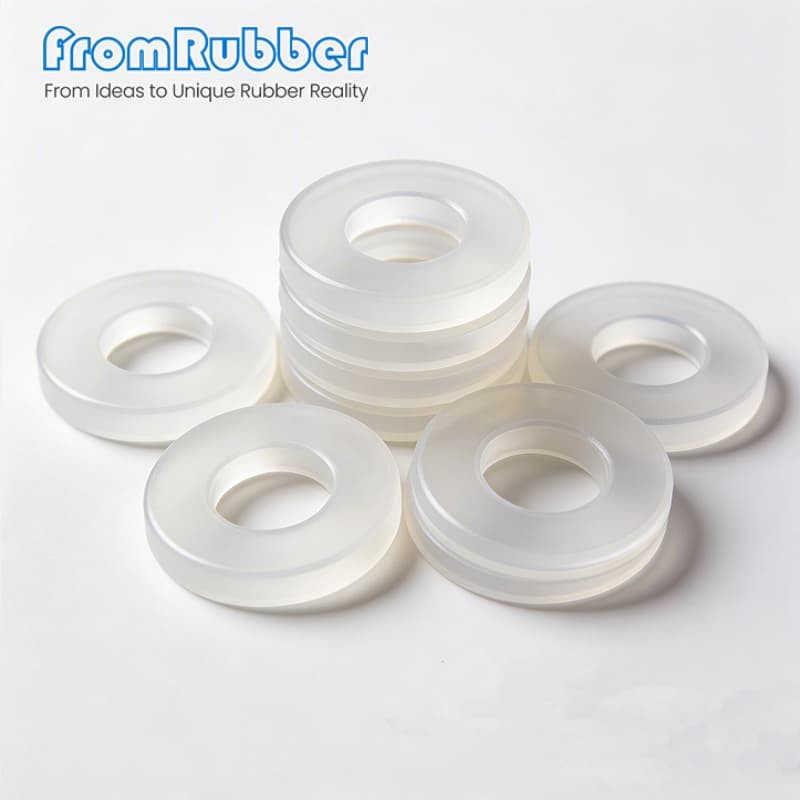
| Unfilled translucent silicone |
Slight yellowing (ΔE < 3) |
None |
| Pigmented (red/orange) silicone |
Moderate fading possible |
No cracking |
| Peroxide‑cured high‑consistency |
Very low change |
Crack-free |
Typical data based on accelerated weathering (UVA-340, ISO 4892-3).
Ozone resistance: silicone vs. diene rubbers
Ozone attacks unsaturated carbon‑carbon double bonds. Standard silicone (VMQ, MQ) is fully saturated — no double bonds in the main chain. Therefore, silicone does not undergo ozone cracking even under high ozone concentrations (100 pphm / 1 ppm). Many outdoor specifications require ozone testing (ASTM D1149, 50 pphm, 20% strain): silicone gaskets show zero cracks, while general‑purpose rubbers fail within hours.
| Elastomer type |
Ozone resistance (50 pphm, 72h) |
Typical crack behavior |
| Standard silicone (VMQ) |
Excellent, no cracks |
None |
| Natural rubber / NR |
Poor – severe cracking |
Deep fissures |
| EPDM (ethylene propylene) |
Good to excellent |
Rare micro‑cracks |
Does silicone actually discolor or crack? Field data
After five years of Florida outdoor weathering (ASTM D1435), standard unfilled silicone gaskets typically exhibit slight gloss reduction and a minimal yellowing (Δb* ~ 1-2) but no cracking. However, certain formulations — especially those using iron oxide or organic dyes — may experience pigment fade. This is a surface phenomenon and does not affect sealing functionality. Cracking is virtually absent unless the material is contaminated or poorly cured.
What the standards say
ISO 1431-1 (ozone cracking) and ASTM D1149 classify silicone as “no cracks” at standard test concentrations. For UV, silicone meets the highest class (0) for surface change in many automotive specifications (SAE J1960). Some low‑cost “silicone” blends containing organic extenders can crack, but pure polydimethylsiloxane (PDMS) remains intact.
Long‑term exposure effects (10 years, moderate climate)
| Property |
Silicone (general purpose) |
Observation |
| Color change (ΔE) |
≤ 3 – 5 (depends on pigment) |
Slight chalkiness possible |
| Surface cracks |
None |
No fissures even under 20% strain |
| Tensile retention |
80‑95% |
Slight drop due to crosslink relaxation |
How to prevent minor surface changes
If aesthetic appearance is critical (e.g., visible gaskets in architecture), specify UV‑stabilised silicone grades with low‑extractable catalysts and high‑purity silica. Carbon‑black loaded conductive silicone shows no UV degradation. For extreme UV (high altitude, concentrated solar), some manufacturers add titanium dioxide (TiO₂) or cerium‑based stabilisers that absorb short wavelengths without discolouring.
Importantly, ozone will never crack pure silicone — a key reason why silicone gaskets are specified for corona discharge equipment, ozone generators, and outdoor high‑voltage insulators. There is no chemical mechanism for chain attack by O₃ on the siloxane bond.
Final verdict: silicone gaskets & weather
UV discoloration
Minimal to slight yellowing over years — purely cosmetic, no cracking.
Ozone cracking
Zero. Silicone is inherently ozone‑proof, unlike NR, NBR, or CR.
Lifespan
Typical silicone gaskets last 10–20+ years outdoors without functional failure.
For applications where optical clarity or color stability is paramount, select platinum‑cured, post‑baked silicone with UV additives. But for 99% of industrial outdoor uses, standard silicone gaskets will not crack and only show negligible aesthetic change.
This article is for informational purposes. Always consult with your material supplier for specific UV/ozone resistance data under your operating conditions. Product specifications may vary by manufacturer.